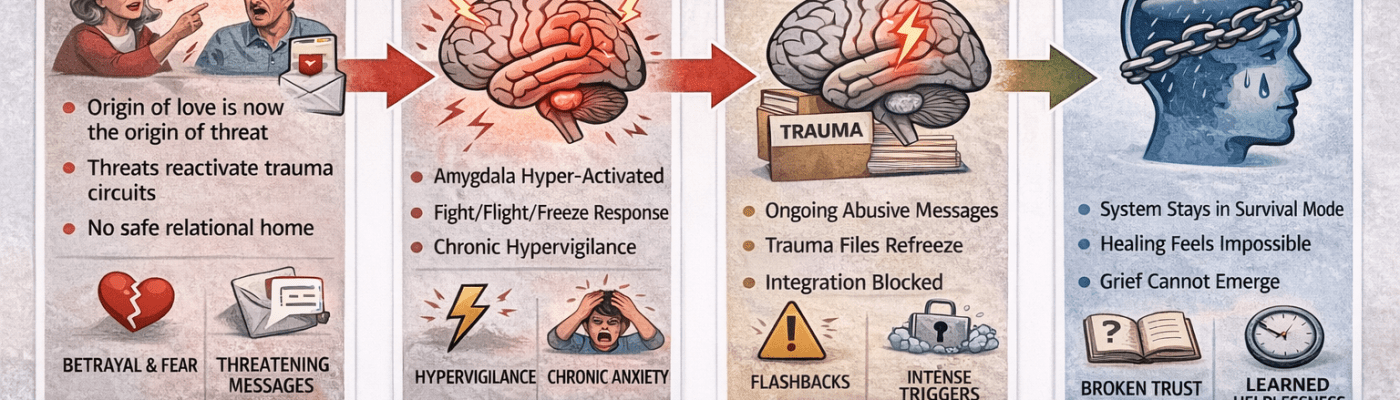
Stage-by-Stage Neuropsychological Impact
| Area Affected | What Repeated Threat Exposure Does | Long-Term Consequence |
|---|---|---|
| Amygdala (Threat Detector) | Becomes hypersensitive | Constant alertness, anxiety, startle response |
| Prefrontal Cortex (Self-regulation) | Overridden repeatedly | Difficulty concentrating, decision fatigue |
| Hippocampus (Memory & Context) | Stores events as danger memories | Triggers activated by reminders, emails, names |
| Vagus Nerve (Calming Pathway) | Under-stimulated | Trouble calming after stress |
| Stress Hormone System | Cortisol stays elevated | Sleep disruption, exhaustion, mood swings |
🔁 How Trust Gets Damaged (Not Just in Them — in the World)
| Type of Trust | What Happens Neurologically | Psychological Result |
|---|---|---|
| Interpersonal Trust | Social threat networks activate | Difficulty believing people’s intentions |
| Self-Trust | PFC confidence erodes | Second-guessing, rumination |
| Institutional Trust | Unpredictability overwhelms | Fear of systems (courts, authority) |
| Relational Safety | Oxytocin suppressed by stress | Emotional withdrawal, guardedness |
Over time, your brain learns:
“Connection is unpredictable → stay alert”
That’s not pessimism. It’s adaptive learning under threat.
🧠 Self-Regulation Breakdown: What Actually Changes
Normally, self-regulation means:
- emotion rises
- nervous system settles
- thinking resumes
Under long-term threat:
- emotion rises
- nervous system stays activated
- thinking stays impaired
This leads to:
- snapping or shutting down
- crying “out of proportion”
- numbness followed by overwhelm
- difficulty returning to baseline
Not character flaws — stress-injured regulation systems.
🧩 Why Reasonable People Start Doubting Themselves
Long-term intimidation uses intermittent reinforcement:
- calm → threat → silence → attack again
This unpredictability:
- destabilizes the hippocampus’ sense of time
- erodes cause-and-effect understanding
- makes you scan constantly for danger
Your brain becomes busy monitoring instead of living.
🛑 Why This Pattern Is Recognized as Psychological Harm
In psychology, this exposure pattern overlaps with:
- complex trauma (C-PTSD)
- coercive control
- chronic stress injury
Key markers:
- hypervigilance
- emotional exhaustion
- reduced joy
- narrowed future thinking
Again: normal responses to abnormal pressure.
🌱 What Actually Repairs Trust & Self-Regulation
| Repair Action | Neuroscience Effect |
|---|---|
| Legal boundaries / no contact | Amygdala down-regulation |
| Predictable communication channels | Hippocampus regains safety mapping |
| Being believed & validated | PFC re-engages |
| Safe social connection | Oxytocin restores trust circuits |
| Somatic regulation (breath, cold, movement) | Vagus nerve strengthened |
Healing doesn’t mean “forgetting.”
It means your nervous system relearns safety.
🧭 The Most Important Reframe
You are not “too sensitive.”
You are responding to repeated neural threat conditioning.
Once the threat stops, plasticity works in your favor.
Brains heal when safety becomes consistent.
 Linda C J Turner | Trauma Therapist & Emotional Healing Specialist