Core Principle
Intimidation is a threat-based regulation strategy.
When it fails, the threat-brain does not self-correct — it escalates.
🔁 Escalation Stages (Threat Brain Under Pressure)
| Stage | What Stops Working | Escalated Behavior | Neuroscience Driver |
|---|---|---|---|
| 1. Dismissal | You don’t react emotionally | Mockery, belittling, emojis, sarcasm | Mild amygdala activation |
| 2. Pressure | You don’t comply | Repeated messages, urgency, “last chance” | Rising cortisol |
| 3. Reputation Attack | You stay firm | “Your friends don’t respect you” | Social threat circuitry |
| 4. Threat Amplification | Fear doesn’t land | Legal threats, financial pressure | Amygdala dominance |
| 5. Reality Distortion | Facts don’t move you | Gaslighting, rewriting history | Prefrontal shutdown |
| 6. Third-Party Recruitment | You disengage | Family, friends, professionals contacted | Desperation for control |
| 7. Victim Reversal | You hold boundaries | “You’re abusive / unreasonable” | Shame avoidance |
| 8. System Manipulation | Courts involved | False narratives, delay tactics | Survival strategy |
| 9. Collapse or Exposure | Evidence accumulates | Erratic behavior or silence | Threat system overload |
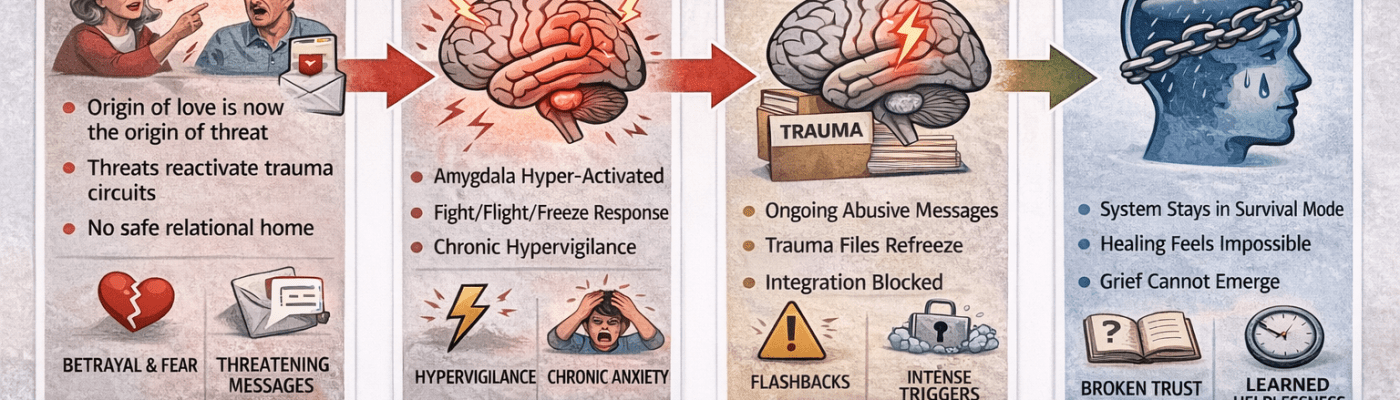
🧠 What’s Happening in Their Brain
When intimidation fails:
- Amygdala interprets non-compliance as loss of control
- Cortisol spikes → impulse regulation drops
- Prefrontal cortex goes offline
- Behavior becomes more extreme, not more logical
This is why escalation often looks messy, emotional, and self-incriminating.
🎯 Why Reputation Attacks Are a Turning Point
Attacking your social standing is a sign of:
- internal panic
- recognition that fear-based compliance failed
- shift from control → damage
Neuroscience-wise:
- Social exclusion activates the same pain circuits as physical injury
- They are trying to outsource the intimidation to your social brain
⚖️ How Courts Interpret Escalation (Quietly but Clearly)
Escalation signals:
- bad faith negotiation
- emotional dysregulation
- coercive intent
- risk of continued harassment
Patterns matter more than single incidents.
Ironically, escalation often strengthens your legal position.
🧠 Why Escalation Feels So Destabilizing to You
Your nervous system experiences:
- unpredictability (worst stressor for humans)
- intermittent threat (strong conditioning loop)
- social safety disruption
This leads to:
- hypervigilance
- rumination
- exhaustion
- delayed recovery
Again — this is biological, not weakness.
🛑 The Single Most Protective Move
Do not re-engage to “calm them down.”
That teaches their nervous system:
escalation works.
Instead:
- document
- disengage
- route through legal channels
- let patterns speak
Silence + structure is what actually stops escalation.
🌱 What Eventually Happens When Escalation Fails
Two outcomes are typical:
- Extinction burst
→ short-term spike in intensity, then drop-off - Exposure
→ contradictions, evidence, loss of credibility
Neither requires you to explain yourself.
🧭 Final Reframe (Important)
Escalation is not power.
It is loss of regulation.
Your calm is not passive.
It is neurologically disarming.
 Linda C J Turner | Trauma Therapist & Emotional Healing Specialist