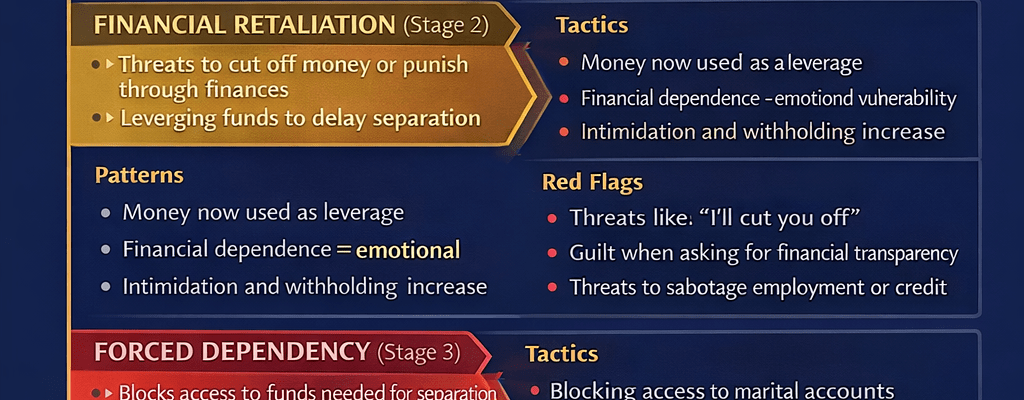
Below is a clear, step-by-step escalation model used in trauma psychology and coercive-control research to explain how financial parasitism intensifies once separation begins.
This is predictable, patterned, and not accidental.
Why Separation Triggers Escalation
Financial parasitism is not just about money.
It is about regulation, control, and entitlement.
When separation starts:
- Access to resources is threatened
- Control over the partner’s nervous system is lost
- The parasitic dynamic goes into survival mode
The behaviour escalates to re-establish dominance or punish autonomy.
The Escalation Pathway
(What happens, in order)
Stage 1: Financial Dependence (Before or Early Separation)
“Just for now… you’re better with money.”
Behaviour
- One-sided financial arrangements become “normal”
- Vague income, hidden debts, unclear accounts
- Partner positioned as provider / rescuer
Psychology
- Gradual erosion of financial autonomy
- Guilt replaces choice
- Dependency is framed as love or necessity
Nervous system effect
- Mild anxiety
- Suppression of gut instincts
- Increasing tolerance of imbalance
Stage 2: Financial Retaliation (Separation Threatened)
“If you leave, you’ll regret it.”
Behaviour
- Threats to cut off support
- Sudden withholding of money
- Using finances to delay or block separation
- Guilt, rage, or emotional punishment when boundaries are set
Psychology
- Money becomes a weapon
- Compliance is demanded through fear
- Entitlement becomes overt
Nervous system effect
- Fight/flight activation
- Fear of survival loss
- Decision paralysis
Stage 3: Forced Dependency (Separation in Motion)
“You can’t survive without me.”
Behaviour
- Blocking access to shared funds
- Draining accounts
- Sabotaging work, credit, or housing
- Creating financial chaos during legal proceedings
Psychology
- Autonomy is reframed as betrayal
- Control replaces connection entirely
- Punishment for leaving becomes the goal
Nervous system effect
- Chronic stress
- Cognitive overload
- “Freeze” response
- Loss of executive function
Stage 4: Economic Ruin (Control Fails)
“If I can’t control you, I’ll destroy your stability.”
Behaviour
- Credit destruction
- Legal financial abuse
- False debts, hiding assets
- Prolonged litigation to bankrupt or exhaust
Psychology
- No longer about resources
- About total domination or revenge
- The partner is seen as an enemy, not a human
Nervous system effect
- Trauma response
- Survival focus only
- Long-term financial PTSD
How This Maps to Coercive Control
Financial parasitism during separation becomes economic abuse, a core pillar of coercive control.
Key coercive elements:
- Isolation (financial dependence limits options)
- Intimidation (fear of destitution)
- Deprivation (blocking access to necessities)
- Punishment (retaliation for autonomy)
- Entrapment (making leaving more dangerous than staying)
This is why courts and clinicians increasingly recognise post-separation financial abuse.
Critical Truth
Healthy partners disengage.
Parasitic partners escalate.
A healthy person may feel hurt, angry, or scared —
but they do not try to bankrupt, destabilise, or sabotage someone they once claimed to love.
Red Flag Summary
If separation leads to:
- Sudden money control
- Financial threats
- Credit or work sabotage
- Prolonged legal draining
- Fear around basic survival
You are not “overreacting.”
You are witnessing coercive control through finances.
Bottom Line
Love lets go with integrity.
Financial parasitism tightens its grip when control is threatened.
That escalation is diagnostic, not situational.
 Linda C J Turner | Trauma Therapist & Emotional Healing Specialist