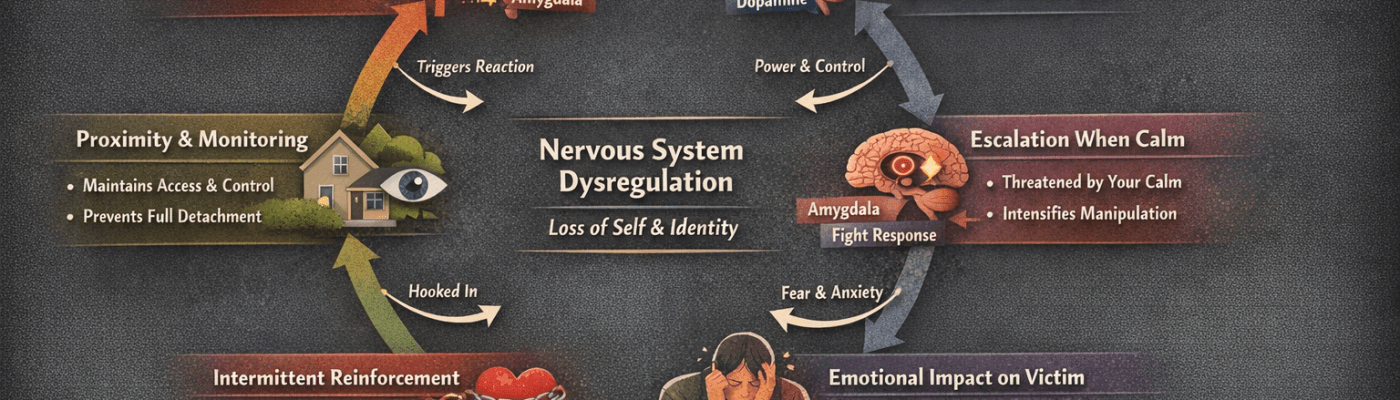
button-pushing, escalation when calm, reliance on your reactions for regulation, and staying close to you physically or symbolically — is actually a hallmark of long-term emotional abuse. Let’s unpack why this is, from both a psychological and neurological perspective.
1. Emotional Abuse Is About Control, Not Connection
Long-term emotional abuse isn’t about conflict or even “anger.” It’s about keeping your nervous system and behavior within their control.
- Button-pushing: trains your nervous system to react predictably
- Provocation as a game: makes you an involuntary participant in their regulation
- Calm being threatening: ensures they feel your emotional impact as a measure of control
- Refusing to move away: keeps you within range for ongoing manipulation
Over time, this erodes your autonomy, self-trust, and emotional stability.
2. The Brain’s Reward System Perpetuates Abuse
Neurologically:
- Abuser’s dopamine system is reinforced when you react
- Your limbic system experiences repeated activation, stress, and unpredictability
- Your prefrontal cortex (logic and planning) gets overridden by fight/flight
This creates a feedback loop:
Your reaction → their reward → escalation/hoovering → your stress → repeat
Long-term exposure rewires your brain to anticipate instability, making emotional abuse chronic.
3. Intermittent Reinforcement Creates Attachment
This is the trauma bond mechanism:
- Occasional kindness or validation keeps you “hooked”
- Emotional spikes (anger, fear, attention) are neurologically addictive
- The abuser gains a predictable regulatory system, and you develop hypervigilance
This explains why long-term abuse often feels like a cycle you “can’t escape,” even mentally.
4. Escalation When Calm Maintains the Pattern
In long-term emotional abuse:
- Calm threatens the abuser’s regulation
- Escalation re-engages your nervous system
- You are pulled back into the dynamic, reinforcing the cycle
Over years, your brain learns:
Calm = instability in the abuser → anxiety, hypervigilance
Reaction = temporary relief for them → repeated patterns
This is why emotional abuse can last for decades without physical proximity.
5. Physical or Symbolic Proximity Extends Abuse
Staying close — geographically, socially, digitally — is not casual:
- It ensures access for manipulation
- It keeps the abuse loop possible
- It prevents your nervous system from fully stabilizing
Even long no-contact may not fully stop the cycle if proximity exists because the memory and environmental cues keep the limbic system active.
6. Identity and Self-Trust Are Undermined
Long-term emotional abuse rewires self-perception:
- You begin to doubt your judgment
- You anticipate conflict or manipulation constantly
- You may even rationalize the abuser’s behavior
- Emotional reactions become both survival and “signal” systems
This explains why even after separation, many survivors feel “on edge” or hyper-aware” — their nervous system has adapted to years of dysregulation.
7. The Core Mechanism
In short, the pattern you’re noticing shows the neuroscience of chronic emotional abuse:
- External regulation: The abuser uses your reactions to regulate themselves
- Intermittent reinforcement: Your nervous system is trained to expect instability
- Threat of calm: Your stability challenges their control and forces escalation
- Proximity as leverage: They maintain access to keep the cycle alive
- Neural rewiring: Long-term exposure strengthens trauma bonds and hypervigilance
The abuser’s behavior isn’t random. It’s systematic, neurological, and relational — designed (consciously or unconsciously) to maintain power and control over you.
 Linda C J Turner | Trauma Therapist & Emotional Healing Specialist