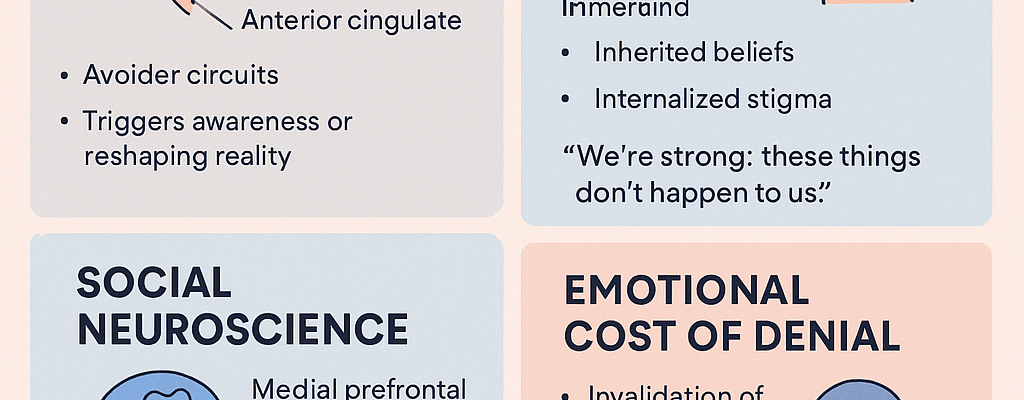
(“My brain knows better” — until it doesn’t)
When intuition signals danger and the conscious mind overrides it, the nervous system doesn’t suddenly agree and stand down.
It escalates.
Denial isn’t calm reasoning — it’s a stress response driven by fear, conditioning, or wishful thinking. Your brain isn’t “being logical”; it’s trying to avoid discomfort, loss, or conflict.
From a neuroscience perspective, this creates a split between survival systems and conscious thought — and that split has consequences.
The Neuroscience Difference: Intuition vs Denial
INTUITION VS DENIAL — WHAT’S REALLY HAPPENING IN THE BRAIN
When You Listen to Intuition
- Amygdala detects a pattern mismatch and sends a warning
- Prefrontal cortex slows decisions
- Nervous system moves toward protection
- Stress hormones rise briefly, then fall
- Body feels relief after action
- Self-trust increases
- Threat is avoided early
When You Ignore Intuition (Denial)
- Amygdala continues signalling danger
- Prefrontal cortex rationalises and suppresses the signal
- Nervous system stays activated
- Cortisol remains elevated
- Body develops symptoms (anxiety, fatigue, tension)
- Self-doubt increases
- Threat escalates before it’s acknowledged
Why Denial Feels Like Logic (But Isn’t)
Denial is driven by:
- fear of loss
- fear of being wrong
- fear of conflict
- fear of disrupting attachment
The brain chooses short-term emotional comfort over long-term safety.
It sounds like:
- “I’m probably overthinking”
- “I don’t have proof”
- “Let’s give it more time”
- “I don’t want to be unfair”
- “Maybe it’ll change”
Neuroscience translation:
“This truth feels threatening, so I’ll suppress it.”
That suppression takes energy — and your body pays the bill.
What the Body Does When You Don’t Listen
When intuition is ignored, the nervous system raises the volume:
- Stage 1 – Subtle Signals
Gut tension, unease, tiredness after contact - Stage 2 – Emotional Escalation
Anxiety, rumination, irritability, sleep disturbance - Stage 3 – Physical Symptoms
Headaches, stomach issues, immune drops, exhaustion - Stage 4 – Crisis or Burnout
Panic, collapse, illness, or a situation that forces awareness
Your body will eventually make the decision for you if your mind won’t.
The Cost of “Thinking You Know Better”
When you override intuition repeatedly:
- self-trust erodes
- boundaries weaken
- tolerance for harm increases
- red flags start to feel “normal”
This is how intelligent, kind people stay in damaging situations longer than they ever imagined.
Not because they’re foolish —
but because they were taught to distrust their own signals.
The Key Reframe That Changes Everything
Intuition isn’t anti-logic.
It’s pre-verbal data.
Logic asks why.
Intuition says pause.
Ignoring intuition doesn’t make you rational.
It puts your nervous system in conflict with itself.
And a nervous system at war always loses energy, clarity, and health.
The Truth in One Line
Your intuition speaks quietly at first.
Ignore it — and your body will start shouting.
 Linda C J Turner | Trauma Therapist & Emotional Healing Specialist