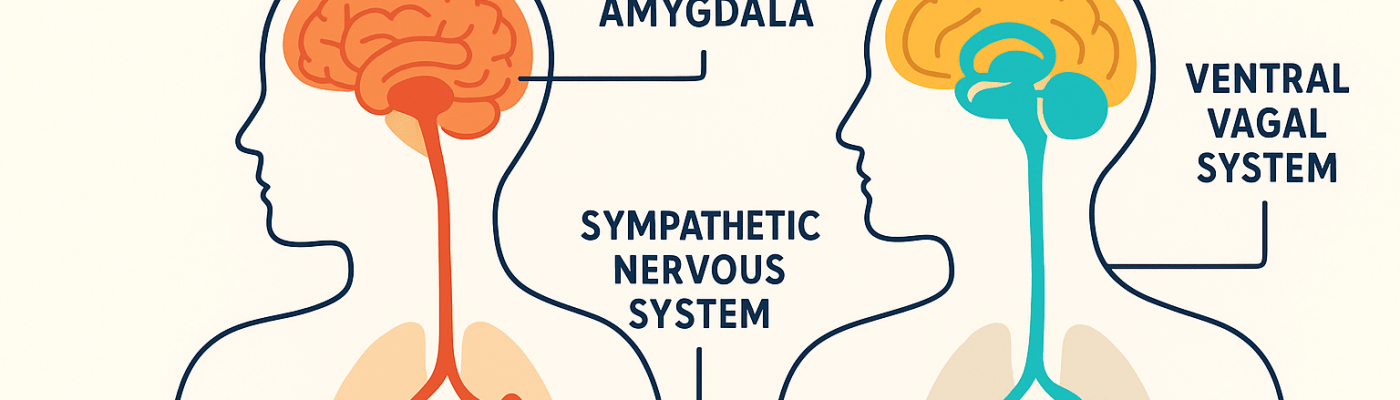
The human brain constantly scans the environment for safety using the amygdala and autonomic nervous system.
In a calm environment, the ventral vagal system (social engagement pathway) keeps you grounded and relaxed.
But in crowds — with loud sounds, unpredictable movements, and strangers — your brain interprets this as sensory overload or even potential threat.
This triggers:
- Increased amygdala activity (fear and vigilance)
- Activation of the sympathetic nervous system (fight/flight)
- Elevated cortisol and adrenaline (stress hormones)
You may feel your heart race, your muscles tense, or your senses sharpen — not because you “chose” to, but because your body is protecting you from overstimulation.
💡 2. Possible Causes or Temperamental Factors
This sensitivity can come from several factors — none of which imply “illness”:
a. Introversion and sensory processing sensitivity
Some people are naturally wired with lower thresholds for sensory input.
Psychologist Elaine Aron calls this trait High Sensitivity (HSP).
Highly sensitive people experience sound, light, and emotion more intensely — parties, discos, and crowds can feel physically painful or exhausting.
b. Past experiences or trauma
If someone has experienced danger, humiliation, or overwhelm in social environments, their brain may associate crowds with loss of control.
This creates a learned defensive pattern — the amygdala fires early to prevent a repeat of that feeling.
c. Social anxiety or PTSD
In clinical cases, avoidance may stem from social anxiety disorder, panic disorder, or post-traumatic stress.
In those instances, the discomfort isn’t just preference — it’s the body’s learned survival response.
🧘 3. The Difference Between Choice and Regulation
Avoiding noise or crowds is rarely a conscious choice like choosing coffee over tea.
It’s a regulation strategy — your nervous system trying to stay within its “window of tolerance.”
When stimulation exceeds that window, your body automatically moves into fight, flight, or freeze.
With practice, therapy, or gradual exposure, you can widen that window — but the initial reaction is not moral weakness or snobbery.
It’s physiology.
🫀 4. The Psychology of Safety and Authenticity
Some people thrive on external stimulation — others recharge in peace.
Neither is right or wrong.
The key is knowing what allows your nervous system to feel safe enough to be authentic.
If your body feels drained or overwhelmed in noisy environments, it’s sending you useful information, not shame.
Respecting that boundary is self-awareness, not avoidance.
🌱 5. Summary
| Situation | Likely Cause | Classification |
|---|---|---|
| Dislike of loud, crowded events | Personality / sensory preference | Normal trait |
| Physical anxiety, sweating, panic | Nervous system overstimulation | Possible anxiety response |
| Avoidance due to past trauma | Conditioned protection | Trauma-related, not a choice |
| Calm preference for quiet, meaningful settings | Introversion / HSP | Healthy individual difference |
🧩 In short:
It’s not an illness and not a moral choice — it’s the way your nervous system protects your equilibrium.
Some people find peace in solitude, others in sound. Both are valid forms of being human.
 Linda C J Turner | Trauma Therapist & Emotional Healing Specialist