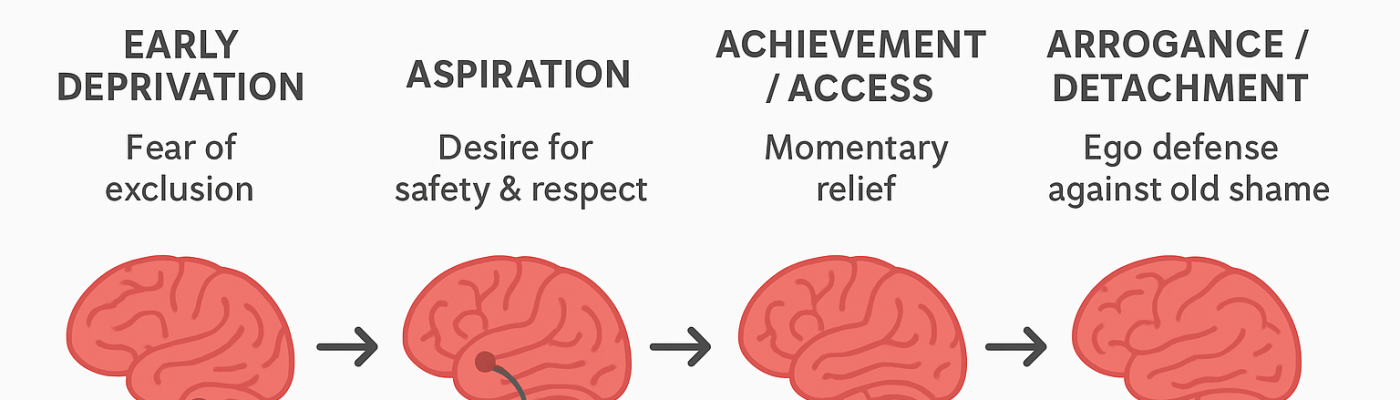
Growing up with material insecurity or social stigma chronically activates the amygdala–HPA axis (the brain’s threat circuit).
- Cortisol stays high → the child’s brain learns that safety = control and status.
- The dopamine system (reward motivation) becomes tuned to external symbols of safety — money, appearance, approval.
- Over time, this wires the brain to chase status cues as a way to feel calm.
So in adulthood, luxury or social advancement doesn’t just feel nice — it feels neurologically soothing, like relief from danger.
🧩 2. Psychology: From Inferiority to Overcompensation
Alfred Adler called this the inferiority–superiority loop.
When someone grows up feeling “less than,” they may swing between:
- Shame and self-doubt → “I’m not good enough.”
- Overcompensation → projecting confidence, dismissing others, or chasing symbols of success.
It’s not arrogance at its core — it’s defensive pride.
Their ego tries to protect a wounded identity by flipping the script:
“If I act superior, no one can make me feel small again.”
⚙️ 3. The Social-Climbing Cycle
| Stage | Inner Drive | Typical Behavior | Brain Activity |
|---|---|---|---|
| Early deprivation | Fear of exclusion | Heightened comparison | Amygdala + cortisol |
| Aspiration | Desire for safety & respect | Imitation of higher-status norms | Dopamine anticipation |
| Achievement / Access | Momentary relief | Gratification, pride | Reward circuits fire |
| Arrogance / Detachment | Ego defense against old shame | Looking down on “past self” or others | Prefrontal-limbic conflict |
| Emptiness / Burnout | Loss of meaning | Anxiety, identity crisis | Reward desensitization |
💬 4. Why the “Chip on the Shoulder” Appears
That chip is really an internalized hierarchy — a brain that still expects rejection or judgment.
When people feel looked down on long enough, they often pre-empt it by looking down first.
It’s a neural form of self-protection: dominance masks vulnerability.
🌱 5. Healing and Integration
- Self-awareness training – noticing when ambition is driven by fear rather than inspiration.
- Reframing status – connecting success to contribution, not comparison.
- Therapeutic work on shame – reducing amygdala reactivity through compassion-based therapy or mindfulness.
- Rebuilding intrinsic reward – finding dopamine through purpose, not prestige.
When people from hard beginnings integrate rather than overcompensate, they often become the most grounded, empathetic, and capable leaders — because they’ve lived both sides of the hierarchy.
 Linda C J Turner | Trauma Therapist & Emotional Healing Specialist