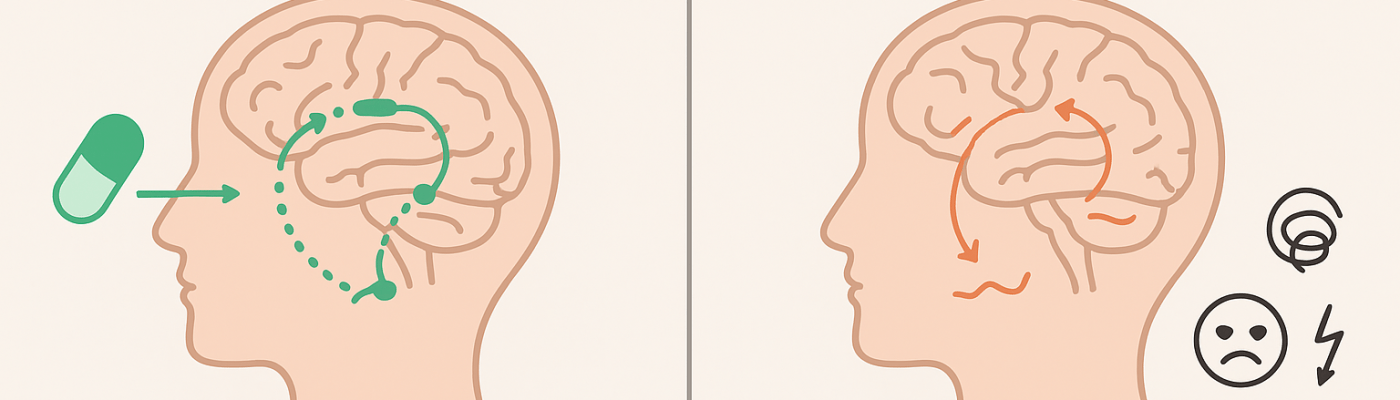
Antipsychotic medication (used for conditions like schizophrenia, schizoaffective disorder, or severe bipolar disorder) works by regulating dopamine and sometimes serotonin activity in key brain circuits — especially those involving:
- The prefrontal cortex (thinking, planning, judgment)
- The limbic system (emotion and fear regulation)
- The striatum (motivation and reward)
When you’ve been on these medications for years, your brain adapts to their presence:
- Receptors adjust (for example, dopamine receptors become more sensitive or upregulate).
- Neural pathways stabilize under medication influence.
So, if someone suddenly stops taking the medication, the brain’s chemistry rebounds — dopamine activity can spike unpredictably.
This “dopamine rebound” can reignite psychotic symptoms, cause agitation, paranoia, mood swings, and even physical withdrawal effects like insomnia or tremors.
🧩 2. What happens psychologically
Without medication — especially after long use — a person may experience:
- Disorganized thoughts (difficulty connecting ideas logically)
- Paranoia or suspiciousness
- Irritability or hostility
- Reduced insight — the person might not realize their perceptions are distorted
- Emotional volatility — switching between calm and agitated states quickly
- Difficulty sleeping, which amplifies all the above
When someone takes medication on and off (“as they feel like it”), the brain and mind are in a constant state of instability — never allowing neural circuits to recalibrate or reach equilibrium.
It’s like constantly turning a computer on and off mid-update: over time, system errors accumulate.
🧍♀️ 3. Behavioural patterns you might observe
Without consistent medication, behaviour can:
- Become unpredictable or erratic
- Show fluctuations in speech coherence or emotional tone
- Include suspiciousness, social withdrawal, or sudden anger
- Display neglect of self-care or hygiene
- Lead to impulsivity or risky actions (especially if insight is low)
Sometimes, people report feeling “clearer” right after stopping — but within weeks or months, symptoms slowly resurface, often worse than before, due to neural hypersensitivity.
⚖️ 4. Why medical supervision matters
Stopping medication safely usually involves gradual tapering under psychiatric supervision.
Doctors monitor:
- Brain and body reactions
- Emotional regulation
- Sleep and stress response
- Possible relapse signs
They may use psychological therapy (like CBT for psychosis, mindfulness-based therapy, or trauma-informed approaches) to help the brain retrain itself while reducing medication safely.
🧩 In short
If you stop and start psychosis medication on your own:
The brain’s dopamine system becomes unstable →
Thought patterns and emotions become dysregulated →
Behaviour can shift from rational to chaotic unpredictably →
Relapse risk rises sharply.
 Linda C J Turner | Trauma Therapist & Emotional Healing Specialist