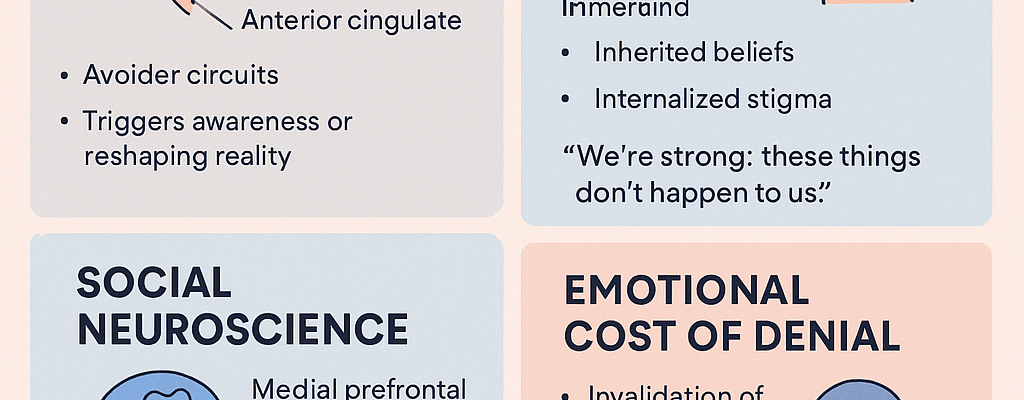
Denial is not just psychological — it’s neurobiological.
When the brain encounters something threatening to identity, reputation, or emotional safety, the amygdala (fear center) and anterior cingulate cortex (conflict detector) activate.
This triggers avoidance circuits — the brain unconsciously blocks awareness or reshapes reality to reduce emotional pain.
In other words:
“If I don’t admit it, I don’t have to feel it.”
The brain does this to preserve emotional stability, especially when the truth feels unbearable.
🧩 2. Psychological dynamics: shame, stigma, and identity
Families often deny mental illness publicly because it clashes with:
- Social image — “What will people think?”
- Inherited beliefs — “We’re strong; these things don’t happen to us.”
- Internalized stigma — decades of cultural messages equating mental illness with weakness or danger.
From a psychodynamic lens, denial protects the family ego.
Admitting mental illness forces them to face:
- Loss of control
- Fear of genetic blame (“Did we cause this?”)
- Fear of rejection by their community
So denial becomes an emotional shield — protecting them from shame, guilt, or perceived social humiliation.
💬 3. Social neuroscience: belonging and status
The human brain is wired for social belonging.
The medial prefrontal cortex and default mode network light up when we think about how others perceive us.
Families fear exclusion or judgment, so they unconsciously “curate the story” — presenting normalcy to protect social acceptance.
It’s a tribal survival mechanism in modern form.
❤️ 4. Emotional cost of denial
For the person who’s unwell, this denial can feel deeply invalidating:
- Their suffering becomes invisible.
- Their truth is dismissed to maintain appearances.
- They may internalize shame and feel unworthy of empathy.
Psychologically, this creates double trauma — one from the illness itself, and another from being silenced or hidden.
🌱 5. Path to healing
Breaking denial requires:
- Psychoeducation (understanding brain-based illness)
- Family therapy (to address guilt, fear, and shame)
- Compassion training — reframing illness as a shared challenge, not a family flaw
When families learn that mental illness is a brain condition, not a character failure, compassion begins to replace denial.
 Linda C J Turner | Trauma Therapist & Emotional Healing Specialist