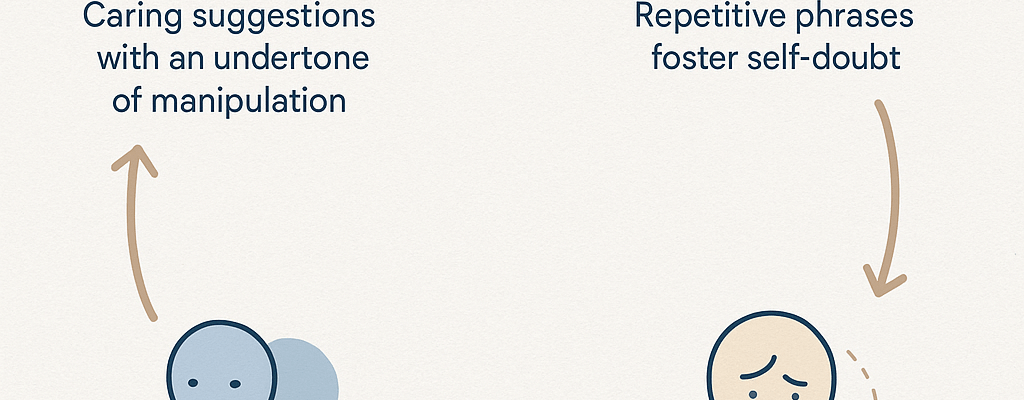
One of the most insidious features of long-term manipulation is its disguise. It rarely announces itself as cruelty or domination. Instead, it cloaks itself in the language of concern: “I’m only reminding you because you got it wrong before.” “I’m telling you this for your own good.” To an outside ear, these phrases may sound protective. But when repeated relentlessly, they become the soundtrack of control—a form of psychological conditioning that erodes self-trust.
The Mechanics of Manipulation
Manipulators often recycle the same phrases over and over:
- “Don’t you think you should do it this way?”
- “Remember when you got it wrong before?”
- “That person isn’t really your friend.”
- “What happens between us is private.”
At first, such comments may feel like advice. But repetition transforms them into mental programming. The brain, wired for efficiency, strengthens connections between neurons that fire together. When you hear the same criticism or warning repeatedly, your amygdala (the brain’s fear center) pairs the memory of mistakes with anxiety. Over time, this forms a neural shortcut: choice → doubt → fear.
The manipulator then positions themselves as the “safe guide” who knows better, reinforcing dependency. This is not care—it’s a deliberate effort to undermine your autonomy.
The Illusion of Privacy
“Don’t tell anyone about the abuse.” “Our financial situation is private.” The refrain of secrecy serves a dual purpose:
- It isolates you from potential allies who might validate your experiences.
- It creates shame around natural human struggles—money, relationships, mistakes—convincing you that disclosure equals disloyalty.
Psychologically, this taps into a survival instinct: humans fear rejection and crave belonging. By framing secrecy as “loyalty,” the manipulator ensures silence, which is the soil in which abuse thrives.
The Brainwashing Effect
When phrases are repeated often enough, they bypass critical thinking. Neuroscientists call this the illusory truth effect—the tendency to believe information simply because it’s familiar. Even if you know a statement is harmful or untrue, its repetition increases its psychological weight.
This is why over time, you begin to question your memory: Maybe I did get it wrong. Maybe I shouldn’t tell anyone. Maybe I really don’t know who my friends are. It’s not weakness on your part—it’s the natural function of the brain under sustained conditioning.
The Emotional Toll
- Erosion of self-trust: You begin to outsource decisions to avoid criticism.
- Heightened anxiety: The amygdala remains overactivated, scanning for mistakes.
- Social withdrawal: Friends and allies are redefined as threats, leaving you isolated.
- Internalized blame: You start to believe you’re inherently flawed and need “guidance.”
Breaking the Cycle
The antidote begins with awareness. Naming the pattern—“this is manipulation, not protection”—interrupts the automatic loop. Each time you identify the tactic, you weaken its hold. The prefrontal cortex, responsible for reasoning and self-reflection, gradually reclaims authority from the fear-driven amygdala.
Healing involves reclaiming what was stolen: the right to share your truth, the right to lean on friends, the right to make choices without seeking permission. Each act of speaking, deciding, or disclosing—even in small ways—rewires the brain toward freedom and trust in your own judgment.
In short: what was framed as “for your own good” was, in reality, for their own power. Repetition was their tool; silence their shield. But awareness is yours—and with it comes the slow but steady rewiring of your brain back to its rightful state of autonomy.
 Linda C J Turner | Trauma Therapist & Emotional Healing Specialist