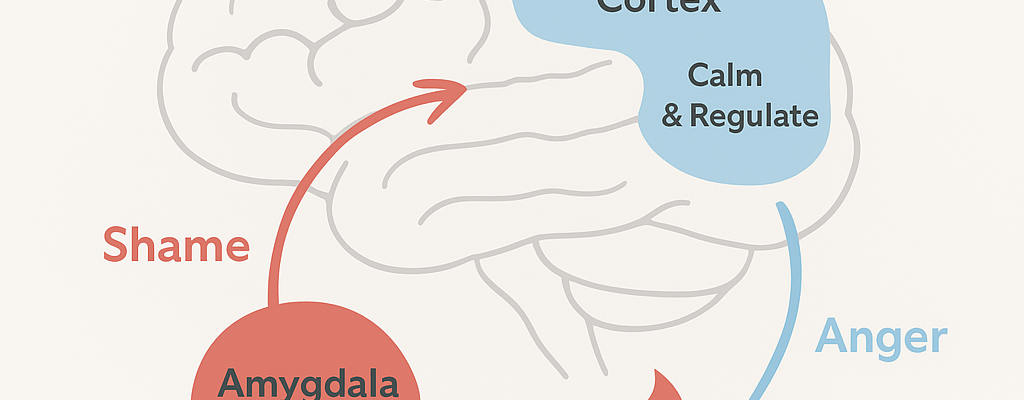
💙 — deep shame and unresolved anger in adulthood often trace back to early attachment issues. Neuroscience shows that the first years of life are when the brain’s relational blueprint is formed, and if a child’s caregivers are inconsistent, neglectful, frightening, or rejecting, those early experiences can wire the brain for mistrust, self-blame, and dysregulated emotions. Let me unpack this:
🔬 How Attachment Issues Lead to Shame & Anger in Adults
1. Shame: “Something is Wrong with Me”
- When caregivers are unresponsive or rejecting, a child’s brain doesn’t think “my parent is struggling” — it thinks “I must be unlovable.”
- This becomes toxic shame — a deeply rooted sense of being “not enough.”
- The hippocampus encodes these implicit emotional memories, while the amygdala reinforces a fear of rejection.
- In adulthood, this shame can manifest as self-criticism, low self-worth, or perfectionism.
2. Anger: The Fight Response
- If a child feels unsafe or unseen, their stress system (HPA axis) over-fires, releasing cortisol.
- The amygdala becomes hypersensitive → quick to perceive threat or disrespect.
- Without secure co-regulation in childhood, the prefrontal cortex doesn’t fully develop strong control over the amygdala.
- Result: anger outbursts, irritability, or difficulty managing conflict in adulthood.
3. The Shame–Anger Loop
- Shame and anger often work together:
- Shame inside (“I’m not good enough”).
- Anger outside (“Don’t you dare make me feel small”).
- Many adults with attachment trauma swing between self-blame and explosive anger because their nervous system is stuck in survival mode.
🌱 Healing Pathways
The good news is these patterns can be rewired:
- Therapy: Attachment-based, somatic experiencing, IFS, EMDR help process preverbal shame.
- Relationships: Safe, consistent connections release oxytocin, teaching the brain that closeness can be safe.
- Self-compassion practices: Counteract the inner critic that shame creates.
- Mind-body regulation: Breathwork, mindfulness, and grounding strengthen prefrontal cortex regulation of anger.
👉 In short: yes — shame and anger in adulthood can absolutely stem from attachment issues. They’re not signs of being “broken,” but of early survival adaptations. With awareness and healing, adults can learn to transform shame into self-acceptance, and anger into healthy boundaries.
 Linda C J Turner | Trauma Therapist & Emotional Healing Specialist