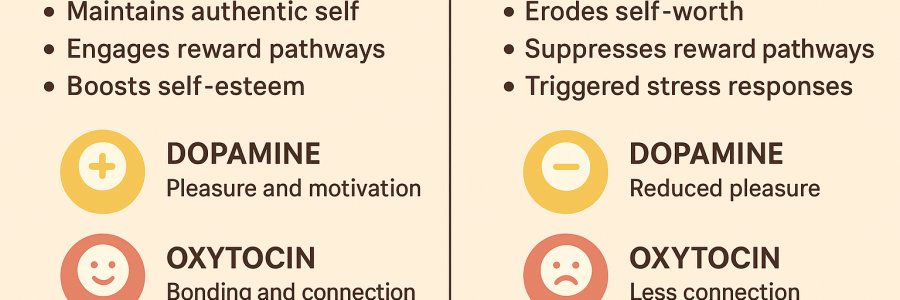
Truth-telling activates reward circuits

🔑 Legend 🟢 Calm / low activity → truth-aligned 🔴 High activity / stress → lying 🌟 Reward → truth-telling feels satisfying 🟠 Reduced reward → lying feels empty Takeaway:Truth-telling activates reward circuits, keeps your fear center calm, and minimizes internal conflict. Lying overloads multiple brain areas — your prefrontal cortex, amygdala, and conflict monitor —… Read More Truth-telling activates reward circuits

🧠 1. Lies Are Cognitively Expensive

This is one of my favorite topics because it shows just how deeply our brains are wired for truth. Here’s a breakdown of the neuroscience behind why truth-telling feels lighter and more resilient than defending a lie: 🧠 1. Lies Are Cognitively Expensive Fabricating a story requires your prefrontal cortex to create and maintain a consistent false narrative. You… Read More 🧠 1. Lies Are Cognitively Expensive

🧠 Emotional Toll of False Accusation

When accused, the amygdala (your brain’s threat detector) goes on high alert. Adrenaline and cortisol flood your system, preparing you to defend yourself. Physical effects: increased heart rate, tense muscles, shallow breathing, digestive slowdown. This response is adaptive short-term but toxic if prolonged. If the accusation lingers or is repeated, cortisol levels remain high. Chronic… Read More 🧠 Emotional Toll of False Accusation

🧠 Why People Accuse Others to Cover Their Tracks

Projection (psychology): When someone has done something wrong but feels guilt or fear, their brain may unconsciously project their actions or motives onto another person. This deflects attention and temporarily relieves their internal discomfort. Self-preservation: The human nervous system is wired to avoid social punishment. False accusations are sometimes a desperate way to protect one’s reputation or… Read More 🧠 Why People Accuse Others to Cover Their Tracks

🌌 Facing Shocking Truths, Finding Your Way Forward 🌌

Sometimes life delivers a moment you cannot ignore. A person steps forward after years of silence, revealing something shocking—something that confirms your worst suspicions, something you know you must act upon for the safety of others. In that instant, you feel the weight of truth land heavy in your heart. 🧠 How the Brain Reacts to… Read More 🌌 Facing Shocking Truths, Finding Your Way Forward 🌌

🌸 Your Caring Heart Is a Gift — Protect It Wisely 🌸

Being kind, loving, and caring is never the problem. The world needs more of that. But when your caring nature meets the wrong person, it can be exploited. ✨ Neuroscience insight:Your brain’s empathy circuits (like the anterior insula and mirror neuron system) are naturally activated when you see someone in need. This makes you quick to trust and give.… Read More 🌸 Your Caring Heart Is a Gift — Protect It Wisely 🌸

🌹 The Worst Thing You Can Do as a Woman: Settle for Less Than You Deserve 🌹

When you settle in love—no romance, no flowers, no surprises, no vacations, no real quality time—you’re not just accepting mediocrity in a relationship. You’re teaching your brain and heart to believe that this is all you’re worth. ✨ Neuroscience shows that our brains are wired to respond to love, novelty, and effort. When a partner surprises you, invests… Read More 🌹 The Worst Thing You Can Do as a Woman: Settle for Less Than You Deserve 🌹

How police can track a phone (technically)

Police can track a mobile phone’s location, but normally only with legal authorization (judicial order/warrant) or in narrow emergency/exceptional circumstances. How and when they may do it depends on the country, the seriousness of the suspected crime, and the legal safeguards in place. I’ll summarise the practical, technical and legal points (with sources) and then give… Read More How police can track a phone (technically)