Resource Harvesting

Opportunist Pattern: Moving Between Two Countries One week on / one week off — targeting wealth This is not normal migration behavior. It’s rotational exploitation strategy. Why This Pattern Is Highly Suspicious When someone: This suggests resource harvesting, not lifestyle choice. What This Pattern Typically Indicates 1. Multi-Source Financial Extraction This allows: Essentially: Diversified emotional income streams 2.… Read More Resource Harvesting

How to Spot Financial vs Emotional Exploitation

Because They Look Similar — But Feel Different Exploitation in relationships rarely announces itself. It often arrives as: But underneath, there are two common patterns:financial exploitation and emotional exploitation. Here’s how to tell the difference — and why both are damaging. 💰 Financial Exploitation “I need your resources.” This is about money, material support, and lifestyle access. Common… Read More How to Spot Financial vs Emotional Exploitation

Mechanisms of Moral Disengagement

Moral disengagement is the psychological process that allows people to act against their moral standards without feeling distress or guilt. Albert Bandura identified several mechanisms by which this occurs, often used to justify harmful actions or unethical behavior. 1. Moral Justification 2. Euphemistic Labeling 3. Advantageous Comparison 4. Displacement of Responsibility 5. Diffusion of Responsibility 6.… Read More Mechanisms of Moral Disengagement

Can People Really Change?(A neuroscience-informed answer — not a comforting one)

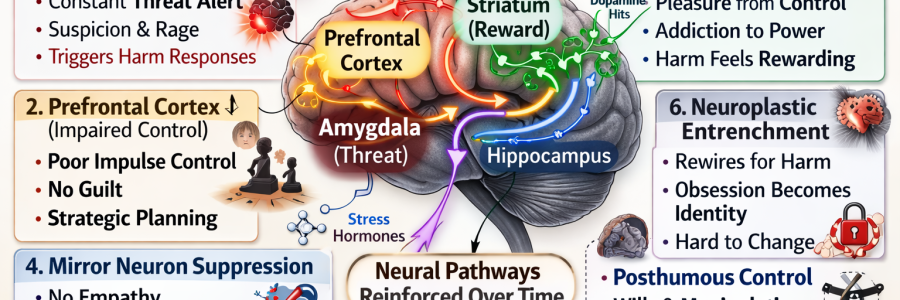
This is one of the most painful questions people ask after long-term harm.Not because they’re naïve.But because hope often feels safer than grief. Neuroscience gives us a steadier answer than wishful thinking or blanket cynicism. Yes — people can change.But not in the way most people hope.And not without conditions that are rare, demanding, and long-term. What change is not Change… Read More Can People Really Change?(A neuroscience-informed answer — not a comforting one)

Emotional Deadness vs Covert Emotional Neglect

(Internal state → Relational experience) 1. Core state Emotional deadnessA chronically under-activated emotional system. Feelings are dulled, muted, or inaccessible. Covert emotional neglectYour emotional needs are consistently unmet — not through cruelty, but through absence. 2. What it looks like day to day Emotional deadness Covert emotional neglect 3. Nervous system pattern Emotional deadness Covert emotional… Read More Emotional Deadness vs Covert Emotional Neglect

Safe Disengagement When ASPD-Type Dynamics Are Present

When antisocial traits are involved, disengagement is not relational — it is operational.You are not leaving a mutual bond; you are exiting a system where you were an asset. 🧭 Core Shift (This Is Non-Negotiable) You are not dealing with misunderstanding — you are dealing with entitlement. There is no insight coming.There is no repair coming.There is no shared… Read More Safe Disengagement When ASPD-Type Dynamics Are Present

What is ASPD (Antisocial Personality Disorder)?

Antisocial Personality Disorder (ASPD) is a clinical diagnosis used to describe a persistent pattern of disregard for the rights, safety, and boundaries of others. It’s not about being “difficult” or having a bad temper. It’s about how someone relates to people, rules, and responsibility over time. Common features include: Importantly:Not everyone with antisocial traits has ASPD, and not… Read More What is ASPD (Antisocial Personality Disorder)?

How Other People’s Agendas Can Distort Separation and Divorce Decisions

During separation and divorce, one of the most important — and most difficult — boundaries to hold is this: Do not allow siblings, children, extended family, or friends to sway your decisions simply because they are close to you. Not everyone involved has your best interests at heart — even when they believe they do.… Read More How Other People’s Agendas Can Distort Separation and Divorce Decisions

Mental cruelty from the family of an abuser — what it is

Mental cruelty by an abuser’s family occurs when relatives knowingly or recklessly engage in behaviours that reinforce, enable, excuse, or extend the abuser’s control, causing psychological harm and undermining the victim’s autonomy, safety, or credibility. This is sometimes called: They may not hit you.They may never raise their voice.But the harm is systemic and strategic. How… Read More Mental cruelty from the family of an abuser — what it is

What is the definition of cruelty when it is abuse?

Plain-language definition Cruelty is abuse when someone deliberately or repeatedly causes suffering, distress, or harm in order to control, punish, dominate, or diminish another person. The key elements are: Clear definition (psychological + legal overlap) Cruelty in abuse is the intentional or sustained infliction of emotional, psychological, physical, or relational harm, where the perpetrator knows… Read More What is the definition of cruelty when it is abuse?