Neuroscience & Psychological Mechanisms Behind This Behaviour

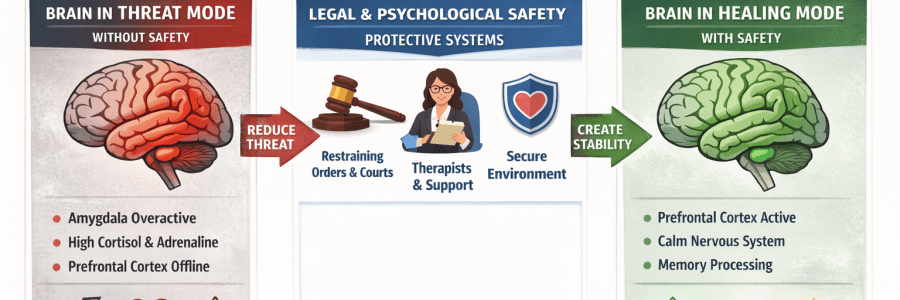
Below is a clear breakdown of why people engage in sustained coercive harassment, even when legal boundaries exist. 1. Threat-Based Brain Activation (“Survival Mode”) When someone fears losing control, status, or assets, the brain’s amygdala goes into high-alert.This creates: This pattern shows a shift from logical reasoning (prefrontal cortex) to survival-driven emotional reactivity (amygdala). 2. Coercive Control Circuits (Power–Reward Loop) People who harass to… Read More Neuroscience & Psychological Mechanisms Behind This Behaviour

Juzgado de Violencia sobre la Mujer 

Juzgado de Violencia sobre la Mujer (specialised gender-violence court in Spain), tailored to highlight coercive control and decision-making under threat: 🧠 Understanding Coercive Legal and Emotional Control in the Context of the Juzgado de Violencia sobre la Mujer 1. Court Context The Juzgado de Violencia sobre la Mujer is specialised in handling cases of: It recognises patterns of psychological abuse and manipulative… Read More Juzgado de Violencia sobre la Mujer 

Where Do We Learn Gratitude, Kindness, and Manners?

Gratitude, kindness, etiquette, and manners are often seen as “soft skills,” but they are foundational to human relationships. These behaviors are not innate — they are learned through a combination of family upbringing, cultural environment, education, and sometimes formal training. Let’s break down how we acquire them. 1. Family: The First Classroom The family is the… Read More Where Do We Learn Gratitude, Kindness, and Manners?

🌍 A Global Problem, A Shared Responsibility

When Abuse Crosses Borders: The Legal, Psychological, and Neuroscientific Dimensions of Child Exploitation Networks in Europe In the digital age, borders no longer confine crime. Unfortunately, this also applies to one of the darkest forms of human exploitation — the organized production and distribution of child sexual abuse material. These criminal networks often operate across… Read More 🌍 A Global Problem, A Shared Responsibility

Major Works by Alfred Adler

Alfred Adler (1870–1937) was an Austrian physician, psychotherapist, and the founder of Individual Psychology — a school of thought that emphasized human motivation, social belonging, and personal meaning rather than pathology or instinct. His ideas remain foundational in modern psychology, counseling, and even neuroscience-informed therapy. Here’s a concise overview of his key works and core ideas 👇 📚 Major Works… Read More Major Works by Alfred Adler

🧠 1. Early Scarcity Rewires the Stress System

Growing up with material insecurity or social stigma chronically activates the amygdala–HPA axis (the brain’s threat circuit). So in adulthood, luxury or social advancement doesn’t just feel nice — it feels neurologically soothing, like relief from danger. 🧩 2. Psychology: From Inferiority to Overcompensation Alfred Adler called this the inferiority–superiority loop.When someone grows up feeling “less than,” they may swing… Read More 🧠 1. Early Scarcity Rewires the Stress System

Let’s unpack Moral Disengagement (Bandura, 1999) clearly and deeply 👇

🧩 What It Is Albert Bandura — the same psychologist who developed Social Learning Theory — coined moral disengagement to describe how people disconnect their actions from their moral standards so they can behave unethically while still thinking of themselves as “good people.” In other words: “I know this is wrong, but I’ll convince myself it’s fine — so I can do… Read More Let’s unpack Moral Disengagement (Bandura, 1999) clearly and deeply 👇