Neuroscience Behind People Who Leave You Hanging

1. Avoidant Attachment & Threat Perception People who disappear, delay responses, or keep you waiting often have an avoidant attachment style.To them, closeness feels threatening — their amygdala (fear center) misinterprets emotional intimacy as loss of control or loss of independence. Brain mechanism: So the silence or unpredictability is not deep thinking — it’s avoidance triggered by fear.… Read More Neuroscience Behind People Who Leave You Hanging

Neuroscience and Psychology Behind “Walls” and Letting Go

1. The Closed-Off Partner – Emotional Walls 2. The Persistent Partner – Reaching Out 3. Letting Go – Choosing Yourself 4. Emotional Freedom 5. Love Needs a Home, Not a Fortress Summary When someone “won’t let you in,” their behaviour is often: Letting go is not failure — it is a conscious, adaptive choice to protect your… Read More Neuroscience and Psychology Behind “Walls” and Letting Go

Coercive Legal Tactics: Neuroscience & Psychology

Let’s unpack this. 1. Coercive Control: Psychological Mechanism Definition:Coercive control is a pattern of behaviour intended to dominate, intimidate, and control another person. It can be subtle (manipulation, threats) or overt (legal or physical threats). Mechanisms at play here: 2. Legal Threats as Psychological Weapons 3. Why People Fall Into Pressure Traps From a neuroscience… Read More Coercive Legal Tactics: Neuroscience & Psychology

Why Highly Trusting People Are the Way They Are — Neuroscience Perspective

1. Your Brain Is Wired for Warmth, Not Suspicion Many trusting individuals have stronger activity in neural systems associated with: ⭐ Ventromedial Prefrontal Cortex (vmPFC) Responsible for: This creates a natural optimistic bias, making you more likely to assume honesty, kindness, and goodwill. ⭐ Oxytocin System You also tend to produce more oxytocin — the bonding… Read More Why Highly Trusting People Are the Way They Are — Neuroscience Perspective

Behavioral Choice Pathways: Neuroscience of Deliberate Actions

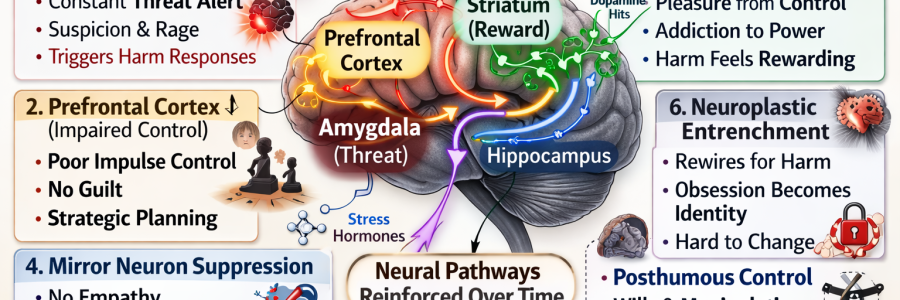
Here’s a neuroscience-informed explanation of behavioral choice pathways, specifically in the context of abusive or manipulative behavior. This framework emphasizes that abuse is a deliberate, neurologically reinforced choice rather than a symptom or accident. 1. Key Brain Circuits Involved Brain Region Function in Behavioral Choice Implication for Abuse Prefrontal Cortex (PFC) Executive function, planning, decision-making, inhibition Enables abuser… Read More Behavioral Choice Pathways: Neuroscience of Deliberate Actions

Medication, Behavior, and Abuse: Choice and Responsibility

Here’s a neuroscience-informed explanation addressing the relationship between medication, behavioral regulation, and abusive behavior, framed in terms of choice and accountability. 1. Abuse is a Choice, Not a Symptom 2. Role of Medications 3. Choosing Not to Take Medication 4. Psychological and Legal Implications Scenario Neuroscience Insight Accountability Abuse while on medication Reward circuits still drive pleasure from… Read More Medication, Behavior, and Abuse: Choice and Responsibility

Abuse as a Deliberate Behavioral Pattern: A Neuroscience and Psychology Perspective

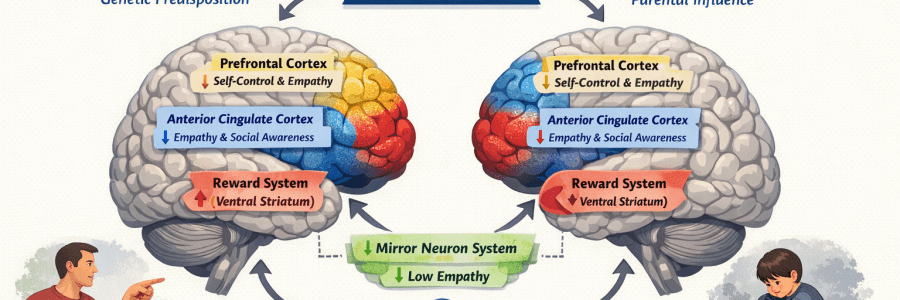
Introduction Abuse is often misunderstood in popular discourse as the result of stress, mental illness, or poor emotional regulation. Neuroscience and psychology research increasingly clarify that abuse is a conscious, deliberate behavior aimed at power and control rather than an accident or symptom. Understanding the underlying mechanisms helps survivors, professionals, and the legal system recognize patterns, predict… Read More Abuse as a Deliberate Behavioral Pattern: A Neuroscience and Psychology Perspective

Co-Dependent Individuals: Neuroscience and Psychology

Co-dependency refers to a pattern where an individual consistently prioritizes others’ needs over their own, often to the point of emotional, psychological, or even physical detriment. It’s commonly observed in relationships with emotionally unavailable, abusive, or high-conflict partners. 1. Brain Mechanisms in Co-Dependency A. Reward System Dysregulation B. Emotional Regulation C. Attachment Circuitry D. Stress Response… Read More Co-Dependent Individuals: Neuroscience and Psychology

Neuroscience-Informed Guide to Trauma-Bond Resistance

1. Understanding the Neurobiology of Trauma Bonds Trauma bonds form when intermittent reinforcement (alternating kindness and abuse) hijacks the brain’s reward and stress systems: Result: Even when abused, your brain craves connection, creating a powerful attachment. 2. Key Psychological Mechanisms 3. Strategies to Build Resistance (Neuroplastic Approach) A. Strengthen Prefrontal Cortex Engagement Activates rational decision-making, reduces impulsive reactivity.… Read More Neuroscience-Informed Guide to Trauma-Bond Resistance