Why Silence Protects Survivors During Escalation

Escalation is the most dangerous phase in abusive dynamics because regulation is failing. Silence works because it removes the very signals escalation feeds on. 1️⃣ Escalation Requires Feedback — Silence Removes It During escalation, the abuser’s nervous system is: dysregulated reward-seeking threat-focused They are scanning for: emotional reaction fear engagement resistance 🧠 Silence provides none. ➡️ Without feedback,… Read More Why Silence Protects Survivors During Escalation

Silence Removes the Regulation Source

Abusive dynamics work because the abuser uses another person to: regulate anxiety discharge tension stabilise identity confirm power When you go silent: there is no emotional input no reaction no feedback loop 🧠 ResultThe nervous system loses its external regulator. ➡️ Dysregulation begins internally. 2️⃣ The Brain Encounters Reward Collapse Cruelty and control rely on dopamine prediction: “If… Read More Silence Removes the Regulation Source

How One Enforced Boundary Disrupts the Entire Cruelty Loop

Cruelty depends on access.A single boundary works because it removes fuel, not because it teaches insight. 1️⃣ Boundary Enforcement = Circuit Interruption When a survivor enforces a boundary (not explains it, not negotiates it): No response No emotional feedback No repair attempt No re-entry point 🧠 Neurological effect Dopamine prediction fails The brain expected reward → receives none The cruelty→relief… Read More How One Enforced Boundary Disrupts the Entire Cruelty Loop

How Cruelty Escalates Neurologically Over Time

Think of cruelty not as a personality switch, but as a learning loop inside the brain. Stage 1: Initial Threat → Control Response Brain state: Stress + insecurity threatened shamed powerless dysregulated The nervous system searches for regulation stop anxiety regain dominance silence discomfort 🧠 Neural activity Amygdala (threat) is high Prefrontal cortex (reflection) is reduced Control briefly restores calm… Read More How Cruelty Escalates Neurologically Over Time

Are People Born Cruel — or Is Cruelty Learned?

People are not born cruel.Cruelty is learned, reinforced, and practiced over time. From a neuroscience perspective: Infants are born with capacity for empathy Empathy circuits (mirror neurons, anterior insula, ACC) strengthen with attuned caregiving neglected overridden by fear rewarded for dominance, humiliation, or control Cruelty becomes conditioned behavior, not an innate trait. How Cruelty Becomes Reinforced in the Brain When… Read More Are People Born Cruel — or Is Cruelty Learned?

Moral High Ground

When someone takes the “moral high ground” while their family has a documented history of serious misconduct, such as conviction for theft while in a professional fiduciary role. This is both ethically and psychologically complex, and it’s worth unpacking carefully. 1. Understand the Dynamics Moral high ground: Often involves asserting superiority in ethics, judgment, or behavior. Family misconduct history: Conviction… Read More Moral High Ground

Why Disclosure Is Important (and Protective)

You absolutely should inform your lawyer, the judge (via your lawyer), and your psychologist if you believe the family lawyers on your ex’s side have been manipulating matters. This isn’t about accusation; it’s about protective disclosure and record‑keeping. Here’s how and why to do it safely and effectively. Why Disclosure Is Important (and Protective) 1. To Your Lawyer Your… Read More Why Disclosure Is Important (and Protective)

Free from Threat

Safety is both internal and external, and it can look very different depending on context. Here’s a structured set of examples for survivors of abuse, framed in psychological and nervous-system terms: 1. Physical Safety External environment is secure, predictable, and free from threat. Examples: Living in a home where the abuser cannot enter or monitor you. Locked… Read More Free from Threat

Road to Safety: Step-by-Step Framework

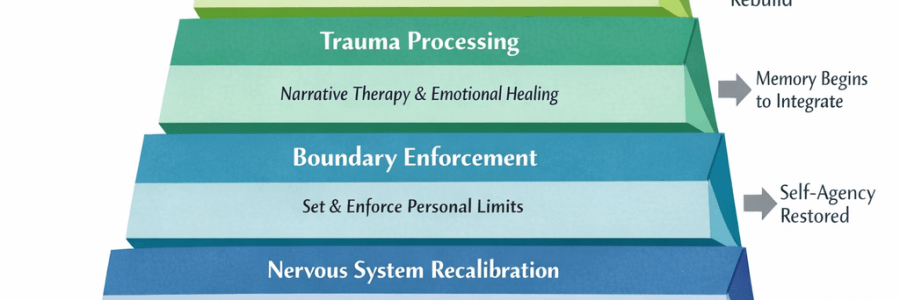
Layer 1: External Safety Goal: Remove immediate threatActions: Physical separation (home, distance) Legal protection (restraining orders, custody agreements) Digital security (blocking, privacy controls) Supportive network of trusted allies Nervous System: Amygdala downregulation starts once the environment is reliably safe. Layer 2: Nervous System Recalibration Goal: Teach the body that danger is not constantActions: Mindfulness, grounding, breathwork Somatic therapies… Read More Road to Safety: Step-by-Step Framework

Establish External Safety First

Recovering safety after decades of abuse is absolutely possible, but it’s a gradual, nervous-system-centered process, not something that happens overnight. Safety is both internal (how your body and mind respond) and external (your environment, relationships, and boundaries). Here’s a comprehensive framework: 1. Establish External Safety First Before the nervous system can relax, you need to remove ongoing threat. Steps include: Physical separation: Living… Read More Establish External Safety First