HOW TO SPOT RECIPROCITY CAPACITY EARLY
Below is a clear framework for spotting reciprocity capacity early, before you give time, care, labour, money, or emotional energy. 🔍 HOW TO SPOT RECIPROCITY CAPACITY EARLY (Brain → behaviour → signal) 1️⃣ MICRO-RECIPROCITY TESTS (SAFE & LOW COST) These are tiny, neutral tests that reveal nervous-system wiring without confrontation. Example tests: 🧠 What’s happening neurologically: ✅ Reciprocity capacity looks… Read More HOW TO SPOT RECIPROCITY CAPACITY EARLY

Neuroscience Map: Abuse vs. Real Love

Domain Real Love Abuse / Financial, Physical, Emotional + Sadistic Attachment System Secure attachment, oxytocin bonding, trust circuits active Trauma bonding, attachment hijacked by fear and reward; oxytocin spikes tied to intermittent reinforcement Nervous System Parasympathetic activation: calm, safe, regulated Sympathetic / HPA axis overactivation: chronic fight/flight/freeze, hypervigilance, stress hormone surge Prefrontal Cortex Clear thinking,… Read More Neuroscience Map: Abuse vs. Real Love

Healthy vs Unhealthy Separation

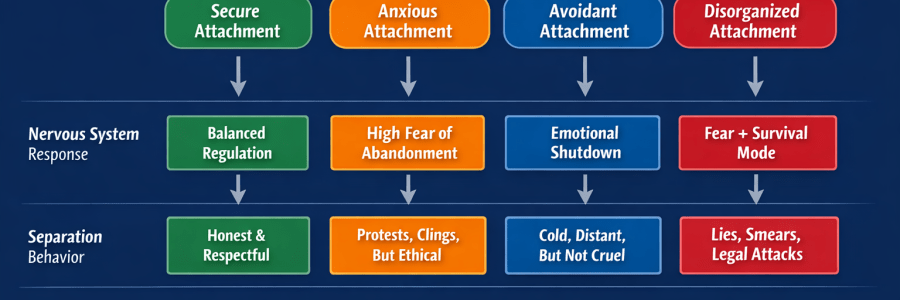
Below is a clear, side-by-side comparison followed by a direct mapping to attachment styles.This is the framework clinicians, trauma specialists, and increasingly courts use to distinguish healthy separation from abusive or unsafe dynamics. Healthy vs Unhealthy Separation (Side-by-Side Comparison Chart) Domain Healthy Separation Unhealthy / Abusive Separation Core mindset “This relationship is ending; we are still human.” “I must win, control,… Read More Healthy vs Unhealthy Separation

How Healthy Partners Behave — Even During Separation

This is a crucial distinction, especially during separation or divorce when stress is high.Healthy partners may be hurt, angry, or grieving — but they do not cross core moral lines, even when the relationship ends. Below is how this looks psychologically, neurologically, and behaviorally. How Healthy Partners Behave — Even During Separation (Neuroscience & Psychology) 1. They Do… Read More How Healthy Partners Behave — Even During Separation

Why Abusers Often Refuse to Leave the Area

This is not coincidence, nostalgia, or practicality.It is about regulation, identity, and power. The key distinction: So they stay close. 1. Proximity Regulates Their Nervous System For an abuser, proximity to a former target functions like a regulatory anchor. Neurologically: reduces their internal anxiety. Even imagined access calms: They don’t need contact.They need potential access. Distance removes that — and their… Read More Why Abusers Often Refuse to Leave the Area

You are not refusing truth — you are refusing harm

✅ DO — Protect yourself while acting responsibly 🧠 Nervous system first 📩 Communication 📁 Information handling ⚖️ Responsibility 🌱 Aftercare 🚫 DON’T — Avoid what harms recovery ❌ Engagement ❌ Emotional load ❌ Cognitive traps ❌ Role confusion ❌ Self-betrayal thoughts to notice (not obey) These are trauma-conditioned empathy reflexes, not obligations. 🧩 One-sentence response… Read More You are not refusing truth — you are refusing harm

The Hidden Dangers of Dating Apps: Con Men, Pretenders, and Emotional Fraud

Dating apps aren’t inherently bad — but they are highly efficient environments for deception. They allow people to present a carefully curated version of themselves with very little accountability, history, or social consequence. And that creates opportunity — not just for romance, but for manipulation. Who Thrives on Dating Apps (and Why) Dating apps are especially attractive… Read More The Hidden Dangers of Dating Apps: Con Men, Pretenders, and Emotional Fraud

In Simple Terms: What’s Actually Going On

This isn’t new behaviour.It’s the same pattern that’s been happening for decades — just playing out in a different way. When someone ignores divorce proceedings, doesn’t respond to solicitors, blocks the sale of a house, removes signs, and then later blames or sues you for delays — that isn’t confusion or bad communication. It’s control.… Read More In Simple Terms: What’s Actually Going On