What is the Zeigarnik effect?

The Zeigarnik effect is a psychological phenomenon where the brain remembers unfinished or interrupted experiences more strongly than completed ones. In simple terms: Your brain hates open loops. If something ends cleanly, the brain files it away.If something ends mid-emotion, mid-story, mid-hope — the brain keeps replaying it. Why it’s brutal in relationships 💔 Romantic situations are perfect Zeigarnik traps because… Read More What is the Zeigarnik effect?

Why Some Men Seek Vulnerable Women to Exploit

Certain men intentionally target women who: Motivation 🧠 Neurological reinforcement: Their brain associates your compliance + trust → reward (control, pleasure, gain), strengthening the pattern over time. 2️⃣ The Trust Cycle That Leads to Nervous System Reset Here’s how the danger unfolds: The nervous system is saying: “This is unsafe; reset and protect.” 3️⃣ How to Slow It Down… Read More Why Some Men Seek Vulnerable Women to Exploit

Trusting or Being Intimate Too Soon

When you allow trust or intimacy to build faster than the other person proves reliability, your nervous system is essentially “rewiring” based on incomplete data. Consequences: The system has learned: “Connection + danger = chaos.” Rushing rewards can trigger old survival responses. 2️⃣ When They Don’t Answer Your Questions or Are Evasive Evasion signals that they may be protecting themselves… Read More Trusting or Being Intimate Too Soon

1️⃣ Visual “Road to Safety in New Relationships”

Think of this as a stepwise journey, showing how trust, boundaries, and emotional reward rebuild over time: 2️⃣ Specific Exercises to Test Trust Safely Exercise Purpose How to Apply Safely Low-Stakes Requests Test reliability Ask for small favors or follow-throughs; observe consistency Boundary Enforcement Drill Test respect for limits Say “I need space” or “I’m not… Read More 1️⃣ Visual “Road to Safety in New Relationships”

Why Some Abusers Escalate Once More Before Stopping

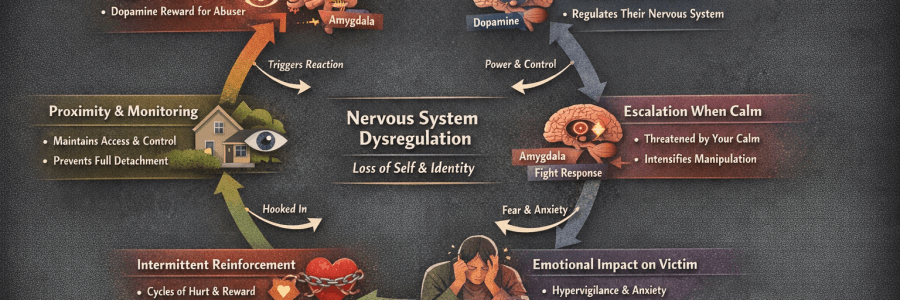
This is called an extinction burst in neuroscience and behavioural psychology. It happens when a behaviour that used to work suddenly stops working. 1️⃣ The Brain Detects Reward Loss When a survivor enforces boundaries or goes silent, the abuser’s brain experiences: 🧠 The brain registers: “My usual strategy has failed.” But it does not interpret this as “stop.” 2️⃣ The… Read More Why Some Abusers Escalate Once More Before Stopping

Why Silence Protects Survivors During Escalation

Escalation is the most dangerous phase in abusive dynamics because regulation is failing. Silence works because it removes the very signals escalation feeds on. 1️⃣ Escalation Requires Feedback — Silence Removes It During escalation, the abuser’s nervous system is: They are scanning for: 🧠 Silence provides none. ➡️ Without feedback, the brain cannot calibrate intensity.➡️ This creates hesitation instead… Read More Why Silence Protects Survivors During Escalation

Silence Removes the Regulation Source

Abusive dynamics work because the abuser uses another person to: When you go silent: 🧠 ResultThe nervous system loses its external regulator. ➡️ Dysregulation begins internally. 2️⃣ The Brain Encounters Reward Collapse Cruelty and control rely on dopamine prediction: “If I do X, I will get Y (reaction, fear, reassurance, submission).” Silence creates: 🧠 Dopamine drops sharply.This feels… Read More Silence Removes the Regulation Source

How One Enforced Boundary Disrupts the Entire Cruelty Loop

Cruelty depends on access.A single boundary works because it removes fuel, not because it teaches insight. 1️⃣ Boundary Enforcement = Circuit Interruption When a survivor enforces a boundary (not explains it, not negotiates it): 🧠 Neurological effect ➡️ The system experiences error, not satisfaction. 2️⃣ Why Silence Collapses the Reward Circuit Cruelty requires: Silence removes all three. What silence does neurologically… Read More How One Enforced Boundary Disrupts the Entire Cruelty Loop

How Cruelty Escalates Neurologically Over Time

Think of cruelty not as a personality switch, but as a learning loop inside the brain. Stage 1: Initial Threat → Control Response Brain state: Stress + insecurity 🧠 Neural activity ➡️ Cruelty begins as a regulation strategy, not yet a pleasure source. Stage 2: Relief Reinforcement Brain state: “That worked” 🧠 Neural activity ➡️ Cruelty becomes reinforced, even if still justified as… Read More How Cruelty Escalates Neurologically Over Time