Healing Changes the Body: What Neuroscience & Psychology Say About Recovery Results

Tomorrow I receive the results of my routine hospital tests after returning to private medical care. And naturally, a question arises: Will my physical health now reflect the emotional healing I’ve been doing? From a neuroscience and psychology perspective, the answer is:👉 Very possibly — yes. 🧠 Trauma Lives in the Body — So Does Healing… Read More Healing Changes the Body: What Neuroscience & Psychology Say About Recovery Results

When Healing Shows: How Trauma Recovery Transforms Mind, Brain & Body

Two years ago, under extreme psychological stress and PTSD from an abusive marriage, my eyesight measured just 70% without glasses.Eighteen months after leaving that environment, my vision is now 90% without glasses. The optician also said something unexpected:“You look lighter. Brighter.” And that moment says everything about trauma, healing, and the incredible power of the human… Read More When Healing Shows: How Trauma Recovery Transforms Mind, Brain & Body

Understanding Neuroscience & Neuroplasticity

1. What is Neuroscience? Neuroscience is the scientific study of the brain and nervous system — how neurons communicate, how brain regions control behavior, and how cognition, emotion, and perception emerge. It combines biology, psychology, chemistry, and even computational science to understand how the brain functions in health and disease. Key focus areas include: 2. What is Neuroplasticity? Neuroplasticity… Read More Understanding Neuroscience & Neuroplasticity

Neuroscience of a Lifelong Obsession with Harm

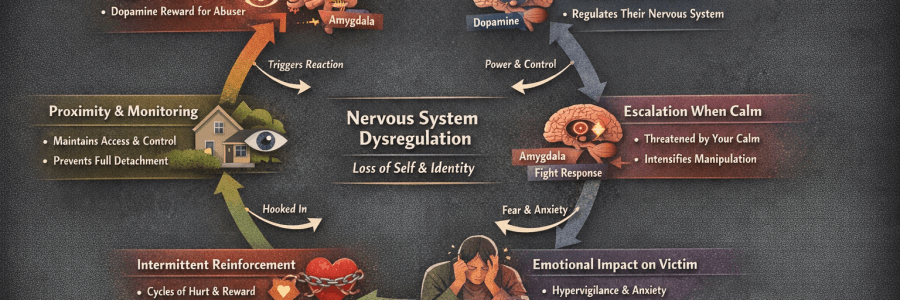
1. Hyperactive Threat Circuits 2. Prefrontal Cortex Dysfunction 3. Reinforced Reward Pathways 4. Mirror Neuron Suppression 5. Neuroplastic Entrenchment 6. Stress and Cortisol Loop 7. Death and Posthumous Influence 💡 Summary Insight:A person who obsesses over harming others develops a brain wired for control, vigilance, and manipulation. Empathy circuits weaken, reward pathways reinforce harm, and stress systems… Read More Neuroscience of a Lifelong Obsession with Harm

Aftermath & Long-Term Impact

In inheritance or high-stakes family conflicts, people often follow a predictable escalation pattern. Understanding it helps you anticipate moves, protect yourself, and even de-escalate tension. 1. Initial Anxiety & Awareness 2. Strategic Maneuvering 3. Escalation & Pressure 4. Open Conflict 5. Aftermath & Long-Term Impact How to Anticipate or Manage These Behaviors Inheritance conflicts are… Read More Aftermath & Long-Term Impact

Brain Structure & Neurobiology

Prefrontal Cortex (PFC) Anterior Cingulate Cortex (ACC) Amygdala Reward System (Ventral Striatum / Nucleus Accumbens) 2️⃣ Psychology & Personality Factors Attachment & Early Environment Learned Behavior & Modeling Personality Traits 3️⃣ Epigenetics ✅ Key Takeaways In short: it’s a mix of biology, environment, early life experiences, and personality traits. The brain literally learns these patterns through repeated exposure and reinforcement.

 Social Learning & Mirror Neurons

The neuroscience of learned greed, manipulation, and dishonesty—basically, how teaching someone to take advantage of others can create a cycle where those behaviors get reflected back to you. Let’s break this down carefully: 1. Social Learning & Mirror Neurons 2. Reward System & Dopamine 3. Prefrontal Cortex & Moral Control 4. Empathy & Social Awareness 5. Karma-Like Reciprocity in the Brain… Read More  Social Learning & Mirror Neurons

Genetic and Heritable Factors

he neuroscience behind why a “Me, Me, Me” personality—self-centeredness or narcissistic traits—can appear to “run in the family.” Let’s break it down carefully: 1. Genetic and Heritable Factors 2. Brain Networks & Neurobiology 3. Environmental & Epigenetic Influences 4. The Neuroscience of “Running in the Family” ✅ Key Takeaway A “Me, Me, Me” pattern in families is usually: