iPhone Safety Plan (Ex‑Partner Scenario)

⚠️ First rule Do NOT accuse, confront, or tip them off yet.If they are monitoring you, confrontation often escalates behaviour. 1️⃣ Use Apple’s built‑in Safety Check (this is designed for exactly this situation) 📱 Settings → Privacy & Security → Safety Check Choose “Manage Sharing & Access” (not Emergency Reset yet). This lets you: 👉 Do not rush to revoke everything if you’re worried… Read More iPhone Safety Plan (Ex‑Partner Scenario)
How to Pace Connection Safely (When Kindness Feels Big)

When kindness feels intense, the instinct is often to lean in quickly — to attach, explain, disclose, or merge. That urge makes sense after deprivation. But pacing is what turns safety into something sustainable. Pacing does not mean pulling away.It means letting connection unfold at a speed your nervous system can actually integrate. Here’s how… Read More How to Pace Connection Safely (When Kindness Feels Big)

If You Feel Embarrassed by Crying When Someone Is Kind

If you cry when someone shows you kindness and then feel embarrassed — please hear this clearly: There is nothing wrong with you. Those tears are not immaturity, instability, or weakness. They are a nervous system response to safety after deprivation. Many people who grew up with neglect or lived through long-term emotional abuse learned… Read More If You Feel Embarrassed by Crying When Someone Is Kind

A Simple Neuroscience Explanation

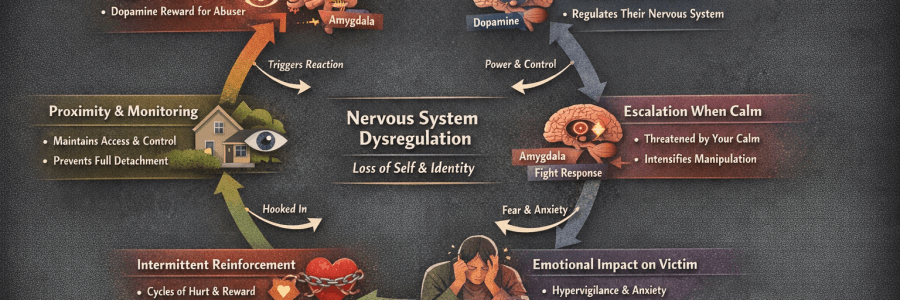
When you become emotional in response to kindness, your brain isn’t “overreacting” — it’s recalibrating. Long-term neglect or abuse sensitises the amygdala, the brain’s threat detector. It learns that relationships are unpredictable, conditional, or unsafe. At the same time, the prefrontal cortex (logic, perspective, emotional regulation) often down-regulates because survival takes priority over reflection. Your nervous system adapts… Read More A Simple Neuroscience Explanation

When You Become Emotional If Anyone Shows You Kindness

If you find yourself tearing up when someone is kind to you, it doesn’t mean you’re fragile. It usually means you went a long time without care. When you’ve lived with neglect, dismissal, or emotional deprivation, your system learns not to expect softness. You survive by coping, not by receiving. So when kindness finally appears… Read More When You Become Emotional If Anyone Shows You Kindness

Why Kindness Feels Intense After Neglect

If kindness feels overwhelming after neglect, there is nothing wrong with you. Long-term emotional neglect or abuse changes the nervous system. You adapt by lowering expectations, minimising needs, and staying alert for withdrawal or punishment. Your body learns that connection is fragile and conditional. So when someone offers genuine care — listening, warmth, follow-through, softness… Read More Why Kindness Feels Intense After Neglect

Before You Try “One Last Time” — Please Look Again

If you’re considering one last try, it doesn’t mean you’re weak or naïve.It usually means you are hopeful, invested, and wanting to believe that things could finally be different. That hope deserves respect — and protection. So before you decide, pause. Not to panic. Just to look again. A Quiet Question to Ask Yourself Is what you’re… Read More Before You Try “One Last Time” — Please Look Again

The Moment I Thought Abuse Was Over — And Why It Wasn’t

I was finished with abuse the moment I decided to move to Spain on my own. I had found a small, manageable, affordable property.It was realistic.It was sustainable.It gave me safety, autonomy, and breathing space. I was ready to start again — without chaos, without control, without fear. But I was convinced otherwise. I was told that… Read More The Moment I Thought Abuse Was Over — And Why It Wasn’t

“A Fresh Start” Does Not Stop an Abuser — It Just Resets the Stage

When an abuser suggests “making a fresh start” — moving house, changing country, starting again — it is often presented as hope, healing, or renewal. But a fresh location does not erase abusive behaviour. Abuse is not caused by the place.It is caused by the person. Why “Fresh Starts” Are So Appealing To outsiders — and often to survivors… Read More “A Fresh Start” Does Not Stop an Abuser — It Just Resets the Stage