Clinical comparison: Assertive vs Aggressive

Writing ASSERTIVE TONE (Clinically Regulated) Nervous system Intent Language Volume & pacing Boundaries Response to disagreement Impact (clinical lens) AGGRESSIVE BEHAVIOUR (Clinically Dysregulated) Nervous system Intent Language Volume & pacing Boundaries Response to disagreement Impact (clinical lens) The key clinical takeaway (this matters) Assertiveness is defined by regulation and respect — not by how comfortable… Read More Clinical comparison: Assertive vs Aggressive

Language-proof boundary scripts

Below are language-proof boundary scripts designed to be calm, precise, and very hard to distort. They’re written to remove emotional hooks, limit projection, and keep you in a regulated, authoritative position. I’ll explain the principles briefly, then give you copy-ready scripts you can actually use. The principles (why these work) Language-proof boundaries share four traits: No justification. No over-explaining. No… Read More Language-proof boundary scripts

Strong Woman

When a strong woman is assertive and someone labels her “aggressive,” several neuroscience processes are often firing in the accuser, not in her. Let’s break it down cleanly. 1. Threat detection misfires (amygdala-driven) The amygdala scans for threat — not just physical danger, but status, control, and predictability. When someone expects: …and instead encounters calm boundaries + confidence, their brain may interpret… Read More Strong Woman

Key Principles of Heart–Brain Neurodynamics

Let’s dive into the heart–brain neurodynamics—how the heart and brain communicate, influence each other, and regulate physiology, emotion, and cognition. I’ll break it down systematically. 1. Heart–Brain Communication Pathways The heart and brain are constantly exchanging information through several channels: A. Neural Pathways B. Hormonal & Biochemical Pathways C. Electromagnetic Field 2. Heart–Brain Feedback Loops The heart and… Read More Key Principles of Heart–Brain Neurodynamics

1. What is the “Intelligence of the Heart”?

The term comes from heart–brain science, polyvagal theory, and biofeedback research. It refers to the heart’s ability to sense, respond, and influence physiological, emotional, and cognitive states. Key insight: The heart is not just a pump—it is a dynamic regulator of the nervous system. 2. Trauma and the Heart Trauma impacts the autonomic nervous system (ANS): Heart intelligence interventions aim to restore… Read More 1. What is the “Intelligence of the Heart”?

The Neurophysiology of Trauma

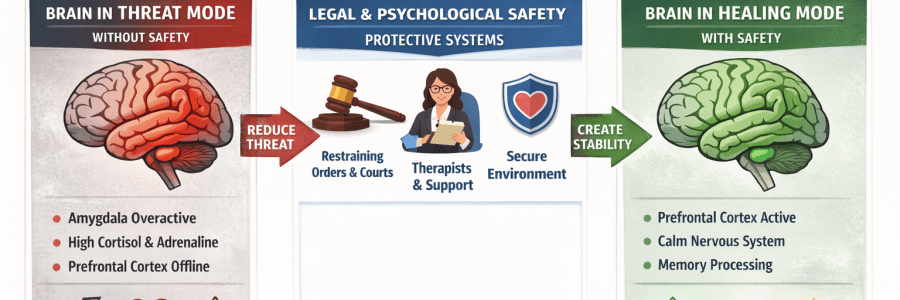
Trauma is not just psychological—it physically changes the brain and body. Key Brain Structures Involved Structure Role in Trauma Amygdala Detects threats; hyperactive in trauma → fear, hypervigilance, emotional reactivity Hippocampus Contextualizes memories; trauma can reduce volume → fragmented, intrusive memories Prefrontal Cortex (PFC) Executive function, emotional regulation; trauma → impaired top-down control Anterior Cingulate Cortex… Read More The Neurophysiology of Trauma

HRV Biofeedback Cheat Sheet for Self-Regulation

1. Tools You’ll Need Tool Purpose Tips Chest strap HR monitor (Polar H10, Wahoo, Garmin) Most accurate HRV measurement Comfortable, wear snug but not tight Smartwatch or ring (Apple Watch, Oura, Garmin) Convenient HRV tracking Best for daily trends, not precise metrics HRV Biofeedback app (Elite HRV, Inner Balance, HeartMath, Kubios) Real-time feedback & guided… Read More HRV Biofeedback Cheat Sheet for Self-Regulation

What Is Trauma‑Informed Care?

At its core, trauma‑informed care (TIC) means understanding how trauma affects a person’s brain, body, behaviour, and relationships — and using that understanding to shape how support is offered. Instead of asking: “What’s wrong with you?”A trauma‑informed approach asks:“What happened to you, and how can we help you feel safe?” This shift changes how people are seen,… Read More What Is Trauma‑Informed Care?