relatives of an abuser stalking your social media two years later—can be unsettling, confusing, and even feel threatening. Neuroscience and psychology give us some insight into why this might happen and what it does to your brain. Let’s break it down carefully.
1️⃣ Why this may be happening
Even after a relationship ends, especially an abusive one, some family members may remain hyper-focused on the dynamics. Neuroscience suggests several mechanisms:
a) Attention and salience
The human brain’s amygdala flags emotionally charged events as highly salient. Trauma or conflict “tags” your presence in their memory networks. Your social media posts are triggers—they reactivate neural circuits associated with the drama or conflict.
b) Reward / curiosity loops
The dopamine system can drive repetitive checking or stalking behaviors. Seeing updates about someone they perceive as “connected” to their relative’s past can create a rewarding sense of control or reassurance—even if it’s unhealthy.
c) Control and unresolved threat
Abusers’ families may have learned power and surveillance behaviors as a way to control others. Neuroscience research on the prefrontal cortex + amygdala interaction shows that when people feel threatened or frustrated, attention often narrows obsessively onto the perceived target. Even 2 years later, your social media is a safe, low-effort way to “monitor” outcomes.
2️⃣ What it does to your brain
Even if it’s distant or passive, knowing you’re being watched can trigger:
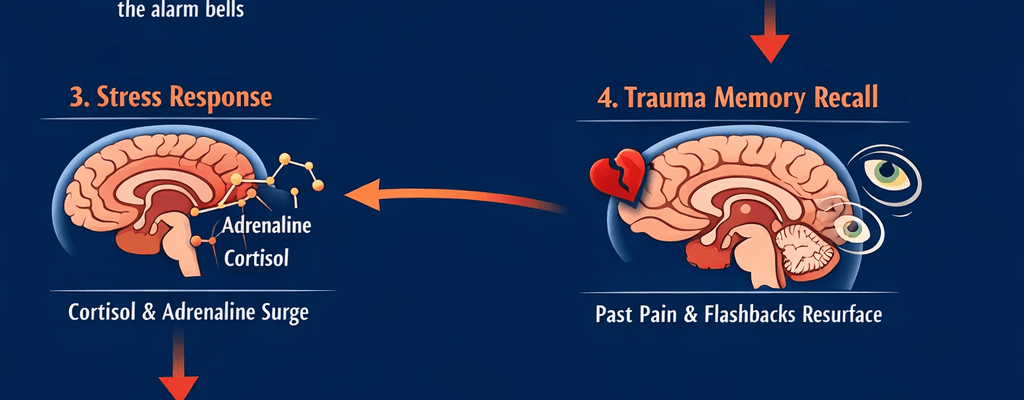
Hypervigilance Amygdala activation → alertness, anxiety, quick stress responses. Stress hormone release Cortisol spikes → insomnia, intrusive thoughts, irritability. Reactivation of trauma circuits Hippocampus + amygdala → memories of prior abuse may flash back unexpectedly. Heightened social cognition Prefrontal cortex tries to predict “what they’re thinking” → mental energy drains.
3️⃣ Why it can continue so long
Even years later, the brain does not forget emotional salience quickly:
Studies of trauma and social threat show that highly emotional events can leave persistent memory traces. Online social media feeds the brain constant updates, keeping these circuits “active.” Essentially, it’s a feedback loop: your posts → their attention → your awareness (if you notice) → stress → repeated activation.
4️⃣ What helps you regain control
From a neuroscience and safety perspective:
Boundaries online Limit what you post publicly Use block or restricted lists Consider private accounts or minimal posting Stress regulation Breathing, meditation, or grounding → downregulates amygdala activation Exercise → increases BDNF, supporting healthy prefrontal-amygdala balance Cognitive reframing Recognize this behavior is about them, not you Your prefrontal cortex can actively reduce rumination Therapeutic support Trauma-informed therapy → helps decouple stress responses from reminders of the abuser EMDR or CBT → specifically address lingering surveillance stress
⚡ Bottom line
Neuroscience says:
They are triggered by the emotional weight of the past, not by rational concern. Their behavior activates old threat circuits in your brain—even if you’re safe now. You can restore your calm and control by setting boundaries and regulating stress.
 Linda C J Turner | Trauma Therapist & Emotional Healing Specialist