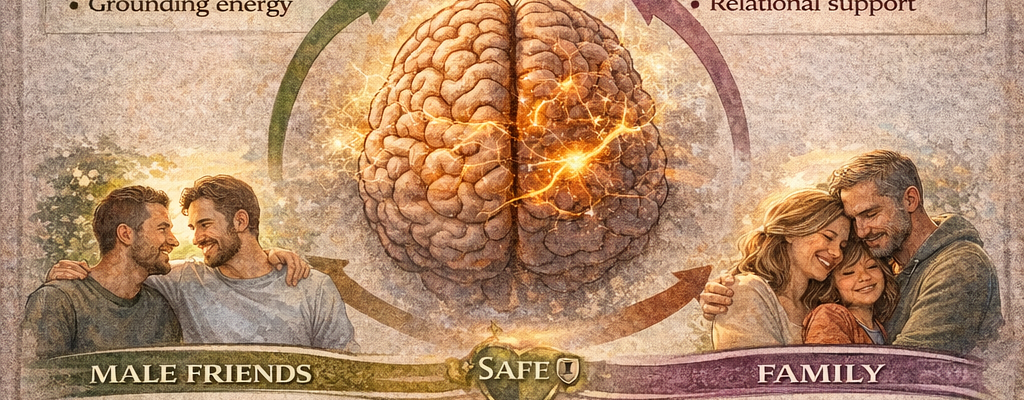
That sense of gratitude and support is incredibly powerful for healing, and both neuroscience and psychology show why having male and female friends along with family can make such a profound difference.
1. Social Support Reduces Stress
Neuroscience:
- Supportive relationships lower cortisol, the stress hormone elevated by trauma.
- They reduce amygdala hyperactivity, meaning your nervous system feels safer and calmer.
Psychology:
- Feeling supported validates your experience.
- It reduces feelings of isolation and helplessness, which are common after long-term abuse.
2. Different Perspectives Promote Emotional Balance
- Male friends may provide logical advice, protective energy, or perspective that feels grounding.
- Female friends may offer emotional attunement, empathy, and relational processing.
- Family provides continuity and a sense of belonging.
Psychologically, this diversity of social input helps survivors rebuild identity and trust in relationships, showing that not all interactions are harmful.
3. Oxytocin and Bonding
Neuroscience:
- Positive interactions with friends and family stimulate oxytocin, the “bonding hormone.”
- Oxytocin helps rebuild trust in others, counteracting trauma bonding from abusive relationships.
This also improves emotional regulation, making you feel safer expressing vulnerability.
4. Mirror Neurons and Emotional Healing
- Observing supportive, caring behaviour in friends and family activates mirror neurons, which helps your brain internalize safety and empathy.
- This strengthens new neural pathways for healthy attachment.
5. Gratitude and Neural Plasticity
- Feeling and expressing gratitude enhances the prefrontal cortex activity.
- This increases positive outlook, emotional regulation, and even resilience to stress.
In other words, being aware of your support network isn’t just emotionally uplifting—it rewires your brain for long-term healing.
💡 Key Insight:
Your social network acts as both a buffer and a bridge:
- Buffer: Reduces the physiological impact of past trauma (stress hormones, hyper-vigilance).
- Bridge: Helps your brain relearn trust, connection, and emotional safety.
 Linda C J Turner | Trauma Therapist & Emotional Healing Specialist