Life often has a way of revealing our past actions, whether through external recognition, legal consequences, social awareness, or internal psychological reckoning.
Whether someone has lied, cheated, stolen, or abused, the “law of averages” or karmic-like outcomes reflects a basic psychological and social reality: past behaviors leave traces that can resurface.
Neuroscience Perspective: How the Brain Processes Past Actions
- Memory and the Hippocampus
- The hippocampus stores episodic memory, meaning your past actions, choices, and consequences remain encoded.
- Even if you try to hide behavior, memories persist in others’ recollections and social networks, making detection likely.
- Amygdala and Emotional Consequences
- The amygdala reacts to threat and fear, including social judgment.
- When your past catches up, your amygdala activates stress and anxiety responses (fight/flight/freeze), signaling danger to your social standing or personal safety.
- Prefrontal Cortex: Planning & Reflection
- The prefrontal cortex is responsible for decision-making, moral reasoning, and behavioral regulation.
- Facing the consequences of past behavior activates reflective processing:
- “What can I do differently?”
- “How do I repair harm?”
- Reward System: Behavior Reinforcement
- Avoidance may provide short-term dopamine relief (escaping responsibility).
- Accountability and amends provide long-term reward through oxytocin, trust, and social reconnection.
Psychological Implications
- Cognitive Dissonance
- Evading consequences while knowing your past harms others creates internal conflict.
- This dissonance produces: guilt, shame, anxiety, or emotional numbness.
- Reputation and Social Psychology
- Humans are social animals. Social networks, cultural memory, and interpersonal trust mean past actions are rarely isolated.
- Betrayal, deceit, or abuse can resurface because someone eventually recognizes patterns or harm.
- Moral Development
- According to Kohlberg’s stages, avoiding consequences keeps someone at pre-conventional moral reasoning (self-interest).
- Making amends moves one toward post-conventional reasoning: ethical principles, justice, and long-term relational integrity.
- Trauma and Neural Pathways
- If past behaviors involved harming others, avoidance may temporarily reduce amygdala activation, but stress and guilt create long-term nervous system dysregulation.
- Facing truth or making amends restores nervous system regulation and allows healthier social engagement.
Two Broad Paths
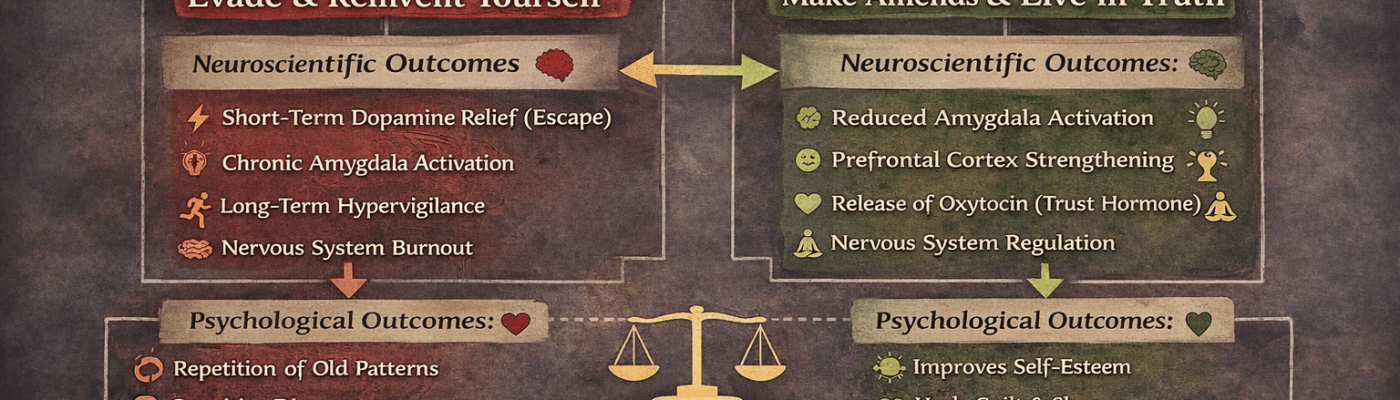
1. Evade & Reinvent
- Physically relocate or attempt social reinvention.
- Short-term relief may occur, but:
- Cognitive dissonance and anxiety persist
- Past patterns may repeat
- Social discovery eventually threatens stability
- The nervous system remains in hypervigilance, anticipating exposure.
2. Make Amends & Live in Truth
- Acknowledge past actions
- Repair harm wherever possible
- Commit to transparent, ethical living
Neuroscientific benefits:
- Reduces chronic stress and amygdala overactivation
- Strengthens prefrontal cortex regulation
- Releases oxytocin through prosocial acts
- Promotes emotional integration and post-traumatic growth
Psychological benefits:
- Reduced guilt and shame
- Improved self-esteem
- Healthier relationships
- Long-term trust with others
A Neuroscience-Grounded Insight
The brain and social system respond better to honesty than to deception.
Avoidance is temporary; integrity is durable.
- Avoidance = short-term safety, long-term stress
- Truth & amends = short-term discomfort, long-term freedom
Practical Steps Toward Accountability
- Self-Reflection
- Examine patterns and acknowledge harm caused.
- Nervous System Regulation
- Meditation, breathing, somatic work to manage fear and anxiety.
- Repair Where Possible
- Direct apologies, restitution, counseling, or reconciliation.
- Commit to Ethical Living
- Avoid repeating patterns
- Align actions with values
- Build trust slowly, sustainably
- Integration of Learning
- Forgive self for past ignorance or immaturity
- Grow conscious behavior patterns
Key Takeaway
Karma, consequences, or social recognition of the past are inevitable.
Neuroscience and psychology both show that facing reality and making amends produces far greater long-term mental, emotional, and relational health than avoidance.
The choice is clear: temporary evasion or lasting integrity.
 Linda C J Turner | Trauma Therapist & Emotional Healing Specialist