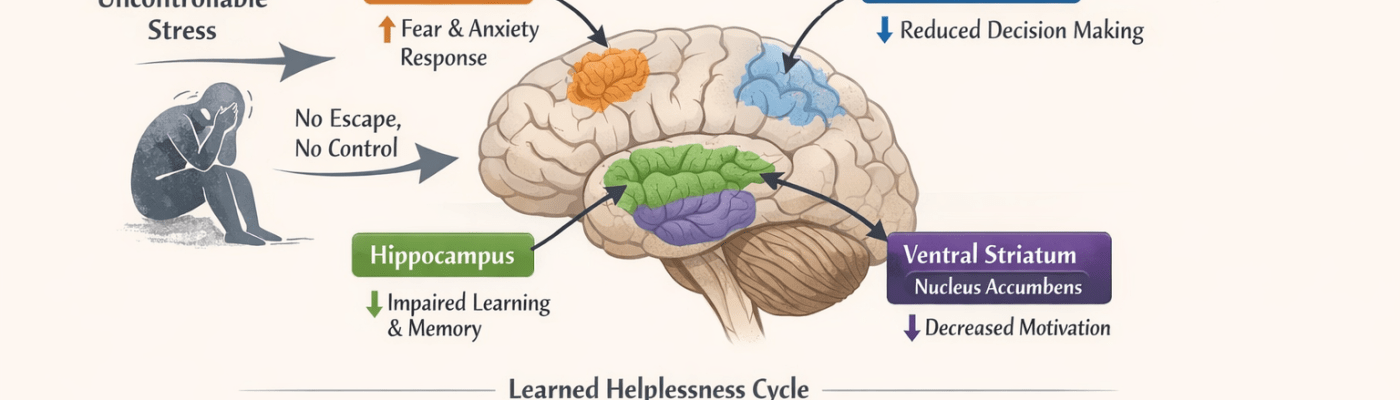
Imagine your brain learning a painful truth: no matter what you do, nothing changes. 😔 That’s learned helplessness, first identified by Martin Seligman and Steven Maier. It’s not laziness or weakness — it’s a neural adaptation to repeated uncontrollable stress.
Here’s what happens inside your brain:
- Amygdala 🔥: Overreacts to fear, signaling “danger everywhere!”
- Prefrontal Cortex (PFC) 🧩: Decision-making and problem-solving shut down
- Hippocampus 📚: Struggles to remember which situations are actually controllable
- Ventral Striatum / Nucleus Accumbens 🎯: Motivation and reward signals drop — literally the “why bother?” switch
The result? A cycle of inaction and hopelessness that reinforces itself. You feel trapped, powerless, and like trying is pointless — even when you can take control.
But here’s the good news: 🌱
The brain is plastic. Positive experiences, small wins, and regained control can retrain these pathways, restore motivation, and break the learned helplessness cycle.
Takeaway: Learned helplessness isn’t defeat — it’s a call to retrain your brain, reclaim agency, and rediscover that your actions do matter. 💛✨
 Linda C J Turner | Trauma Therapist & Emotional Healing Specialist