Inheritance Conflict Escalation Map
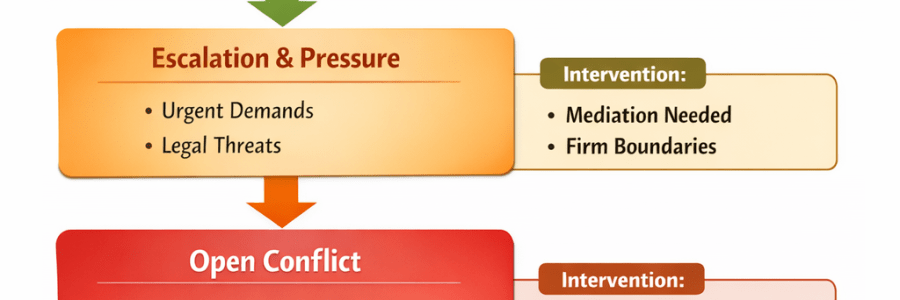
Stage 1: Awareness & Anxiety ↓ Stage 2: Strategic Maneuvering ↓ Stage 3: Escalation & Pressure ↓ Stage 4: Open Conflict ↓ Stage 5: Aftermath & Long-Term Impact 💡 Key Takeaways:
Stage 1: Awareness & Anxiety ↓ Stage 2: Strategic Maneuvering ↓ Stage 3: Escalation & Pressure ↓ Stage 4: Open Conflict ↓ Stage 5: Aftermath & Long-Term Impact 💡 Key Takeaways:

People become frantic, competitive, or even aggressive when they think an inheritance—or any significant reward—is slipping away. Psychologically, this taps into a few predictable human behaviors: These patterns are very common in family inheritance disputes. People literally “run and push” in figurative terms, sometimes even legally or financially, when they feel they might lose out.

Divide and conquer is a classic control strategy. Instead of facing the family as a united group, a manipulative person:→ Separates people→ Controls information→ Creates misunderstandings→ Fuels mistrust→ Turns relatives against each other So they can:Control the narrative.Control decisions.Control outcomes. 🎭 How It Looks in Real Life • Telling different people different stories• Sharing “concerns” selectively• Withholding information•… Read More What “Divide and Conquer” Means in Family Dynamics

This isn’t just emotional manipulation.This is neurological exploitation. As humans age, the brain naturally becomes more vulnerable to:– Cognitive fatigue– Memory decline– Reduced executive function– Increased emotional dependency– Heightened fear of abandonment– Slower decision-making– Greater suggestibility The prefrontal cortex (judgment, logic, reasoning) weakens.The amygdala (fear, threat, emotional processing) becomes more dominant. This creates the perfect neurological storm for coercive influence. Predators… Read More 🧬 The Neuroscience of Inheritance Manipulation — Brain Vulnerability & Exploitation

This isn’t family conflict.This is predatory psychology. Some people don’t love relatives.They study them. They assess:– Vulnerability– Loneliness– Fear of abandonment– Cognitive decline– Guilt– Dependency Then they position themselves as saviours. 🎭 The concerned relative is a performance.🎯 The inheritance is the target. They isolate.They control information.They discourage outside relationships.They create dependency.They rewrite history.They manage narratives.They gatekeep access. This is coercive… Read More 🧠 The Psychology of Inheritance Manipulation

Control the inheritance at all costs.Exclude other family members.Discourage relationships — daughters, sons, friends.Refuse copies of wills.Keep last wills and testaments “handled in-house” by in-laws (aka: outlaws).Isolate relatives from one another. Some people make a living out of inheritance manipulation.And they do it quietly, patiently, strategically. 🚩 Beware the “concerned relative.”They’re only concerned when money is involved. Nowhere to be seen… Read More 🚩 Beware the “concerned relative.”

(Especially in controlling or corrupt family systems) 1. Isolation of the vulnerable person One of the first moves is to isolate the dying or vulnerable person. This looks like: Why?Because isolation creates control and influence. No witnesses = no accountability. 2. Legal override & pressure tactics Families often: Especially when: This is coercive legal manipulation, not justice. 3. Undermining your… Read More Common Inheritance Manipulation Tactics
Financial abuse often develops gradually and is easy to miss while you are inside it. If several of the following are present, it is not miscommunication or poor money management—it is coercive control. Access & Control Information Withholding Restriction & Dependency Labour Without Security Fear, Compliance & Consequences Separation & Future Control Your Inner Signals If… Read More Financial Abuse Warning-Sign Checklist
Financial abuse is often invisible while it is happening. It hides behind marriage, duty, trust, and time. Many people assume it is about money mismanagement or selfishness. In reality, it is about control, dependency, and long-term deprivation. After three decades of marriage, I discovered that the plan was always to leave me with nothing. Alternative wills… Read More Financial Abuse: When Control Is the Plan From the Start

1. The relationship accelerates before trust is earned 2. Money enters the conversation early (even indirectly) 3. Urgency + emotion are used together 4. Boundaries are subtly punished 5. Promises don’t match patterns 6. The balance is one-sided Ask yourself: 7. Your body notices before your mind 🛡️ A Simple Test (Use Early) Try this once: “I… Read More Early Signs Someone Is Using You Financially
 Linda C J Turner | Trauma Therapist & Emotional Healing Specialist