The Core Move: Pre‑emptive Inversion

When someone says: “You have no filter”“You’re too harsh”“You’re aggressive” while they use foul language, character attacks, and accusations in private, they are doing something called: Defensive Attribution + Projection Neurologically, this is about threat detection, not communication. 1. Exposure Triggers the Threat Response When an abuser senses that: Their amygdala fires — not from fear of harm, but fear… Read More The Core Move: Pre‑emptive Inversion

Filters

Upbringing and character shape communication at a nervous-system level, not just a “personality” level. People don’t simply choose how they communicate — they default to what their brain learned was safe, effective, or rewardedearly in life. I’ll break this down clearly and then show how different upbringings produce different communication styles. 🧠 1. Early Environment Wires the Communication System A… Read More Filters

The Psychological Profile

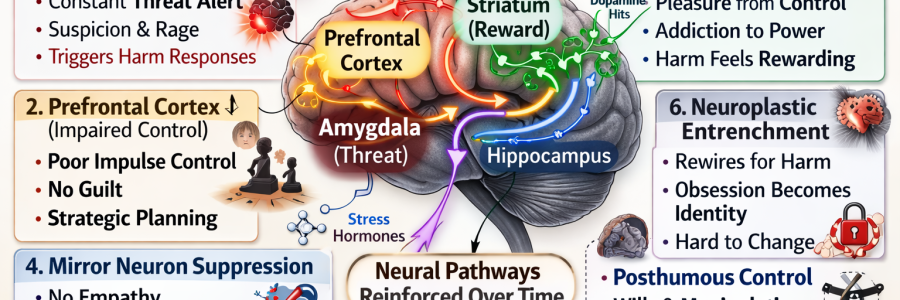
A man who bullies or abuses women and children but never confronts another man is showing selective aggression. That selectivity is the key. 1. Predatory Risk Assessment Abusers are not “out of control.”They are highly controlled when it matters to them. Psychology calls this instrumental aggression — violence used as a tool, not an emotional overflow. The Neuroscience Behind It 2. Amygdala + Prefrontal… Read More The Psychological Profile

“It Didn’t Take My Psychologist Long to See It”: The Neuroscience Behind Denial in Abusive Behaviour

It’s almost laughable how quickly a trained psychologist can see through someone like him.The patterns aren’t subtle. They’re predictable. They’re textbook.It’s not rocket science — unless you’re blind to it, or emotionally invested in the fantasy instead of the truth. But his denial?That’s where the neuroscience gets interesting. 1. Denial Isn’t Ignorance — It’s a Brain-Based Defense Mechanism… Read More “It Didn’t Take My Psychologist Long to See It”: The Neuroscience Behind Denial in Abusive Behaviour

When Someone Says One Thing Publicly and Does Another Privately: The Neuroscience Behind the Double Life

It’s astonishing how some people can present one story to their family — “I’m going to sell the house,” “I’m doing the right thing,” “Everything is fine” — while living a completely different reality behind closed doors.Nothing ever changes. The promises shift, the words get softer, but the behaviour stays the same. And when someone performs one role for… Read More When Someone Says One Thing Publicly and Does Another Privately: The Neuroscience Behind the Double Life

The Sunk Cost Trap

The sunk cost trap is a psychological pattern where you keep investing time, money, or emotion into something because you’ve already invested, even when all signs show it’s not good for you anymore. It’s one of the biggest reasons people stay in bad relationships, toxic friendships, or financially exploitative situations. 🔍 Simple Definition “I’ve already put so much in… I can’t… Read More The Sunk Cost Trap

Freedom After Decades of Abuse: The Neuroscience of Choice and Self-Determination

IntroductionSurvivors of long-term abuse often experience a profound psychological weight. Decades of emotional, physical, or relational trauma can shape not only beliefs and behaviors but also neural architecture. Emerging from such a context into a space of autonomy—symbolized here by “having no ring on your finger”—can trigger complex emotional, cognitive, and neurobiological responses. Psychological Perspective… Read More Freedom After Decades of Abuse: The Neuroscience of Choice and Self-Determination