🧠 Maintaining Your Lifestyle Without Compromising Your Self-Worth

The Psychology of Standards, Identity, and Financial Control There’s a profound difference between being spoilt and being cultured in quality.Some of us were raised to appreciate the finer things — not as excess, but as expressions of care, beauty, and dignity. When you grow up with standards, you’re not demanding; you’re maintaining a learned sense of what feels… Read More 🧠 Maintaining Your Lifestyle Without Compromising Your Self-Worth

Tactical Guide: Presenting a Psychologist’s Report in Court

1️⃣ Structure the Report Clearly Tip: Number each section and use headings — judges and lawyers appreciate clear navigation. 2️⃣ Focus on Objectivity 3️⃣ Evidence Points to Include Tip: Courts value multiple sources of evidence that reinforce the psychologist’s conclusions. 4️⃣ Anticipate Challenges 5️⃣ Presentation in Court 6️⃣ Protective Measures 7️⃣ Recommended Phrasing Techniques ✅ Key Takeaway: The strongest report is neutral,… Read More Tactical Guide: Presenting a Psychologist’s Report in Court

Friendship

Friendship, in its broadest sense, is a voluntary, reciprocal relationship based on trust, affection, shared interests, and mutual support. When we consider friendship between a man and a woman, both neuroscience and psychology provide insights into its nature, dynamics, and unique aspects. Let’s break it down carefully. 1. Psychological Perspective Core elements of friendship: Unique aspects… Read More Friendship

🌿 One Year of Growth: The Neuroscience of Becoming Yourself Again

One year can change everything. Over the past twelve months, I’ve learned more about myself than in a lifetime. I’ve discovered strength I didn’t know I had — not the kind that hides behind a smile, but the quiet resilience that grows from truth, healing, and self-compassion. For years, I was the crutch for others,… Read More 🌿 One Year of Growth: The Neuroscience of Becoming Yourself Again

“One year of your life can make so much difference.”

🧠 The Neuroscience and Psychology of One Year of Growth “One year of your life can make so much difference.”When you consciously choose healing, your brain’s neuroplasticity — its ability to rewire — begins to reshape how you think, feel, and relate. Every moment of self-reflection builds new neural connections for insight and self-compassion. 1. Self-Awareness: Seeing Yourself from… Read More “One year of your life can make so much difference.”

🧠 1. The neuroscience of denial: fear and self-protection

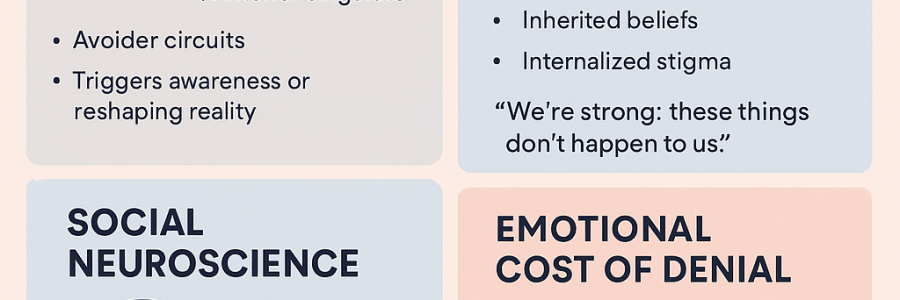
Denial is not just psychological — it’s neurobiological.When the brain encounters something threatening to identity, reputation, or emotional safety, the amygdala (fear center) and anterior cingulate cortex (conflict detector) activate.This triggers avoidance circuits — the brain unconsciously blocks awareness or reshapes reality to reduce emotional pain. In other words: “If I don’t admit it, I don’t have to feel it.” The brain… Read More 🧠 1. The neuroscience of denial: fear and self-protection

🧠 1. What happens in the brain (neuroscience perspective)

Antipsychotic medication (used for conditions like schizophrenia, schizoaffective disorder, or severe bipolar disorder) works by regulating dopamine and sometimes serotonin activity in key brain circuits — especially those involving: When you’ve been on these medications for years, your brain adapts to their presence: So, if someone suddenly stops taking the medication, the brain’s chemistry rebounds — dopamine activity can spike unpredictably.This “dopamine… Read More 🧠 1. What happens in the brain (neuroscience perspective)

“The Look That Never Lied: The Psychology of Hatred and Survival”

You can see the pattern in every picture — birthdays, holidays, celebrations.The smiles around you are bright, the music is playing, yet beside you is that same expression: a cold, hostile glare that never softens.Even on his own birthday, surrounded by friends, the cake lit and the room full of warmth, his eyes stayed fixed… Read More “The Look That Never Lied: The Psychology of Hatred and Survival”

Moral Equilibrium and the Brain: Regret, Empathy, and Compassion

Moral equilibrium is the inner drive to restore balance when someone feels that actions or decisions have violated their own or societal moral standards. It’s the part of us that says, “I wish I had acted differently.” Psychological Perspective From a psychological standpoint, people often experience moral regret when they recognize that an opportunity to act with empathy… Read More Moral Equilibrium and the Brain: Regret, Empathy, and Compassion

When Intimidation Stops Working: The Neuroscience of Calm Power

When fear, threats, and insults stop working — when the person who once scared you realizes you’re no longer shaken — something powerful has shifted.Not in them, but in you. They will throw everything they can: intimidation, legal threats, emotional manipulation, guilt trips, character attacks. But when your nervous system no longer reacts the way it used… Read More When Intimidation Stops Working: The Neuroscience of Calm Power