The Stages Before Leaving (What Actually Happens)
1. Idealisation & Bond Formation What it looks like What’s happening internally Key trap “This feels special — I’ve never had this before.” 2. First Boundary Breaches (Minimised) What it looks like Internal response Why she doesn’t leave 3. Cognitive Dissonance Phase What it looks like Internal split Neuroscience This is not denial — it’s the brain seeking stability. 4. Self-Erosion… Read More The Stages Before Leaving (What Actually Happens)

Why some personalities trigger trauma bonds (and others don’t)

Trauma bonds form when attachment + threat + intermittent relief get wired together.Some personalities reliably create that wiring. 1. The Hot–Cold / Inconsistent personality 🔥❄️ Traits Why it bondsYour nervous system learns: Connection is unstable — I must work for it. Uncertainty spikes dopamine.Withdrawal spikes cortisol.Relief feels euphoric. This is textbook intermittent reinforcement — the strongest conditioning pattern the brain knows. ResultYou don’t… Read More Why some personalities trigger trauma bonds (and others don’t)

The overlap: why trauma bonds and healthy attachment both create loops

At the surface, both can look like: That’s because both activate attachment circuitry and unfinished emotional processing. But what’s driving the loop is very different. Trauma bonding + Zeigarnik loops 🔥 (the sticky kind) What creates it Trauma bonds form through: Your nervous system learns: Relief = safety. So when the person disappears, the brain: This is dopamine +… Read More The overlap: why trauma bonds and healthy attachment both create loops

Behind the Mask: Why Abusers Misread Social Support and How Communities Respond

Abusers often live under the illusion that they are admired, untouchable, or in control. They misread silence as acceptance, compliance as respect, and avoidance as fear-based loyalty. But the reality is far more nuanced. In almost every social environment — from small towns and cliques to workplaces and extended family networks — people notice patterns… Read More Behind the Mask: Why Abusers Misread Social Support and How Communities Respond

Self-Assessment: Am I in a Healthy or Abusive Relationship?

Read each statement and answer honestly with Yes / Sometimes / No.There are no right or wrong answers — only information. Emotional Safety Respect & Equality Boundaries Trust & Honesty Control & Autonomy Accountability Impact on You Reflection Quiet Interpretation (Not a Diagnosis) A healthy relationship adds to your life.An abusive one requires you to shrink… Read More Self-Assessment: Am I in a Healthy or Abusive Relationship?

Why Some Men Seek Vulnerable Women to Exploit

Certain men intentionally target women who: Motivation 🧠 Neurological reinforcement: Their brain associates your compliance + trust → reward (control, pleasure, gain), strengthening the pattern over time. 2️⃣ The Trust Cycle That Leads to Nervous System Reset Here’s how the danger unfolds: The nervous system is saying: “This is unsafe; reset and protect.” 3️⃣ How to Slow It Down… Read More Why Some Men Seek Vulnerable Women to Exploit

Trusting or Being Intimate Too Soon

When you allow trust or intimacy to build faster than the other person proves reliability, your nervous system is essentially “rewiring” based on incomplete data. Consequences: The system has learned: “Connection + danger = chaos.” Rushing rewards can trigger old survival responses. 2️⃣ When They Don’t Answer Your Questions or Are Evasive Evasion signals that they may be protecting themselves… Read More Trusting or Being Intimate Too Soon

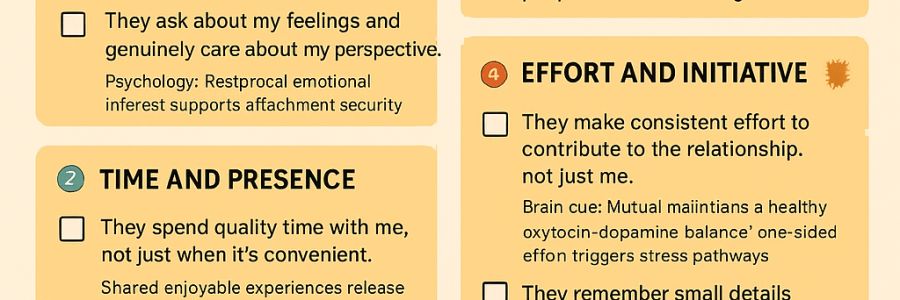
1️⃣ Visual “Road to Safety in New Relationships”

Think of this as a stepwise journey, showing how trust, boundaries, and emotional reward rebuild over time: 2️⃣ Specific Exercises to Test Trust Safely Exercise Purpose How to Apply Safely Low-Stakes Requests Test reliability Ask for small favors or follow-throughs; observe consistency Boundary Enforcement Drill Test respect for limits Say “I need space” or “I’m not… Read More 1️⃣ Visual “Road to Safety in New Relationships”