What Safe Disengagement Actually Looks Like
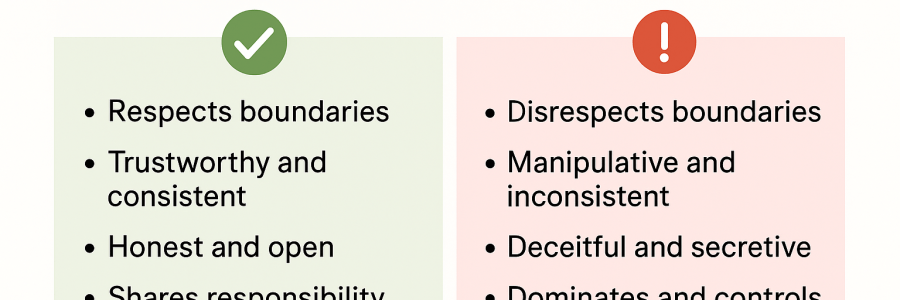
Safe disengagement means leaving or detaching in a way that does not provoke escalation. It is quiet, strategic, and protective — not dramatic or confrontational. 🧭 First: Shift the Goal The goal is safety, not clarity.You do not need: Seeking those often increases danger. 🔇 1. Reduce Emotional Access (Before Physical Distance) This is sometimes called “grey rock” — becoming uninteresting… Read More What Safe Disengagement Actually Looks Like
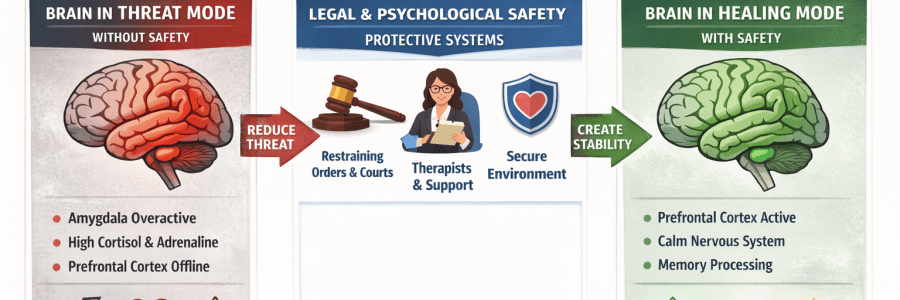
Assessing Risk vs Denial: A Grounded Reality Check

Use this when you’re doubting yourself, being pressured to “calm down,” or told you’re overreacting. 🔍 Step 1: Look at Behaviours, Not Stories Risk is revealed by patterns, not explanations. High-risk indicators: If these exist, risk is real, regardless of apologies or promises. 🧠 Step 2: Check for Denial Signals Denial often sounds like: Denial focuses on comfort, not… Read More Assessing Risk vs Denial: A Grounded Reality Check

Effective Therapeutic Approaches

1. Trauma-Focused Therapy 2. Medical and Neuropsychological Support 3. Psychosocial Support 🔒 Safety Planning After Strangulation Safety planning is essential — survivors are at high risk of escalation or repeat abuse. Immediate Safety Steps Ongoing Risk Reduction Professional Coordination ⚠️ Key Takeaways

Statistics & Prevalence

Here’s a clear, evidence-based overview of what research shows about non-fatal strangulation — including how common it is, how it affects survivors physically and psychologically, and what we know about how it impacts the person doing the strangulation (to the extent research addresses that). This is grounded in scientific literature and public health data. 📊 Statistics & Prevalence Non-fatal strangulation (NFS) is recognised… Read More Statistics & Prevalence

Talking About Strangulation in Therapy: Why It’s So Hard — and How EMDR Can Help

Talking about strangulation in therapy is not just “talking about a memory.”For many survivors, describing the sensations, fear, and loss of control can reactivate the trauma itself. This is not resistance.It is how the nervous system remembers danger. Why Describing It Feels Overwhelming Strangulation is a primal threat to survival. When it happened, the brain and body… Read More Talking About Strangulation in Therapy: Why It’s So Hard — and How EMDR Can Help

How Other People’s Agendas Can Distort Separation and Divorce Decisions

During separation and divorce, one of the most important — and most difficult — boundaries to hold is this: Do not allow siblings, children, extended family, or friends to sway your decisions simply because they are close to you. Not everyone involved has your best interests at heart — even when they believe they do.… Read More How Other People’s Agendas Can Distort Separation and Divorce Decisions

The core principle

Therapy is for truth.Law is for proof.Public statements are for boundaries. You do not owe full truth to every arena. 1. What to keep THERAPEUTIC ONLY  These are essential for healing but usually not necessary or wise to share publicly or legally. Keep in therapy: 📌 Why: ✔️ You can show the messages to your psychologist❌ You don’t need to turn your pain into… Read More The core principle

ENTITLEMENT vs ATTRACTION CHEMISTRY (Early-Stage Comparison)

INITIAL FEEL Entitlement Attraction Chemistry PACE Entitlement Attraction Chemistry RESPONSE TO YOUR BOUNDARIES Entitlement Attraction Chemistry ATTENTION STYLE Entitlement Attraction Chemistry EMOTIONAL DIRECTION Entitlement Attraction Chemistry LANGUAGE CLUES Entitlement Attraction Chemistry NERVOUS SYSTEM SIGNALS (YOURS) Entitlement Attraction Chemistry HOW IT EVOLVES OVER TIME Entitlement Attraction Chemistry The single most reliable tell Attraction enjoys you.Entitlement needs… Read More ENTITLEMENT vs ATTRACTION CHEMISTRY (Early-Stage Comparison)

Entitlement isn’t confidence gone wrong

Entitlement isn’t confidence gone wrong — it’s powerlessness wrapped in dominance strategies. Here’s what’s happening under the hood, clinically and neurologically. 1. Core wound: unstable self-worth (developmental layer) Early experiences of: can leave the brain with a fragile self-model: “I’m not inherently secure or valued.” This lives largely in implicit memory (right hemisphere, limbic system), not conscious thought. So the… Read More Entitlement isn’t confidence gone wrong

Why “aggressive” sticks (the conditioning layer)

For many women — especially thoughtful, capable, emotionally intelligent ones — the word aggressive is wired early as a danger signal, not a descriptor. 1. Early social conditioning (pre-verbal + verbal) From childhood, many girls learn — implicitly or explicitly: So the nervous system learns: Belonging = self-containment When “aggressive” is used later, it doesn’t land as feedback.It… Read More Why “aggressive” sticks (the conditioning layer)