How to spot emotional deadness early
(while staying regulated) First: the mindset shift (this prevents hypervigilance) You are not looking for red flags.You are noticing patterns of aliveness over time. Deadness isn’t danger — it’s absence.Absence reveals itself slowly and consistently. 1. What to watch (externally) vs what to feel (internally) Watch (neutral observation) Feel (your body’s data) Rule:Trust trend, not moment. 2. Early indicators… Read More How to spot emotional deadness early

Why the morning safety + dog + clarity moment matters

1. Your nervous system is no longer co-regulating someone else When you wake now: Your system wakes to itself, not to monitoring another adult. That’s why the thought arrives unforced. Clarity doesn’t come from analysis — it comes from absence of threat. 2. The dog is a real-time polyvagal regulator This isn’t poetic — it’s biology. A calm dog beside… Read More Why the morning safety + dog + clarity moment matters

Why emotionally dead partners are drawn to vibrant ones

This pattern is so common that once you see it, you can’t unsee it. And it’s not romantic fate — it’s nervous systems and attachment dynamics doing exactly what they’re wired to do. Here’s the clean, unsentimental explanation. Why emotionally dead partners are drawn to vibrant ones 1. Borrowed aliveness (nervous-system outsourcing) An emotionally dead person often has low… Read More Why emotionally dead partners are drawn to vibrant ones

Emotional Deadness vs Covert Emotional Neglect

(Internal state → Relational experience) 1. Core state Emotional deadnessA chronically under-activated emotional system. Feelings are dulled, muted, or inaccessible. Covert emotional neglectYour emotional needs are consistently unmet — not through cruelty, but through absence. 2. What it looks like day to day Emotional deadness Covert emotional neglect 3. Nervous system pattern Emotional deadness Covert emotional… Read More Emotional Deadness vs Covert Emotional Neglect

Miserable

Waking up safe, regulated, dog beside you — that’s your nervous system finally exhaling. That detail matters more than it looks. 🐾What you’re noticing now isn’t revisionist history. It’s pattern recognition coming online once your brain is no longer in survival mode. 1. Chronic emotional flatness = nervous system shutdown From a neuroscience perspective, your ex sounds… Read More Miserable

How to Pace Connection Safely (When Kindness Feels Big)

When kindness feels intense, the instinct is often to lean in quickly — to attach, explain, disclose, or merge. That urge makes sense after deprivation. But pacing is what turns safety into something sustainable. Pacing does not mean pulling away.It means letting connection unfold at a speed your nervous system can actually integrate. Here’s how… Read More How to Pace Connection Safely (When Kindness Feels Big)

If You Feel Embarrassed by Crying When Someone Is Kind

If you cry when someone shows you kindness and then feel embarrassed — please hear this clearly: There is nothing wrong with you. Those tears are not immaturity, instability, or weakness. They are a nervous system response to safety after deprivation. Many people who grew up with neglect or lived through long-term emotional abuse learned… Read More If You Feel Embarrassed by Crying When Someone Is Kind

Why Kindness Feels Intense After Neglect

If kindness feels overwhelming after neglect, there is nothing wrong with you. Long-term emotional neglect or abuse changes the nervous system. You adapt by lowering expectations, minimising needs, and staying alert for withdrawal or punishment. Your body learns that connection is fragile and conditional. So when someone offers genuine care — listening, warmth, follow-through, softness… Read More Why Kindness Feels Intense After Neglect

“A Fresh Start” Does Not Stop an Abuser — It Just Resets the Stage

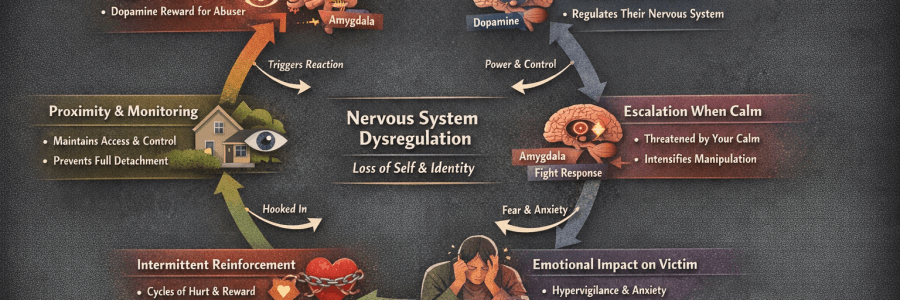
When an abuser suggests “making a fresh start” — moving house, changing country, starting again — it is often presented as hope, healing, or renewal. But a fresh location does not erase abusive behaviour. Abuse is not caused by the place.It is caused by the person. Why “Fresh Starts” Are So Appealing To outsiders — and often to survivors… Read More “A Fresh Start” Does Not Stop an Abuser — It Just Resets the Stage

Safe Disengagement When ASPD-Type Dynamics Are Present

When antisocial traits are involved, disengagement is not relational — it is operational.You are not leaving a mutual bond; you are exiting a system where you were an asset. 🧭 Core Shift (This Is Non-Negotiable) You are not dealing with misunderstanding — you are dealing with entitlement. There is no insight coming.There is no repair coming.There is no shared… Read More Safe Disengagement When ASPD-Type Dynamics Are Present