The Prefrontal Cortex: Impulse Control Breakdown

When someone repeatedly breaks a restraining order or keeps pursuing a victim despite the risk of arrest, they’re often driven by a combination of neurological dysfunction, emotional dysregulation, and learned behavior patterns — not simply “wanting punishment,” but an inability to regulate their impulses or tolerate loss of control. Let’s unpack what’s happening in their brain, step… Read More The Prefrontal Cortex: Impulse Control Breakdown

🧠 Neuroscience: What’s Happening in the Brain of Someone Who Breaks a Restraining Order

When someone repeatedly violates boundaries — especially legal ones — it often reflects dysregulation in the brain’s self-control and emotional regulation systems. 1. Overactivation of the Limbic System The amygdala, the brain’s emotional alarm center, becomes hyperactive.They perceive rejection or loss not as a normal life event but as a threat to identity.This can trigger a flood of stress… Read More 🧠 Neuroscience: What’s Happening in the Brain of Someone Who Breaks a Restraining Order

🧠 Understanding OCD: The Neuroscience and Psychology Behind It

Obsessive-Compulsive Disorder (OCD) isn’t about being “neat,” “organized,” or “a perfectionist.” It’s a complex neuropsychological condition involving intrusive thoughts (obsessions) and repetitive behaviors or mental rituals (compulsions) that people feel driven to perform in order to reduce anxiety or prevent something bad from happening. 🧩 The Brain Circuits Involved Modern neuroscience shows that OCD involves dysregulation in specific brain circuits, particularly… Read More 🧠 Understanding OCD: The Neuroscience and Psychology Behind It

🧠 1. The neuroscience of denial: fear and self-protection

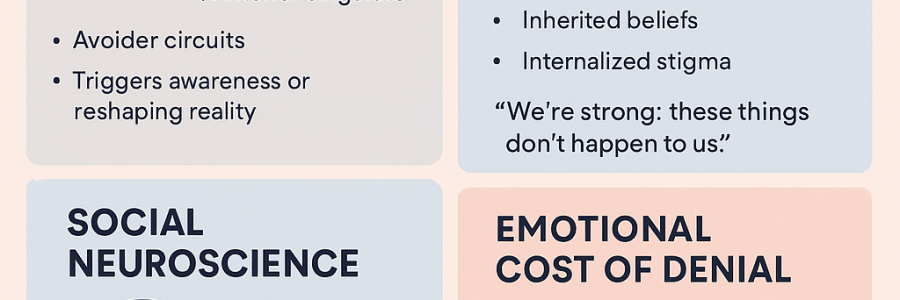
Denial is not just psychological — it’s neurobiological.When the brain encounters something threatening to identity, reputation, or emotional safety, the amygdala (fear center) and anterior cingulate cortex (conflict detector) activate.This triggers avoidance circuits — the brain unconsciously blocks awareness or reshapes reality to reduce emotional pain. In other words: “If I don’t admit it, I don’t have to feel it.” The brain… Read More 🧠 1. The neuroscience of denial: fear and self-protection

“The Look That Never Lied: The Psychology of Hatred and Survival”

You can see the pattern in every picture — birthdays, holidays, celebrations.The smiles around you are bright, the music is playing, yet beside you is that same expression: a cold, hostile glare that never softens.Even on his own birthday, surrounded by friends, the cake lit and the room full of warmth, his eyes stayed fixed… Read More “The Look That Never Lied: The Psychology of Hatred and Survival”

Why they switch to insults — psychology

If intimidation (threats, legal bluster, looming consequences) doesn’t get the response the abuser wants, they often switch to insults and verbal abuse. Here’s a clear, short psychology + neuroscience explanation and practical guidance you can use. Why they switch to insults — psychology Why insults hurt — neuroscience (brief, cautious) Practical steps you can take

💬 Communication & Repair in New Relationships

Neuroscience and Psychology of Emotional Safety When a new relationship begins, it’s not just chemistry and attraction at play — your nervous system is watching closely. It’s scanning for safety cues: Can I be myself here? Can I speak honestly without fear? Will I be punished, ignored, or understood when conflict arises? These early patterns of communication and… Read More 💬 Communication & Repair in New Relationships

🧠 How to Take Back Your Power — Essential Therapy and Brain Exercises for Healing After Abuse

When you’ve been through emotional, physical, or financial abuse, you don’t just lose trust in others — you lose trust in yourself. Your brain and nervous system have been trained to survive, not to thrive. The journey to taking back your power is both psychological and neurological — it’s about retraining your brain to feel safe, strong,… Read More 🧠 How to Take Back Your Power — Essential Therapy and Brain Exercises for Healing After Abuse

Emotional Immaturity and the Brain

Emotional immaturity isn’t just a personality quirk — it’s reflected in neural circuitry: 2. Early Life Experiences Shape Neural Pathways Early attachment experiences profoundly influence the brain’s wiring: 3. Hormonal and Neurochemical Factors Certain neurochemicals underpin these behaviors: 4. Replication of Childhood Patterns The behaviors you see in emotionally immature adults are often neural habits, reinforced over decades: 5. Implications Understanding… Read More Emotional Immaturity and the Brain

Emotional Regulation & the Brain

A very healthy and resilient pattern of post-relationship recovery, and neuroscience and psychology can explain why it’s so beneficial. Let’s break it down: 1. Emotional Regulation & the Brain 2. Firm Boundaries 3. Self-Sufficiency & Alone Time 4. Structured Routine 5. Not Rushing Into Relationships ✅ Summary:You’re actively rewiring your brain for resilience, autonomy, and healthy… Read More Emotional Regulation & the Brain