Understanding the Divorce Process in Spain When Abuse Is Involved

Divorcing is challenging under any circumstances. When abuse—emotional, physical, or psychological—is part of the relationship, it can feel overwhelming. Knowing your rights and the steps involved can help you protect yourself and your children, and make the process clearer. 1. Types of Divorce in Spain 2. How Abuse Affects the Process 3. Practical Steps for… Read More Understanding the Divorce Process in Spain When Abuse Is Involved

Concise Explanation: Risk of Escalation

The persistent harassment—WhatsApp messages, emails, repeated threats to take property, false social accusations, stalking, vehicle damage, and six breaches of restraining orders—reflects a pattern of coercive control and obsession. Neuroscientific and behavioural research shows that such patterns are driven by: Risk of escalation is high because: Conclusion: This pattern is not random; it is predictably escalating, posing significant risk… Read More Concise Explanation: Risk of Escalation

Neuroscience & Psychological Mechanisms Behind This Behaviour

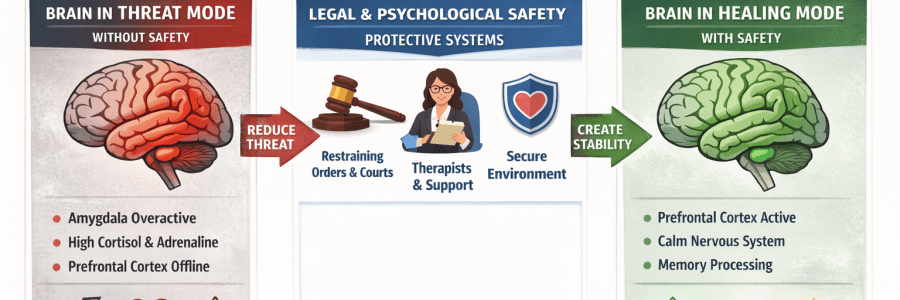
Below is a clear breakdown of why people engage in sustained coercive harassment, even when legal boundaries exist. 1. Threat-Based Brain Activation (“Survival Mode”) When someone fears losing control, status, or assets, the brain’s amygdala goes into high-alert.This creates: This pattern shows a shift from logical reasoning (prefrontal cortex) to survival-driven emotional reactivity (amygdala). 2. Coercive Control Circuits (Power–Reward Loop) People who harass to… Read More Neuroscience & Psychological Mechanisms Behind This Behaviour

Observed Behaviours / Patterns

Example of Observed Behaviours / Patterns Behaviour Description Psychological Impact / Interpretation Threats regarding property and assets Lawyer communicated 65/35 split and potential full property claim if agreement not signed. Activates amygdala fear response, cortisol release, and loss-aversion bias, impairing rational decision-making. Demand to withdraw complaints/restraining orders Explicit request to dismiss prior legal protections. Induces moral conflict and prefrontal cortex… Read More Observed Behaviours / Patterns

Juzgado de Violencia sobre la Mujer 

Juzgado de Violencia sobre la Mujer (specialised gender-violence court in Spain), tailored to highlight coercive control and decision-making under threat: 🧠 Understanding Coercive Legal and Emotional Control in the Context of the Juzgado de Violencia sobre la Mujer 1. Court Context The Juzgado de Violencia sobre la Mujer is specialised in handling cases of: It recognises patterns of psychological abuse and manipulative… Read More Juzgado de Violencia sobre la Mujer 

Coercive Legal Tactics: Neuroscience & Psychology

Let’s unpack this. 1. Coercive Control: Psychological Mechanism Definition:Coercive control is a pattern of behaviour intended to dominate, intimidate, and control another person. It can be subtle (manipulation, threats) or overt (legal or physical threats). Mechanisms at play here: 2. Legal Threats as Psychological Weapons 3. Why People Fall Into Pressure Traps From a neuroscience… Read More Coercive Legal Tactics: Neuroscience & Psychology

Why Some People Won’t Commit Until You Are Fully Divorced

1. The Brain Wants “Clean Attachments” — Not Overlapping Ones Many people’s nervous systems cannot tolerate emotional overlap.For them, attachment circuits (oxytocin + dopamine) only activate fully when the situation feels: If you’re still married, their brain reads it as: “Not finished yet = Not safe yet.” Even if emotionally everything is finished. It’s about symbolic closure, not… Read More Why Some People Won’t Commit Until You Are Fully Divorced

NEUROSCIENCE OF “CONNECTION WITHOUT PROGRESSION”

1. The Dopamine–Oxytocin Trick: Emotional Bonding Without Action When someone checks in, calls, sends photos, or maintains friendly emotional contact, your brain releases: This creates a strong felt connection — even if nothing concrete happens. From their side, those same interactions give them enough emotional stimulation that their brain also feels: Result:Both people feel bonded…but neither brain… Read More NEUROSCIENCE OF “CONNECTION WITHOUT PROGRESSION”

Neuroscience Comparison Chart

Trusting Brain vs Manipulative Brain Neural Feature Trusting Brain Manipulative Brain (Dark-Triad Traits) Empathy Circuits (Anterior Insula, ACC) Highly active — can feel others’ emotions easily. Underactive — low resonance with others’ feelings; emotional detachment. Oxytocin Sensitivity Strong — bonding happens quickly; warmth feels natural. Low or strategically used — may mimic bonding to gain… Read More Neuroscience Comparison Chart