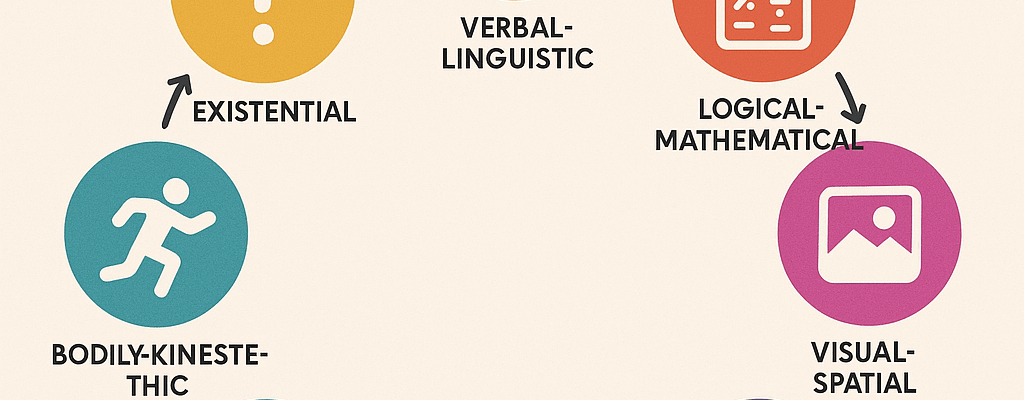
Howard Gardner introduced the Theory of Multiple Intelligences in his 1983 book Frames of Mind: The Theory of Multiple Intelligences. He proposed that intelligence is not a single entity but a collection of different cognitive abilities. Below are the nine types of intelligence he identified:
- Existential Intelligence – Sometimes called moral or spiritual intelligence, this type is characteristic of deep thinkers who question the nature of existence, life, and death. It involves a heightened awareness of the bigger picture and a natural curiosity about our purpose in the world.
- Interpersonal Intelligence – This revolves around strong social skills and the ability to connect with others. People with high interpersonal intelligence communicate effectively, interpret body language, and build strong relationships. They understand emotions, moods, and behaviors, making them excellent communicators and mediators.
- Intrapersonal Intelligence – The ability to deeply understand oneself, including emotions, thoughts, and motivations. This intelligence involves self-awareness and emotional insight, leading to a strong sense of personal identity and empathy for others.
- Kinaesthetic Intelligence – Also known as bodily intelligence, this refers to the ability to control body movements with precision and skill. Athletes, dancers, and craftspeople often have a high level of kinaesthetic intelligence, as they naturally manipulate objects and move with coordination and grace.
- Linguistic Intelligence – The talent for language, words, and communication. This includes a love for writing, reading, storytelling, and verbal expression. Those with high linguistic intelligence often make excellent writers, speakers, and poets.
- Logical-Mathematical Intelligence – More than just number skills, this intelligence type is about recognizing patterns, solving problems, and thinking logically. It plays a role in everything from mathematics and science to decision-making and strategic thinking.
- Musical Intelligence – The ability to understand, appreciate, and create music. People with this intelligence are highly attuned to sounds, rhythms, and tones, often displaying a natural inclination for playing instruments, composing, or simply tapping along to a beat.
- Naturalist Intelligence – A deep connection with nature and the ability to distinguish between different elements of the natural world. Historically useful for survival, this intelligence is now seen in those who are skilled in gardening, farming, and environmental sciences. It also plays a role in recognizing and categorizing objects in everyday life.
- Spatial Intelligence – The ability to visualize and manipulate images in the mind. This intelligence is strong in artists, architects, designers, and engineers who excel in working with visual patterns, perspectives, and creative problem-solving.
Each type of intelligence plays a role in how we understand and interact with the world. While some may be more dominant in certain individuals, intelligence is fluid and can be developed with time and experience.
 Linda C J Turner | Trauma Therapist & Emotional Healing Specialist