Body and mind are often in a chronic survival state

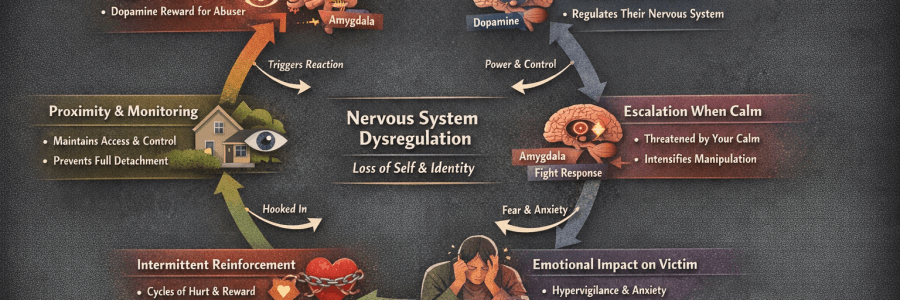
After decades of abuse, the body and mind are often in a chronic survival state, even long after the relationship ends. This isn’t a flaw — it’s the nervous system doing exactly what it was built to do: protect you from ongoing threat. Understanding this helps identify which situations to avoid while rebuilding safety and autonomy. 1.… Read More Body and mind are often in a chronic survival state

The Exact Internal Moment When Strength Reclaims Itself

This is often subtle and gradual, not dramatic. Neuroscience + psychology line up here: Signal What’s Happening Internally Outcome Sudden clarity Prefrontal cortex takes control over amygdala-driven fear loops Realisation: I don’t have to negotiate my worth anymore Shift from hope to self-interest Dopamine cravings from intermittent reinforcement fade Attachment energy is redirected internally Internal boundary… Read More The Exact Internal Moment When Strength Reclaims Itself

The Stages Before Leaving (What Actually Happens)

1. Idealisation & Bond Formation What it looks like What’s happening internally Key trap “This feels special — I’ve never had this before.” 2. First Boundary Breaches (Minimised) What it looks like Internal response Why she doesn’t leave 3. Cognitive Dissonance Phase What it looks like Internal split Neuroscience This is not denial — it’s the brain seeking stability. 4. Self-Erosion… Read More The Stages Before Leaving (What Actually Happens)

Why some personalities trigger trauma bonds (and others don’t)

Trauma bonds form when attachment + threat + intermittent relief get wired together.Some personalities reliably create that wiring. 1. The Hot–Cold / Inconsistent personality 🔥❄️ Traits Why it bondsYour nervous system learns: Connection is unstable — I must work for it. Uncertainty spikes dopamine.Withdrawal spikes cortisol.Relief feels euphoric. This is textbook intermittent reinforcement — the strongest conditioning pattern the brain knows. ResultYou don’t… Read More Why some personalities trigger trauma bonds (and others don’t)

The overlap: why trauma bonds and healthy attachment both create loops

At the surface, both can look like: That’s because both activate attachment circuitry and unfinished emotional processing. But what’s driving the loop is very different. Trauma bonding + Zeigarnik loops 🔥 (the sticky kind) What creates it Trauma bonds form through: Your nervous system learns: Relief = safety. So when the person disappears, the brain: This is dopamine +… Read More The overlap: why trauma bonds and healthy attachment both create loops

The Tactic: Exploitation of Resources Without Reciprocity

Some people use charm, intimacy, or emotional manipulation to gain financial, domestic, or logistical support from their partner while contributing little or nothing in return. Common behaviours: Example:A partner moves in and promises to “help with the bills later,” but never does, while continuing to enjoy meals, utilities, and travel expenses. 2️⃣ The Risk: Long-Term Financial and… Read More The Tactic: Exploitation of Resources Without Reciprocity

Why Some Men Seek Vulnerable Women to Exploit

Certain men intentionally target women who: Motivation 🧠 Neurological reinforcement: Their brain associates your compliance + trust → reward (control, pleasure, gain), strengthening the pattern over time. 2️⃣ The Trust Cycle That Leads to Nervous System Reset Here’s how the danger unfolds: The nervous system is saying: “This is unsafe; reset and protect.” 3️⃣ How to Slow It Down… Read More Why Some Men Seek Vulnerable Women to Exploit

Trusting or Being Intimate Too Soon

When you allow trust or intimacy to build faster than the other person proves reliability, your nervous system is essentially “rewiring” based on incomplete data. Consequences: The system has learned: “Connection + danger = chaos.” Rushing rewards can trigger old survival responses. 2️⃣ When They Don’t Answer Your Questions or Are Evasive Evasion signals that they may be protecting themselves… Read More Trusting or Being Intimate Too Soon