After the Exit: What Happens to Them — and What’s Returning to You
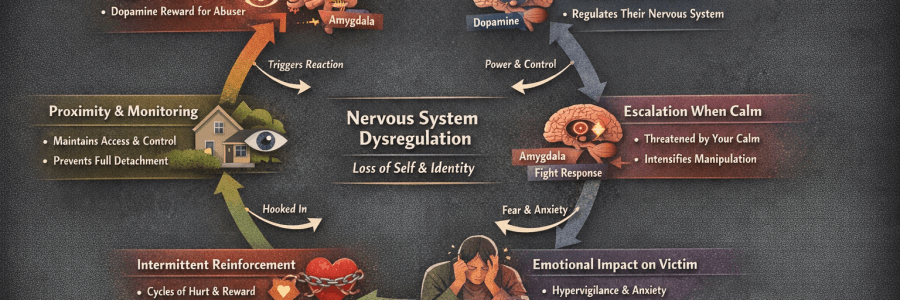
Leaving a coercive, exploitative relationship doesn’t just end proximity.It changes the entire neurological and psychological system that held the abuse in place. What follows explains five things that often emerge after separation — and why each one is a sign of recovery, not damage. 1. Why Abusers Unravel After Separation Abuse is not sustained by confidence — it is sustained… Read More After the Exit: What Happens to Them — and What’s Returning to You

Threat Detection

This manoeuvre has a name and a function. What this tactic is called It sits at the intersection of: In domestic-abuse and coercive-control literature, it’s often described as“restricting the victim’s social world to control the narrative.” What’s really happening psychologically When someone says something like: “I don’t think it’s a good idea for your sister-in-law… Read More Threat Detection

🛑🧠 Boundary Breaches & How to Respond Without Re-Traumatizing

Core Rule A healthy response: 📊 Boundary Breach → Regulating Response Map Type of Boundary Breach What It Looks Like Why It’s Triggering Non-Re-Traumatizing Response Neuroscience Effect Direct Contact After No-Contact Emails, texts, “just checking in” Violates safety expectation Do not reply. Document. Block or route to lawyer. Amygdala learns silence = safety Provocation / Baiting… Read More 🛑🧠 Boundary Breaches & How to Respond Without Re-Traumatizing

🧠 How Long-Term Exposure to Threat & Harassment Damages Trust and Self-Regulation

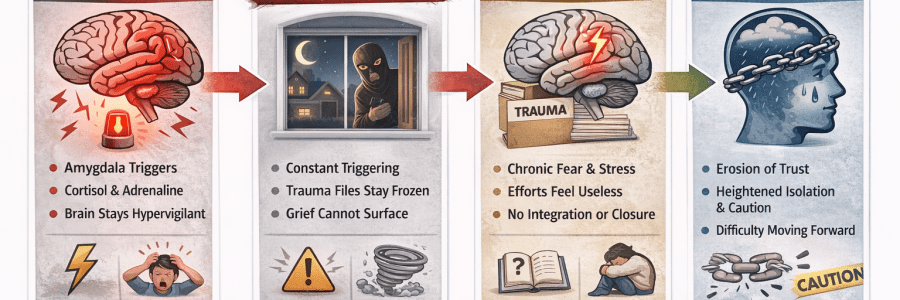
Stage-by-Stage Neuropsychological Impact Area Affected What Repeated Threat Exposure Does Long-Term Consequence Amygdala (Threat Detector) Becomes hypersensitive Constant alertness, anxiety, startle response Prefrontal Cortex (Self-regulation) Overridden repeatedly Difficulty concentrating, decision fatigue Hippocampus (Memory & Context) Stores events as danger memories Triggers activated by reminders, emails, names Vagus Nerve (Calming Pathway) Under-stimulated Trouble calming after stress… Read More 🧠 How Long-Term Exposure to Threat & Harassment Damages Trust and Self-Regulation

Why some people literally cannot grasp another perspective

1. Prefrontal cortex maturity (or lack of it) Perspective-taking, empathy, and reflective thinking live mainly in the prefrontal cortex (PFC) — especially: If someone is emotionally immature, stressed, personality-disordered, or chronically defensive, these areas are functionally offline in conflict. ➡️ They are not choosing not to understand you — their brain cannot access the circuitry required to do so in that moment.… Read More Why some people literally cannot grasp another perspective

Stress and Threat Response

1. Legal Actions You Can Take When an ex’s family member sends derogatory, threatening, or manipulative messages aimed at influencing a financial settlement or your reputation, the law provides several protections: a. Document Everything b. Civil Legal Options c. Criminal Considerations d. In Court 2. Psychological and Neuroscience Impact Being targeted like this by a family member,… Read More Stress and Threat Response

Safety Signals Are Undermined

When family members join in the abuse — sending threatening emails, insults, or manipulative messages — it creates a compound trauma effect. This goes far beyond emotional pain: it directly affects the nervous system, memory processing, and psychological recovery. Here’s a neuroscience- and psychology-informed breakdown. 1️⃣ Safety Signals Are Undermined Normal function: Family is usually the “safe base” for emotional… Read More Safety Signals Are Undermined

Safety is the soil of healing

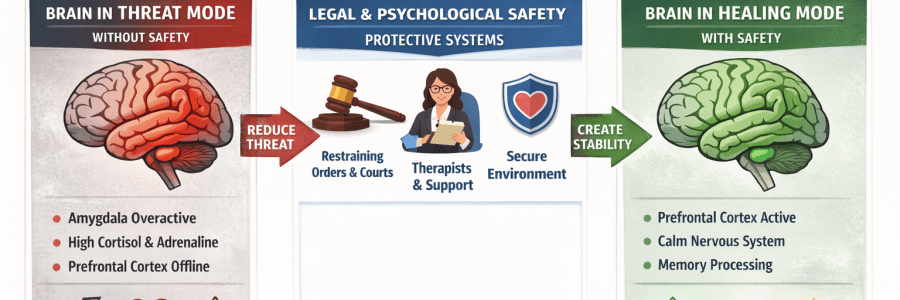
When someone continuously breaks a restraining order, it’s not just a legal violation — it’s a direct assault on the nervous system, and it profoundly affects trauma recovery. I’ll break it down using neuroscience and psychology, step by step. 1️⃣ SAFETY SIGNALS ARE DESTROYED Neuroscience Impact: The nervous system never settles, so healing pauses or reverses. 2️⃣ TRAUMA MEMORY REMAINS… Read More Safety is the soil of healing

🧠 WHY SAFETY IS THE FOUNDATION OF HEALING

1️⃣ Trauma locks the nervous system in survival mode Impact: The brain and body are busy keeping you alive, not updating memories or integrating experience. 2️⃣ Safety switches on the prefrontal cortex Neuroscience truth: Without safety, the brain can’t distinguish between old threat and present reality. Effort alone does not override this — it only increases stress. 3️⃣ Legal protections… Read More 🧠 WHY SAFETY IS THE FOUNDATION OF HEALING

🧠 WHY SOME PEOPLE HEAL AND OTHERS STAY STUCK (DESPITE INSIGHT)

1️⃣ INSIGHT LIVES IN THE THINKING BRAIN — TRAUMA DOES NOT Insight = prefrontal cortex Trauma = subcortical brain You can understand what happened and still: Because the body hasn’t learned the danger is over. Insight alone does not update survival circuits. 2️⃣ HEALING REQUIRES SAFETY — NOT JUST TRUTH Many people gain insight while still living in… Read More 🧠 WHY SOME PEOPLE HEAL AND OTHERS STAY STUCK (DESPITE INSIGHT)