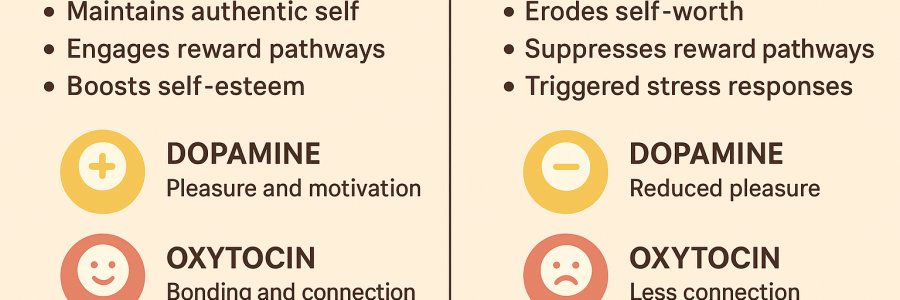
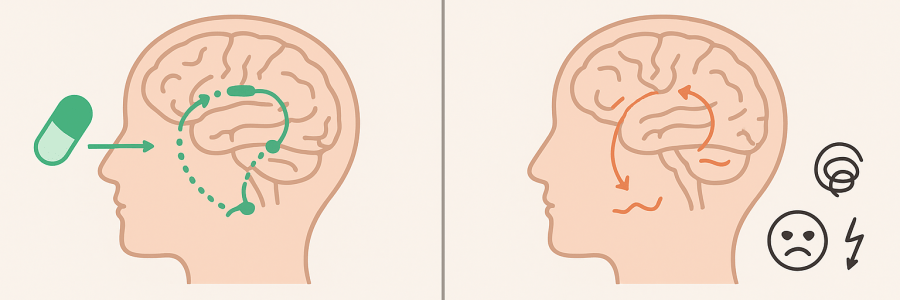
🧠 What “Homeostatic Pull” Means

Homeostasis is a biological term that means balance or stability.Your body is always trying to stay within certain limits — temperature, blood sugar, heart rate, hormone levels — all kept steady by automatic systems. In psychology, we borrow that idea to describe how people and families unconsciously try to keep emotional balance, even if that “balance” is unhealthy. So, homeostatic pull refers to… Read More 🧠 What “Homeostatic Pull” Means

What the research tells us about dating at 60+

1. Prevalence and patterns Implication: Dating later in life is not the norm for everyone, but it is sufficiently common that it’s receiving scholarly attention. 2. Neuroscience and romantic connection Implication: The neurobiology suggests that even after long relationships one can still experience deep romantic or bonding feelings; thus, entering a new dating phase later… Read More What the research tells us about dating at 60+

“Intermittent engagement” or “hot-cold behavior”

“Intermittent engagement” or “hot-cold behavior” in psychology. Let’s break down why this happens from a neuroscience and psychological perspective. 1️⃣ The Behavior: Mixed Signals and “Dangling” When someone says they want to see you but doesn’t follow through, or claims they’ll call tomorrow but disappears, it creates uncertainty and anxiety. This is a form of inconsistent reinforcement — a psychological… Read More “Intermittent engagement” or “hot-cold behavior”

💖 The Science of a Thriving Relationship: Passion, Trust, and Connection

Imagine a relationship where the spark never fades, where mutual trust is rock-solid, and every conversation flows effortlessly. You’re deeply attracted to each other, yet you honor each other’s need for space. No mind games. No doubts. Just connection, respect, and undeniable chemistry. This isn’t just romantic fantasy — neuroscience and psychology show that such… Read More 💖 The Science of a Thriving Relationship: Passion, Trust, and Connection

The Power of Acceptance: Letting Your Partner Be Themselves

One of the deepest lessons in love is learning to let someone be who they are. We often enter relationships with hope that our partner will change — that certain habits, opinions, or patterns will shift to align with our own vision of a “perfect” partnership. But neuroscience and psychology show us that trying to change… Read More The Power of Acceptance: Letting Your Partner Be Themselves

Digital Boundaries: When Family Harassment Crosses the Line

In today’s world, harassment doesn’t always happen face-to-face. It often continues through screens — subtle but invasive monitoring of social media, messages, and personal updates. When family members repeatedly check, comment on, or screenshot your posts despite clear boundaries or even a restraining order, this is not “concern” or “family interest.” It is a form of… Read More Digital Boundaries: When Family Harassment Crosses the Line

“Why won’t he just move away?” 

That question — “Why won’t he just move away?” — is one of the hardest parts of dealing with this kind of person, because the answer isn’t logical. You’re expecting him to think like a healthy adult who wants peace. But psychologically, people who repeatedly violate boundaries don’t seek peace — they seek proximity, power, or emotional control.… Read More “Why won’t he just move away?” 

💎 1. What Self-Respect Really Means

Self-respect isn’t arrogance or pride — it’s self-recognition.It’s knowing: “My time, energy, and love are valuable. I don’t have to beg to be treated well.” Psychologically, it’s the ability to hold your boundaries even when someone tries to guilt, shame, or confuse you into lowering them.You can still be kind — but you stop being a resource for… Read More 💎 1. What Self-Respect Really Means

Tactical Guide: Presenting a Psychologist’s Report in Court

1️⃣ Structure the Report Clearly Tip: Number each section and use headings — judges and lawyers appreciate clear navigation. 2️⃣ Focus on Objectivity 3️⃣ Evidence Points to Include Tip: Courts value multiple sources of evidence that reinforce the psychologist’s conclusions. 4️⃣ Anticipate Challenges 5️⃣ Presentation in Court 6️⃣ Protective Measures 7️⃣ Recommended Phrasing Techniques ✅ Key Takeaway: The strongest report is neutral,… Read More Tactical Guide: Presenting a Psychologist’s Report in Court