Healthy vs Unhealthy Separation
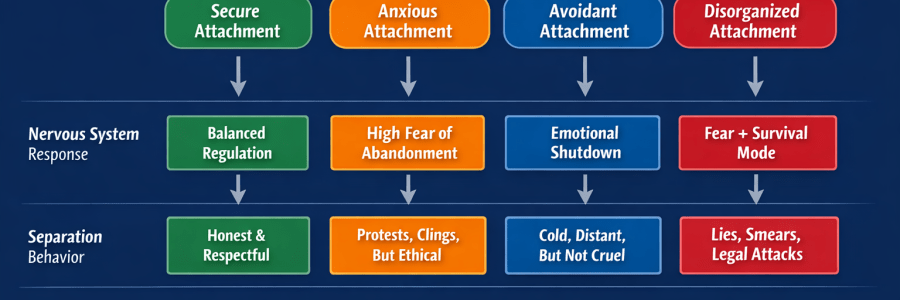
Below is a clear, side-by-side comparison followed by a direct mapping to attachment styles.This is the framework clinicians, trauma specialists, and increasingly courts use to distinguish healthy separation from abusive or unsafe dynamics. Healthy vs Unhealthy Separation (Side-by-Side Comparison Chart) Domain Healthy Separation Unhealthy / Abusive Separation Core mindset “This relationship is ending; we are still human.” “I must win, control,… Read More Healthy vs Unhealthy Separation

How Healthy Partners Behave — Even During Separation

This is a crucial distinction, especially during separation or divorce when stress is high.Healthy partners may be hurt, angry, or grieving — but they do not cross core moral lines, even when the relationship ends. Below is how this looks psychologically, neurologically, and behaviorally. How Healthy Partners Behave — Even During Separation (Neuroscience & Psychology) 1. They Do… Read More How Healthy Partners Behave — Even During Separation

“Once someone is willing to lie under oath, the relationship is already dead.”

“Once someone is willing to lie under oath, the relationship is already dead.” Here’s why — grounded in neuroscience, psychology, and ethics: Why Lying Under Oath Kills a Relationship Permanently 1. It Destroys the Brain’s Safety Model The human attachment system relies on one core question: “Is this person fundamentally safe and truthful?” Lying under oath… Read More “Once someone is willing to lie under oath, the relationship is already dead.”

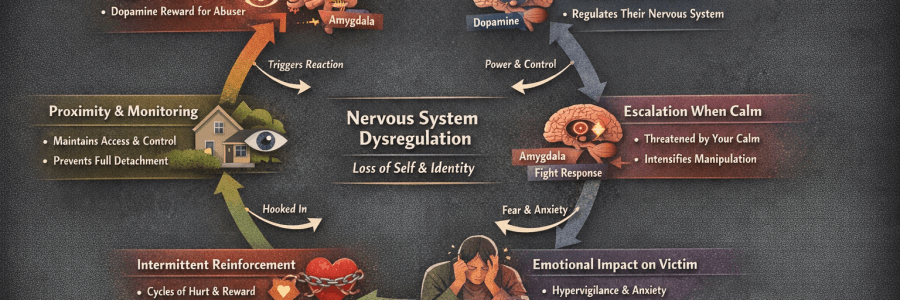
Cycle of Long Term Abuse

button-pushing, escalation when calm, reliance on your reactions for regulation, and staying close to you physically or symbolically — is actually a hallmark of long-term emotional abuse. Let’s unpack why this is, from both a psychological and neurological perspective. 1. Emotional Abuse Is About Control, Not Connection Long-term emotional abuse isn’t about conflict or even “anger.” It’s… Read More Cycle of Long Term Abuse

“I know this is bad for me — why can’t I let go?”

This is where endings become especially difficult — because trauma bonds and long-term relationships don’t just live in memory or emotion. They live in deep survival circuitry. Let’s connect the neuroscience clearly. Trauma Bonds: When the Brain Links Love to Survival A trauma bond forms when attachment is mixed with: Neurologically, this hijacks learning systems. 1. Dopamine + Cortisol =… Read More “I know this is bad for me — why can’t I let go?”

Calm truth creates cognitive dissonance they cannot tolerate

Cognitive dissonance occurs when reality clashes with a person’s self-image. Most abusers hold an internal narrative such as: Your calm, factual truth introduces a competing reality without emotion. That’s the key. Anger can be dismissed.Calm facts cannot. Neuroscience shows that when dissonance cannot be resolved externally (through arguing or provoking), the brain attempts to resolve it internally by… Read More Calm truth creates cognitive dissonance they cannot tolerate

Calm truth

There was never anyone else.I returned from holiday with my family — my children and grandchildren. Nothing more, nothing hidden. The idea of a “mystery man” was a story used to discredit me. In reality, he had another partner while using my hard-earned money and restricting my access to my own finances. For decades, I… Read More Calm truth

Why you should NOT pass details to their family

1. Families are not neutral containers Psychology shows that families are emotionally invested systems, not objective recipients of information. Common outcomes: Neuroscience: This means facts are rarely processed rationally. 2. You become the messenger — and the target Passing information to family shifts your role from: Psychologically, this exposes you to: Your nervous system absorbs stress that does not… Read More Why you should NOT pass details to their family

Why Attention Drops When Survivors Begin to Heal

Trauma Recovery, Post-Abuse Dynamics & the Nervous System For people who have lived through long-term abuse, the shift you’re noticing is not just social — it’s neurobiological and relational. When you were in survival mode, your nervous system, identity, and relationships were organized around threat, appeasement, and endurance. As you heal, that entire structure changes. And not everyone… Read More Why Attention Drops When Survivors Begin to Heal

The Hidden Dangers of Dating Apps: Con Men, Pretenders, and Emotional Fraud

Dating apps aren’t inherently bad — but they are highly efficient environments for deception. They allow people to present a carefully curated version of themselves with very little accountability, history, or social consequence. And that creates opportunity — not just for romance, but for manipulation. Who Thrives on Dating Apps (and Why) Dating apps are especially attractive… Read More The Hidden Dangers of Dating Apps: Con Men, Pretenders, and Emotional Fraud