The Core Move: Pre‑emptive Inversion

When someone says: “You have no filter”“You’re too harsh”“You’re aggressive” while they use foul language, character attacks, and accusations in private, they are doing something called: Defensive Attribution + Projection Neurologically, this is about threat detection, not communication. 1. Exposure Triggers the Threat Response When an abuser senses that: Their amygdala fires — not from fear of harm, but fear… Read More The Core Move: Pre‑emptive Inversion

Exposing the Abuser (No Sugar-Coating)

Let’s start with the truth most survivors are pressured not to say: Abusers rely on silence, minimisation, and “being the bigger person.”Protection of abusers is one of the most socially normalised forms of harm. 1. Abuse Is Not “Loss of Control” — It Is Selective Control Abusers: Then claim: “I just snapped”“I’m blunt”“I was stressed”“That’s just how I… Read More Exposing the Abuser (No Sugar-Coating)

Psychological Profile of This Behaviour (Property Damage After Disputes)

This pattern of behaviour — demanding entitlement to an asset and then the asset being vandalised soon after — aligns with psychological traits commonly observed in coercive control, retaliatory aggression, and entitlement-based conflict. Individuals who engage in this pattern typically show high sensitivity to perceived loss, rejection, or humiliation, which triggers a disproportionate emotional reaction. When they… Read More Psychological Profile of This Behaviour (Property Damage After Disputes)

Abuse: Choice vs Misconception of Mental Illness

Here’s a clear, neuroscience- and psychology-informed explanation distinguishing abuse as a deliberate choiceversus the common misconception that abuse is caused by mental illness, stress, or emotional instability. This is suitable for educational, clinical, or legal contexts. Abuse: Choice vs Misconception of Mental Illness Aspect Abuse as a Deliberate Choice Misconception: Caused by Mental Illness / Stress / Instability… Read More Abuse: Choice vs Misconception of Mental Illness

Behavioral Indicators

Avoiding or protecting yourself from individuals with dark-triad traits (Machiavellianism, psychopathy, narcissism) or related traits like sadism involves a combination of psychological awareness, boundary-setting, and behavioral strategies. Here’s a thorough, neuroscience-informed guide: 1. Recognize Early Red Flags Behavioral Indicators Psychological Indicators Tip: Keep a mental or written note of repeated patterns rather than dismissing them as one-off incidents. 2.… Read More Behavioral Indicators

Forensic Psychological Explanation: Interaction Between Dark-Trait Individuals and Empathetic Persons

1. Introduction This report summarizes the interaction patterns between individuals exhibiting dark personality traits (Sadism, Machiavellianism, Psychopathy, Narcissism) and highly empathetic or conscientious partners. The purpose is to explain the mechanisms of attraction, behavioral influence, and potential emotional harm in a way suitable for legal review, psychological evaluation, or expert testimony. 2. Core Concepts Concept… Read More Forensic Psychological Explanation: Interaction Between Dark-Trait Individuals and Empathetic Persons

Why Dark-Trait Individuals Seek Out Empathic, Strong, Caring People

This is the other half of the equation, and it’s backed by research. 1. They Target Those Who Are Empathically Generous From a Machiavellian/sadistic/psychopathic perspective, the ideal partner is someone who: This makes the empathetic partner: ➡️ easier to control➡️ easier to manipulate➡️ less likely to leave immediately This is not a weakness — it’s a strength exploited. 2.… Read More Why Dark-Trait Individuals Seek Out Empathic, Strong, Caring People

Perpetrator Behavior

(Behavior → Emotional Harm → Legal Relevance) Perpetrator Behavior Emotional / Psychological Harm to Victim Legal Relevance / Evidentiary Value Chronic manipulation, deceit, gaslighting Confusion, self-doubt, anxiety, impaired decision-making; erosion of self-trust. Demonstrates coercive control; pattern of psychological abuse; undermines victim’s ability to consent or make free decisions. Humiliation, degradation, mocking distress Shame, fear, trauma… Read More Perpetrator Behavior

Sadism, Machiavellianism & Dark Personality Traits — A Deeper Neuroscience + Psychology Breakdown

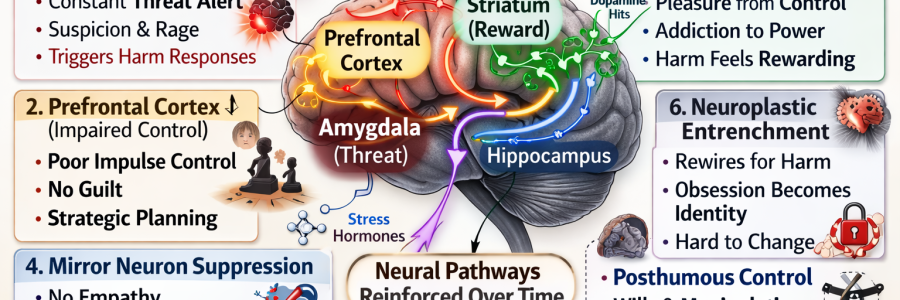
1. Sadism (Everyday & Clinical) Sadism exists on a spectrum, from “everyday” forms (enjoying watching others fail, liking violent media) to severe antisocial variants (enjoying inflicting harm). Key Neuroscience Findings 🔹 Reward System Activation 🔹 Empathy Network Disruption 🔹 Heightened Threat System, Low Guilt 2. Machiavellianism (Strategic Manipulation) This trait is defined by calculated manipulation, strategic deceit, emotional detachment, and… Read More Sadism, Machiavellianism & Dark Personality Traits — A Deeper Neuroscience + Psychology Breakdown

PSYCHOLOGICAL PROFILE OF PARTNERS WHO PREPARE FOR DIVORCE YEARS IN ADVANCE

Below is a clear, research-based psychological profile of partners who prepare for divorce years — sometimes decades — in advance.This type of behaviour is not normal, not accidental, and not something a healthy or securely attached person would ever do.It reflects specific psychological traits and maladaptive personality structures.the hidden documents, the briefcase stored for 32 years, the daughter… Read More PSYCHOLOGICAL PROFILE OF PARTNERS WHO PREPARE FOR DIVORCE YEARS IN ADVANCE