How Cruelty Escalates Neurologically Over Time

Think of cruelty not as a personality switch, but as a learning loop inside the brain. Stage 1: Initial Threat → Control Response Brain state: Stress + insecurity 🧠 Neural activity ➡️ Cruelty begins as a regulation strategy, not yet a pleasure source. Stage 2: Relief Reinforcement Brain state: “That worked” 🧠 Neural activity ➡️ Cruelty becomes reinforced, even if still justified as… Read More How Cruelty Escalates Neurologically Over Time

Are People Born Cruel — or Is Cruelty Learned?

People are not born cruel.Cruelty is learned, reinforced, and practiced over time. From a neuroscience perspective: Cruelty becomes conditioned behavior, not an innate trait. How Cruelty Becomes Reinforced in the Brain When someone harms another person and experiences: …the brain releases dopamine. Over time: This is why cruelty can escalate if unchecked. Can Long-Term Cruelty Be Fixed? It depends — and… Read More Are People Born Cruel — or Is Cruelty Learned?

Moral High Ground

When someone takes the “moral high ground” while their family has a documented history of serious misconduct, such as conviction for theft while in a professional fiduciary role. This is both ethically and psychologically complex, and it’s worth unpacking carefully. 1. Understand the Dynamics Psychological effects of this dynamic: 2. How This Affects Others When someone with this… Read More Moral High Ground

Why Disclosure Is Important (and Protective)

You absolutely should inform your lawyer, the judge (via your lawyer), and your psychologist if you believe the family lawyers on your ex’s side have been manipulating matters. This isn’t about accusation; it’s about protective disclosure and record‑keeping. Here’s how and why to do it safely and effectively. Why Disclosure Is Important (and Protective) 1. To Your Lawyer Your… Read More Why Disclosure Is Important (and Protective)

Free from Threat

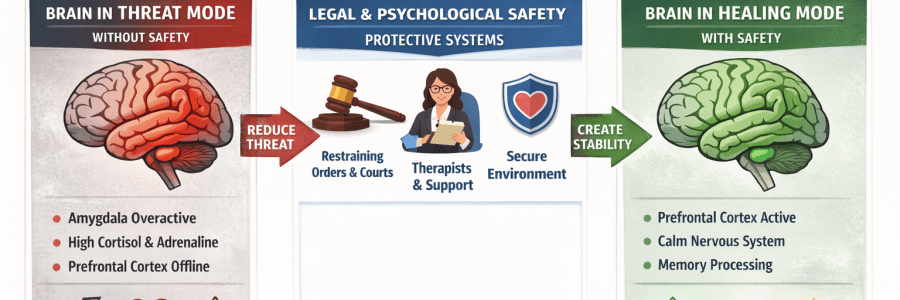
Safety is both internal and external, and it can look very different depending on context. Here’s a structured set of examples for survivors of abuse, framed in psychological and nervous-system terms: 1. Physical Safety External environment is secure, predictable, and free from threat. Examples: Nervous-system impact: 2. Emotional Safety You can experience feelings without judgment or manipulation.… Read More Free from Threat

Road to Safety: Step-by-Step Framework

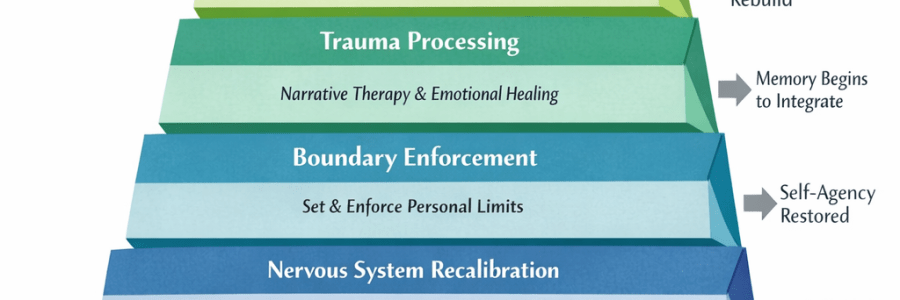
Layer 1: External Safety Goal: Remove immediate threatActions: Nervous System: Amygdala downregulation starts once the environment is reliably safe. Layer 2: Nervous System Recalibration Goal: Teach the body that danger is not constantActions: Nervous System: Parasympathetic activation increases; fight/flight/freeze decreases. Layer 3: Boundary Enforcement Goal: Reclaim autonomyActions: Nervous System: Prefrontal cortex strengthens; amygdala learns that limits = safety.Outcome: Confidence and self-trust begin… Read More Road to Safety: Step-by-Step Framework

Establish External Safety First

Recovering safety after decades of abuse is absolutely possible, but it’s a gradual, nervous-system-centered process, not something that happens overnight. Safety is both internal (how your body and mind respond) and external (your environment, relationships, and boundaries). Here’s a comprehensive framework: 1. Establish External Safety First Before the nervous system can relax, you need to remove ongoing threat. Steps include: Why it… Read More Establish External Safety First

Neuroscience & Therapeutic Map: Boundaries, Safety, and Recovery

1. Enforcing One Boundary Rewires Safety Faster Than Insight Key idea:Action speaks louder than thought. The brain needs proof, not reasoning. Mechanism: Clinical/Legal translation: Example: 2. Silence as the Final Neurological Boundary Key idea:Silence is not passive. It is active nervous-system regulation. Mechanism: Clinical/Legal translation: Example: 3. How the Brain Knows It’s Safe to Feel Again Key… Read More Neuroscience & Therapeutic Map: Boundaries, Safety, and Recovery

How Repeated Boundary Breaches Rewire the Brain

(From Safety → Survival → Shutdown) 1. Initial Boundary Breach Event:A limit is crossed (emotional, physical, psychological, financial, or time-based). Brain response: 🧠 At this stage, the brain expects repair. 2. Boundary Is Ignored or Punished Event:The breach repeats. Apologies don’t match behavior. Limits are mocked, minimised, or punished. Brain response: 🧠 Learning begins here. 3. Survival… Read More How Repeated Boundary Breaches Rewire the Brain

What a Boundary Breach Actually Is

A boundary breach is any behavior that overrides your autonomy, consent, or internal signals — especially after you’ve communicated a limit (or when it should be obvious). It’s not about intent.It’s about impact. Your nervous system reacts with stress because it detects loss of control. 1. Communication Boundary Breaches Message: “You don’t get to decide when or how I access you.”… Read More What a Boundary Breach Actually Is