Why coercive control always backfires in the end

Abuse, control, and manipulation are often used with one goal in mind:to stop someone from leaving. But biologically and psychologically, they do the opposite. They trigger survival escape, not attachment. The survival switch that cannot be controlled When a person is subjected to: their nervous system eventually stops trying to fix the relationship and switches to escape mode. At… Read More Why coercive control always backfires in the end

When Freedom Arrives: What Comes Next — and Why It Hurts Before It Heals

Leaving long-term coercive control does not immediately feel like relief.For many people, the most intense psychological experiences come after distance, not during the abuse. This is not a setback.It is the nervous system finally having the safety required to process reality. 1. Why Self-Blame Appears During Clarity When clarity begins to emerge, self-blame often rushes in behind it.… Read More When Freedom Arrives: What Comes Next — and Why It Hurts Before It Heals

After the Exit: What Happens to Them — and What’s Returning to You

Leaving a coercive, exploitative relationship doesn’t just end proximity.It changes the entire neurological and psychological system that held the abuse in place. What follows explains five things that often emerge after separation — and why each one is a sign of recovery, not damage. 1. Why Abusers Unravel After Separation Abuse is not sustained by confidence — it is sustained… Read More After the Exit: What Happens to Them — and What’s Returning to You

Threat Detection

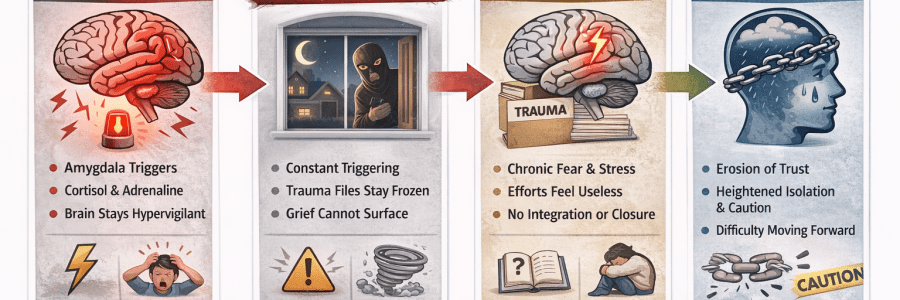
This manoeuvre has a name and a function. What this tactic is called It sits at the intersection of: In domestic-abuse and coercive-control literature, it’s often described as“restricting the victim’s social world to control the narrative.” What’s really happening psychologically When someone says something like: “I don’t think it’s a good idea for your sister-in-law… Read More Threat Detection

Safety Signals Are Undermined

When family members join in the abuse — sending threatening emails, insults, or manipulative messages — it creates a compound trauma effect. This goes far beyond emotional pain: it directly affects the nervous system, memory processing, and psychological recovery. Here’s a neuroscience- and psychology-informed breakdown. 1️⃣ Safety Signals Are Undermined Normal function: Family is usually the “safe base” for emotional… Read More Safety Signals Are Undermined

Safety is the soil of healing

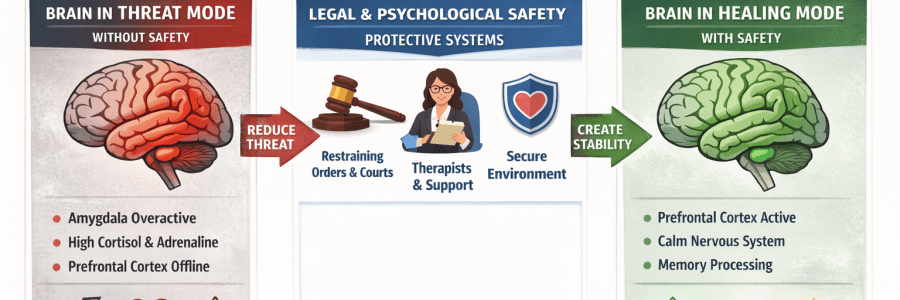
When someone continuously breaks a restraining order, it’s not just a legal violation — it’s a direct assault on the nervous system, and it profoundly affects trauma recovery. I’ll break it down using neuroscience and psychology, step by step. 1️⃣ SAFETY SIGNALS ARE DESTROYED Neuroscience Impact: The nervous system never settles, so healing pauses or reverses. 2️⃣ TRAUMA MEMORY REMAINS… Read More Safety is the soil of healing

🧠 WHY SAFETY IS THE FOUNDATION OF HEALING

1️⃣ Trauma locks the nervous system in survival mode Impact: The brain and body are busy keeping you alive, not updating memories or integrating experience. 2️⃣ Safety switches on the prefrontal cortex Neuroscience truth: Without safety, the brain can’t distinguish between old threat and present reality. Effort alone does not override this — it only increases stress. 3️⃣ Legal protections… Read More 🧠 WHY SAFETY IS THE FOUNDATION OF HEALING

🧠 WHY SOME PEOPLE HEAL AND OTHERS STAY STUCK (DESPITE INSIGHT)

1️⃣ INSIGHT LIVES IN THE THINKING BRAIN — TRAUMA DOES NOT Insight = prefrontal cortex Trauma = subcortical brain You can understand what happened and still: Because the body hasn’t learned the danger is over. Insight alone does not update survival circuits. 2️⃣ HEALING REQUIRES SAFETY — NOT JUST TRUTH Many people gain insight while still living in… Read More 🧠 WHY SOME PEOPLE HEAL AND OTHERS STAY STUCK (DESPITE INSIGHT)

🧠 HOW CERTAINTY BLOCKS HEALING AFTER TRAUMA

(Trauma → brain → behaviour → stalled recovery) 1️⃣ TRAUMA SHATTERS PREDICTABILITY Trauma isn’t just what happened — it’s what it did to meaning. After trauma, the brain learns: This creates an existential threat, not just emotional pain. 2️⃣ CERTAINTY EMERGES AS A NERVOUS-SYSTEM PATCH To survive that threat, the brain reaches for certainty. 🧠 Neurobiology… Read More 🧠 HOW CERTAINTY BLOCKS HEALING AFTER TRAUMA

🧭 HOW TO EXIT FAST-INTIMACY GRACEFULLY

(Nervous system → behaviour → language → outcome) 1️⃣ FIRST: REGULATE BEFORE YOU SPEAK Fast intimacy triggers sympathetic arousal (urgency, pressure, obligation). Before responding: You’re signaling down-regulation. This alone often dissolves the dynamic. 2️⃣ NAME THE PACE — NOT THE PERSON Never say: These trigger shame and escalation. Instead, anchor in your nervous system. Gentle pacing language: Secure people… Read More 🧭 HOW TO EXIT FAST-INTIMACY GRACEFULLY