Healing Through Relationships

Entering a new relationship after decades of cruelty and abuse is a profound and delicate process. It’s not just about finding the right partner — it’s about rewiring your nervous system, reclaiming trust, and protecting your boundaries. Here’s a clear, structured overview: 1️⃣ Understand the Impact of Long-Term Abuse After long-term abuse, survivors often experience: Your nervous system… Read More Healing Through Relationships
Why Silence Protects Survivors During Escalation

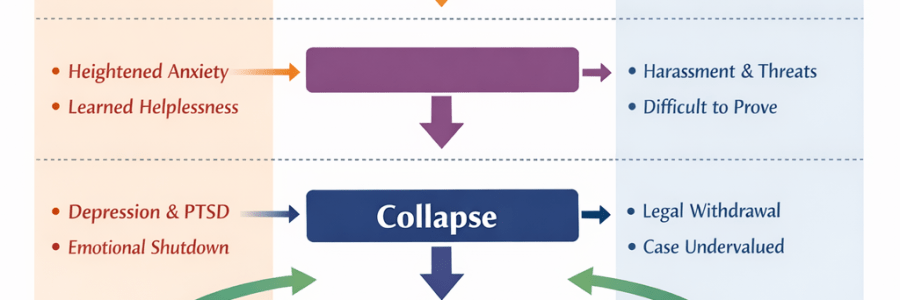
Escalation is the most dangerous phase in abusive dynamics because regulation is failing. Silence works because it removes the very signals escalation feeds on. 1️⃣ Escalation Requires Feedback — Silence Removes It During escalation, the abuser’s nervous system is: They are scanning for: 🧠 Silence provides none. ➡️ Without feedback, the brain cannot calibrate intensity.➡️ This creates hesitation instead… Read More Why Silence Protects Survivors During Escalation

Road to Safety: Step-by-Step Framework

Layer 1: External Safety Goal: Remove immediate threatActions: Nervous System: Amygdala downregulation starts once the environment is reliably safe. Layer 2: Nervous System Recalibration Goal: Teach the body that danger is not constantActions: Nervous System: Parasympathetic activation increases; fight/flight/freeze decreases. Layer 3: Boundary Enforcement Goal: Reclaim autonomyActions: Nervous System: Prefrontal cortex strengthens; amygdala learns that limits = safety.Outcome: Confidence and self-trust begin… Read More Road to Safety: Step-by-Step Framework

Establish External Safety First

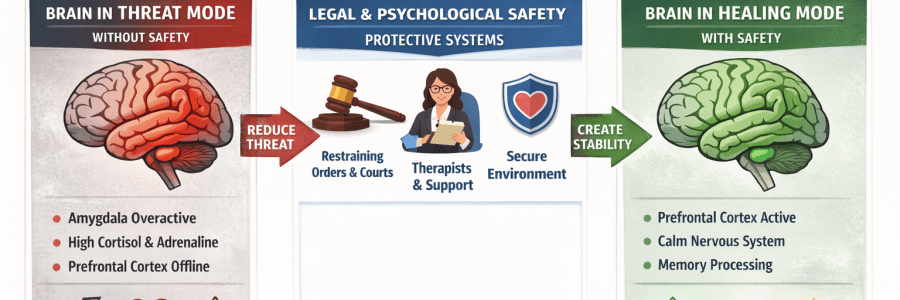
Recovering safety after decades of abuse is absolutely possible, but it’s a gradual, nervous-system-centered process, not something that happens overnight. Safety is both internal (how your body and mind respond) and external (your environment, relationships, and boundaries). Here’s a comprehensive framework: 1. Establish External Safety First Before the nervous system can relax, you need to remove ongoing threat. Steps include: Why it… Read More Establish External Safety First

Neuroscience & Therapeutic Map: Boundaries, Safety, and Recovery

1. Enforcing One Boundary Rewires Safety Faster Than Insight Key idea:Action speaks louder than thought. The brain needs proof, not reasoning. Mechanism: Clinical/Legal translation: Example: 2. Silence as the Final Neurological Boundary Key idea:Silence is not passive. It is active nervous-system regulation. Mechanism: Clinical/Legal translation: Example: 3. How the Brain Knows It’s Safe to Feel Again Key… Read More Neuroscience & Therapeutic Map: Boundaries, Safety, and Recovery

What a Boundary Breach Actually Is

A boundary breach is any behavior that overrides your autonomy, consent, or internal signals — especially after you’ve communicated a limit (or when it should be obvious). It’s not about intent.It’s about impact. Your nervous system reacts with stress because it detects loss of control. 1. Communication Boundary Breaches Message: “You don’t get to decide when or how I access you.”… Read More What a Boundary Breach Actually Is

Three phases of a nervous system exiting captivity.

PHASE 1: DETACHMENT (While still inside, or immediately after leaving) Primary function: Survival efficiencyDominant system: Autonomic nervous system (freeze → controlled shutdown) What’s happening internally This is when people say: They haven’t.They’ve gone offline. Key marker (this is important): You stop explaining yourself — even in your own head. Once justification disappears, detachment has begun. PHASE 2: GRIEF (Only once… Read More Three phases of a nervous system exiting captivity.

1. Why abusers mistake silence for submission

Abusers are trained by cause–effect feedback. Earlier in the relationship: So when silence appears, their brain runs an old rule: “Silence means it’s working.” But post-flip silence is not fear-based.It is attachment shutdown. The misread happens because: So they escalate to “wake you up”: When none of it works, panic sets in. What they feel as loss of controlyou are… Read More 1. Why abusers mistake silence for submission

The exact moment the survival exit flips

The “survival exit” does not flip during the worst abuse. It flips during clarity. That’s the part most people misunderstand. What happens before the flip Before the switch, the person is still in attachment mode, even if they are suffering. Neurologically, they are operating from: Their nervous system still believes: “This relationship is dangerous, but it is also necessary.” As long… Read More The exact moment the survival exit flips