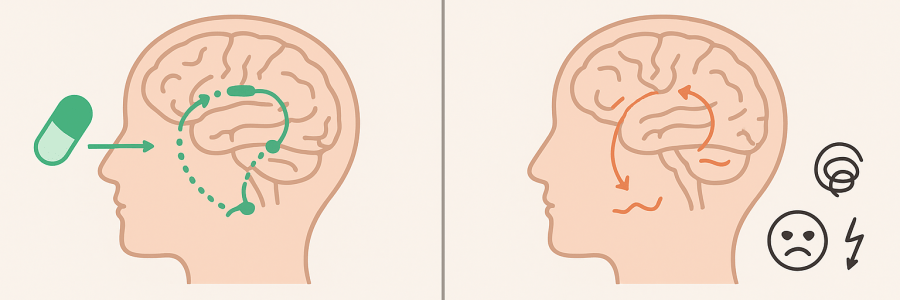
🧠 The Neuroscience of Defensive Dominance: How Fear Becomes Power Displays

1. The Trigger: Perceived Threat It all starts in the amygdala, the brain’s emotional alarm center.When you (or an animal) feel threatened — physically, socially, or emotionally — the amygdala fires, signaling danger. This can be: 2. Fight or Flight — and the Choice to “Puff Up” The amygdala sends an urgent message to the hypothalamus, which activates the autonomic nervous… Read More 🧠 The Neuroscience of Defensive Dominance: How Fear Becomes Power Displays

Shouldn’t have to beg for breadcrumbs

Let’s unpack this from a psychology and neuroscience perspective. The idea that “you will know when it feels right” and that you shouldn’t have to beg for breadcrumbs isn’t just a cliché—it reflects how our brains respond to healthy vs. unhealthy relational dynamics. 1. The Brain on Healthy Connection When a relationship feels “right,” several brain systems are aligned:… Read More Shouldn’t have to beg for breadcrumbs

Guessing Games

“you’re guessing / you’ll never know / you’ll find out when I die” response is not communication; it’s a form of psychological abuse and coercive control. Here’s a deep look at what’s happening from both psychological and neuroscience angles: 🧠 Why “Guessing Games” = Coercive Control (Not Communication) 1. Withholding Information = Power 2. Gaslighting Through Ambiguity 3. Intermittent Reinforcement 🧠 Neuroscience of Living… Read More Guessing Games

Attachment styles

Attachment styles are patterns of relating to others that develop early in life, typically based on interactions with caregivers, and continue to influence relationships in adulthood. They shape how we perceive intimacy, trust, dependence, and emotional regulation. From psychology and neuroscience perspectives, attachment styles are linked to brain circuits involved in emotion regulation, social cognition,… Read More Attachment styles

Rebuilding Trust After Betrayal: A Neuroscience and Psychology Guide

Healing from broken trust is not just an emotional journey — it’s also a neurological one. The brain, shaped by past betrayal or abandonment, wires itself around vigilance and fear. But neuroscience shows us that through compassion, communication, and consistent reliability, those fear circuits can be rewired into pathways of calm and safety. Below, we’ll… Read More Rebuilding Trust After Betrayal: A Neuroscience and Psychology Guide

When Their Phone Goes Silent: Why Healing Minds Spiral Into Panic

For someone learning to trust again after betrayal, abuse, or abandonment, something as small as a partner turning off their phone can ignite a wave of fear. To outsiders, it may seem irrational. But to the brain and nervous system shaped by past wounds, it feels like danger. The Neuroscience Behind the Panic The brain… Read More When Their Phone Goes Silent: Why Healing Minds Spiral Into Panic

When Life Revolves Around Illness: Escaping the Cycle of Hypochondria

Some families seem to have an endless script of ailments: one week it’s a back problem, the next a digestive issue, then headaches, then fatigue. The list never ends, and nothing ever truly resolves. Doctor visits and prescriptions become the rhythm of life, with conversations revolving around symptoms, scans, and “what might be wrong this… Read More When Life Revolves Around Illness: Escaping the Cycle of Hypochondria

When Fear of Abandonment Meets Upward Comparison: Why Some Men Become Hyper-Jealous — A Psychological & Neuroscience View

There’s a difference between ordinary worry (“I miss you when you’re gone”) and the kind of constant, corrosive anxiety that turns a partner into a threat. When that anxiety meets an environment of constant comparison — social media, beauty ideals, social reward for attractiveness — the result can be a destructive pattern: surveillance, accusations, controlling… Read More When Fear of Abandonment Meets Upward Comparison: Why Some Men Become Hyper-Jealous — A Psychological & Neuroscience View

Relearning Autonomy After Manipulation: The Strange Freedom of Making Your Own Choices

For anyone who has lived under the shadow of control, manipulation, or coercion, the moment of stepping into true autonomy can feel less like liberation and more like vertigo. Suddenly the air feels different—you’re not being told what to do, but instead left with the unnerving task of making your own decisions. At first, this… Read More Relearning Autonomy After Manipulation: The Strange Freedom of Making Your Own Choices