Why Some Abusers Escalate Once More Before Stopping

This is called an extinction burst in neuroscience and behavioural psychology. It happens when a behaviour that used to work suddenly stops working. 1️⃣ The Brain Detects Reward Loss When a survivor enforces boundaries or goes silent, the abuser’s brain experiences: 🧠 The brain registers: “My usual strategy has failed.” But it does not interpret this as “stop.” 2️⃣ The… Read More Why Some Abusers Escalate Once More Before Stopping

Why Silence Protects Survivors During Escalation

Escalation is the most dangerous phase in abusive dynamics because regulation is failing. Silence works because it removes the very signals escalation feeds on. 1️⃣ Escalation Requires Feedback — Silence Removes It During escalation, the abuser’s nervous system is: They are scanning for: 🧠 Silence provides none. ➡️ Without feedback, the brain cannot calibrate intensity.➡️ This creates hesitation instead… Read More Why Silence Protects Survivors During Escalation

How Survivors’ Safety Rises Faster Than Abusers Decline

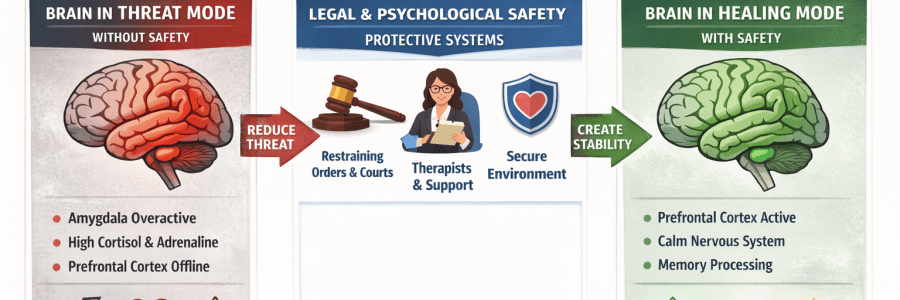
This asymmetry is biological, not moral. 🧠 Survivor nervous system Once danger is removed: Safety is additive.Each boundary enforced strengthens regulation. ➡️ Recovery accelerates because the nervous system is designed to heal when threat stops. 🧠 Abuser nervous system Cruelty-based regulation depends on: When access is removed: ➡️ Decline is slower because the system resists change. Key difference This… Read More How Survivors’ Safety Rises Faster Than Abusers Decline

How Long-Term Cruelty Erodes the Abuser’s Own Wellbeing

Cruelty damages the person using it, even if they never admit it. 1️⃣ Emotional Range Narrows Over time: 🧠 Empathy suppression spreads to all emotions, not just compassion. ➡️ Life feels flatter, emptier. 2️⃣ Stress Physiology Becomes Chronic Cruelty keeps the nervous system: 🧠 This increases: ➡️ The body pays the price. 3️⃣ Identity Becomes Fragile When… Read More How Long-Term Cruelty Erodes the Abuser’s Own Wellbeing

When Escalation Turns Dangerous

Cruelty becomes dangerous when regulation fails and desperation replaces control. 🔴 Key neurological warning points Escalation crosses into danger when you see three shifts together: 1️⃣ Loss of Predictability 🧠 This signals collapsing self-regulation. 2️⃣ Increased Risk-Taking 🧠 Impulse control (prefrontal cortex) is losing authority. 3️⃣ Externalisation of Blame Intensifies 🧠 The brain reframes danger as justified action. ➡️ This is… Read More When Escalation Turns Dangerous

Cruelty can become addictive, and it tends to escalate over time.

Here’s why, in plain but accurate terms: 🧠 Why Cruelty Becomes Addictive Cruelty isn’t usually about “enjoying pain” at the start.It begins as a way to regulate the nervous system. That relief triggers dopamine (the brain’s learning/reward chemical). The brain learns: “This behaviour works.” That’s the beginning of addiction. 📈 Why It Escalates Over the Years Just like… Read More Cruelty can become addictive, and it tends to escalate over time.

Silence Removes the Regulation Source

Abusive dynamics work because the abuser uses another person to: When you go silent: 🧠 ResultThe nervous system loses its external regulator. ➡️ Dysregulation begins internally. 2️⃣ The Brain Encounters Reward Collapse Cruelty and control rely on dopamine prediction: “If I do X, I will get Y (reaction, fear, reassurance, submission).” Silence creates: 🧠 Dopamine drops sharply.This feels… Read More Silence Removes the Regulation Source