Body and mind are often in a chronic survival state

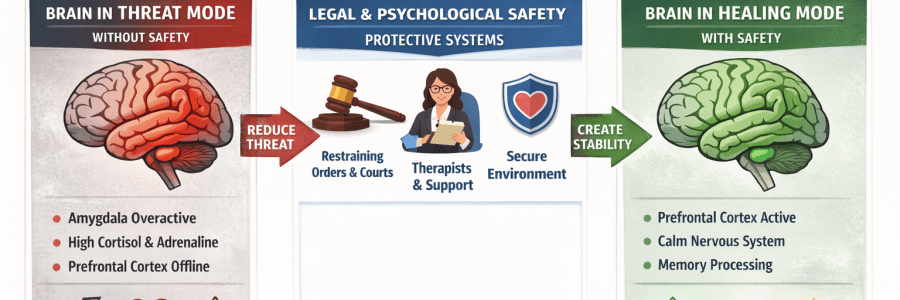
After decades of abuse, the body and mind are often in a chronic survival state, even long after the relationship ends. This isn’t a flaw — it’s the nervous system doing exactly what it was built to do: protect you from ongoing threat. Understanding this helps identify which situations to avoid while rebuilding safety and autonomy. 1.… Read More Body and mind are often in a chronic survival state
The Exact Internal Moment When Strength Reclaims Itself

This is often subtle and gradual, not dramatic. Neuroscience + psychology line up here: Signal What’s Happening Internally Outcome Sudden clarity Prefrontal cortex takes control over amygdala-driven fear loops Realisation: I don’t have to negotiate my worth anymore Shift from hope to self-interest Dopamine cravings from intermittent reinforcement fade Attachment energy is redirected internally Internal boundary… Read More The Exact Internal Moment When Strength Reclaims Itself

Personality traits most likely to target strong women

These traits cluster together. You rarely see just one. 🔻 Core targeting traits (They are not always obvious at first.) Strong women signal supply to these traits: competence, credibility, emotional depth, resilience. 2. How strength slowly gets turned against itself This is the quiet inversion that happens over time. Stage 1: Strength is admired Your competence feels… Read More Personality traits most likely to target strong women

Strong, intelligent women are not targeted despite their strength.They are often targeted because of it.

Here’s why, clearly and without myth. 1. Strength Looks Like a Resource to a Predator Abusive personalities don’t look for “weakness” in the way people imagine. They scan for: To them, this signals: “This person can absorb pressure, adapt, and keep functioning.” That’s not romance. That’s resource assessment. 2. Intelligence Enables Rationalisation (Early On) Highly intelligent… Read More Strong, intelligent women are not targeted despite their strength.They are often targeted because of it.

The Stages Before Leaving (What Actually Happens)

1. Idealisation & Bond Formation What it looks like What’s happening internally Key trap “This feels special — I’ve never had this before.” 2. First Boundary Breaches (Minimised) What it looks like Internal response Why she doesn’t leave 3. Cognitive Dissonance Phase What it looks like Internal split Neuroscience This is not denial — it’s the brain seeking stability. 4. Self-Erosion… Read More The Stages Before Leaving (What Actually Happens)

Why some personalities trigger trauma bonds (and others don’t)

Trauma bonds form when attachment + threat + intermittent relief get wired together.Some personalities reliably create that wiring. 1. The Hot–Cold / Inconsistent personality 🔥❄️ Traits Why it bondsYour nervous system learns: Connection is unstable — I must work for it. Uncertainty spikes dopamine.Withdrawal spikes cortisol.Relief feels euphoric. This is textbook intermittent reinforcement — the strongest conditioning pattern the brain knows. ResultYou don’t… Read More Why some personalities trigger trauma bonds (and others don’t)

The overlap: why trauma bonds and healthy attachment both create loops

At the surface, both can look like: That’s because both activate attachment circuitry and unfinished emotional processing. But what’s driving the loop is very different. Trauma bonding + Zeigarnik loops 🔥 (the sticky kind) What creates it Trauma bonds form through: Your nervous system learns: Relief = safety. So when the person disappears, the brain: This is dopamine +… Read More The overlap: why trauma bonds and healthy attachment both create loops

Write the ending your brain didn’t get ✍️

Alright — here’s how to consciously close a Zeigarnik loop, step by step, in a way your nervous system can actually accept (not just your logic). This isn’t about “getting over it.”It’s about finishing the story your brain keeps replaying. Step 1: Name the open loop (precisely) Your brain can’t close what’s vague. Instead of: Name it like this:… Read More Write the ending your brain didn’t get ✍️

What is the Zeigarnik effect?

The Zeigarnik effect is a psychological phenomenon where the brain remembers unfinished or interrupted experiences more strongly than completed ones. In simple terms: Your brain hates open loops. If something ends cleanly, the brain files it away.If something ends mid-emotion, mid-story, mid-hope — the brain keeps replaying it. Why it’s brutal in relationships 💔 Romantic situations are perfect Zeigarnik traps because… Read More What is the Zeigarnik effect?