Normal vs Dark Triad Behavior Warning Signs

Behavior / Trait Normal / Healthy Dark Triad / Warning Signs Self-interest Healthy ambition, takes care of own needs without harming others Extreme selfishness, disregards others’ needs, exploitative Empathy Can understand and respond to others’ feelings Lack of empathy, dismissive of others’ emotions, manipulative Anger / Aggression Occasional frustration, resolves conflicts constructively Frequent hostility, abusive,… Read More Normal vs Dark Triad Behavior Warning Signs

Dark Behavior Brain

Antisocial, greedy, abusive, violent, mean, negative, controlling behaviors—are often signs of deeper psychological and neurological patterns, not just “bad behavior.” Let’s break it down clearly: 1️⃣ Possible Personality Patterns 2️⃣ Neurological & Brain Factors 3️⃣ Environmental & Developmental Factors 4️⃣ Key Takeaways

Lazy vs Brain Adaptation vs Disorder

Lazy vs Brain Adaptation vs Disorder Cheat Sheet Trait / Behavior Likely Cause Notes Scruffy appearance / poor hygiene Brain adaptation / learned habits Often linked to low motivation from early trauma, depression, or neglect. Not just laziness. Lack of ambition / no goals Brain adaptation / environment Prefrontal cortex underdevelopment or learned helplessness can… Read More Lazy vs Brain Adaptation vs Disorder

Why Some People Are Scruffy, Mean, and Selfish—Inside and Out

Some people seem sloppy, unambitious, greedy, and even abusive, both in how they look and how they act. Here’s why, from a brain and psychology perspective: 1️⃣ The Brain’s Role 2️⃣ Personality Traits 3️⃣ Life Experiences 4️⃣ Epigenetics ✅ Bottom Line Being scruffy, greedy, or abusive isn’t always just a choice. It’s a mix of: Brain… Read More Why Some People Are Scruffy, Mean, and Selfish—Inside and Out

Brain Structure & Neurobiology

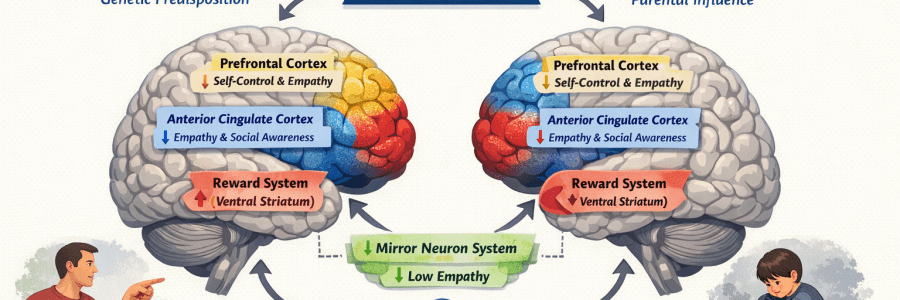
Prefrontal Cortex (PFC) Anterior Cingulate Cortex (ACC) Amygdala Reward System (Ventral Striatum / Nucleus Accumbens) 2️⃣ Psychology & Personality Factors Attachment & Early Environment Learned Behavior & Modeling Personality Traits 3️⃣ Epigenetics ✅ Key Takeaways In short: it’s a mix of biology, environment, early life experiences, and personality traits. The brain literally learns these patterns through repeated exposure and reinforcement.

 Social Learning & Mirror Neurons

The neuroscience of learned greed, manipulation, and dishonesty—basically, how teaching someone to take advantage of others can create a cycle where those behaviors get reflected back to you. Let’s break this down carefully: 1. Social Learning & Mirror Neurons 2. Reward System & Dopamine 3. Prefrontal Cortex & Moral Control 4. Empathy & Social Awareness 5. Karma-Like Reciprocity in the Brain… Read More  Social Learning & Mirror Neurons

Genetic and Heritable Factors

he neuroscience behind why a “Me, Me, Me” personality—self-centeredness or narcissistic traits—can appear to “run in the family.” Let’s break it down carefully: 1. Genetic and Heritable Factors 2. Brain Networks & Neurobiology 3. Environmental & Epigenetic Influences 4. The Neuroscience of “Running in the Family” ✅ Key Takeaway A “Me, Me, Me” pattern in families is usually:

Me Me Me

“ME ME ME” mindset isn’t just annoying; it’s a full-blown neurological pattern. 🧠 Here’s what’s happening under the hood: The result? You can be standing next to them for decades, pouring your heart out, and still feel unseen. Because neurologically, you literally aren’t in their world map.

Self Absorption

When someone is entirely absorbed in themselves, whether due to narcissism, extreme self-focus, or just habitual self-absorption, several brain and cognitive patterns come into play: In short, neuroscience confirms that deep self-absorption isn’t just emotional—it’s wired into attention, perception, and social processing circuits. The tragic irony is that presence alone doesn’t equal awareness: someone can be physically close… Read More Self Absorption