Real love

Real love doesn’t hide in cards or show up only on birthdays and Christmas. Real love stands beside you when no one’s watching. Every day. All year round. Anything less? That was never love — and it was never yours to keep.
Real love doesn’t hide in cards or show up only on birthdays and Christmas. Real love stands beside you when no one’s watching. Every day. All year round. Anything less? That was never love — and it was never yours to keep.

1️⃣ Understanding the “fake family” dynamic When people (like abusers or their enablers) act under their own agendas: Attachment Theory: Your brain may have tried to form secure bonds, but insecure or manipulative patterns prevented it. Trauma Bonding: Repeated exposure to manipulation or conditional love strengthens neural circuits linking pain to attachment. Amygdala Hyperactivation: Your… Read More Fake family

When relatives have already witnessed abusive behaviour and still minimise, deny, or side with the abuser, it can feel especially confusing — because now it’s not just disbelief, it’s contradiction of what they’ve seen. Neuroscience and psychology offer a clearer (and sobering) explanation: 🧠 1. The brain doesn’t just see — it interprets Even when someone… Read More The hard truth
When you tell someone’s relatives, you’re not just sharing information — you’re challenging their entire internal model of who that person is. The brain experiences this as a threat. A few key mechanisms: Cognitive Dissonance People hold a mental image like “he’s a good son/brother.” When your truth conflicts with that, it creates psychological discomfort.… Read More 🧠 Why the reaction can feel “as bad as the abuse”
It’s a beautiful life now — calm, genuine, and quietly exciting. It’s different when things flow naturally…when effort is mutual, and you don’t have to ask to be valued. I didn’t realise it could feel this easy.

I’m actually looking forward to growing older. Doing what I love. Going where I want. Being with the people who truly value me. At last… my life is about me. Spending my money on myself — exactly as it should have always been. Not selfish. Not indulgent. Just finally… correct. Because when you’ve spent years… Read More Looking forward

It’s a beautiful life… when you are finally with the right people. It took me decades to get here. Decades of abuse. Trauma. People-pleasing. Manipulation. Control — not just from one person, but reinforced, witnessed, and enabled by an entire system around me. There were always warnings. Subtle. Then not so subtle. “Wait and see… Read More It’s a beautiful life
For decades, your brain adapted to one kind of environment… and now it’s finally experiencing something different: safety, connection, and ease. Let’s break down what’s happening 👇 🧠 1. Your brain is recalibrating “what is normal” If you’ve spent years in environments where there was: tension unpredictability emotional inconsistency your brain wires that as baseline… Read More Real and Normal
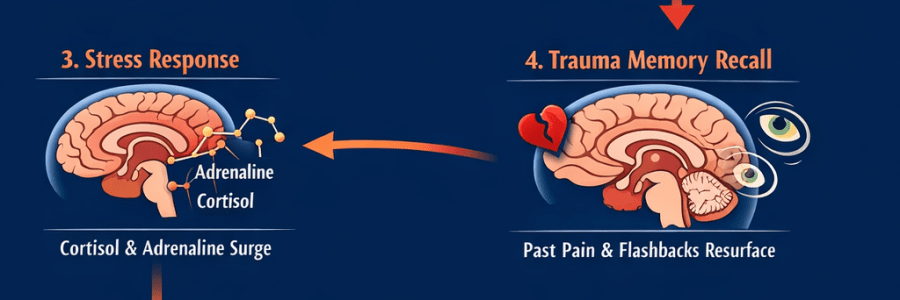
relatives of an abuser stalking your social media two years later—can be unsettling, confusing, and even feel threatening. Neuroscience and psychology give us some insight into why this might happen and what it does to your brain. Let’s break it down carefully. 1️⃣ Why this may be happening Even after a relationship ends, especially an… Read More Stalkers
There are certain dates that arrive quietly each year, yet carry the weight of transformation. April 5 is one of those days for me. One year ago today, something shifted. Not dramatically, not loudly—but deeply. It was the day I realised that happiness had not left me. It had simply been waiting… patiently, gently… for… Read More April 5 — The Day I Found Myself Again
 Linda C J Turner | Trauma Therapist & Emotional Healing Specialist