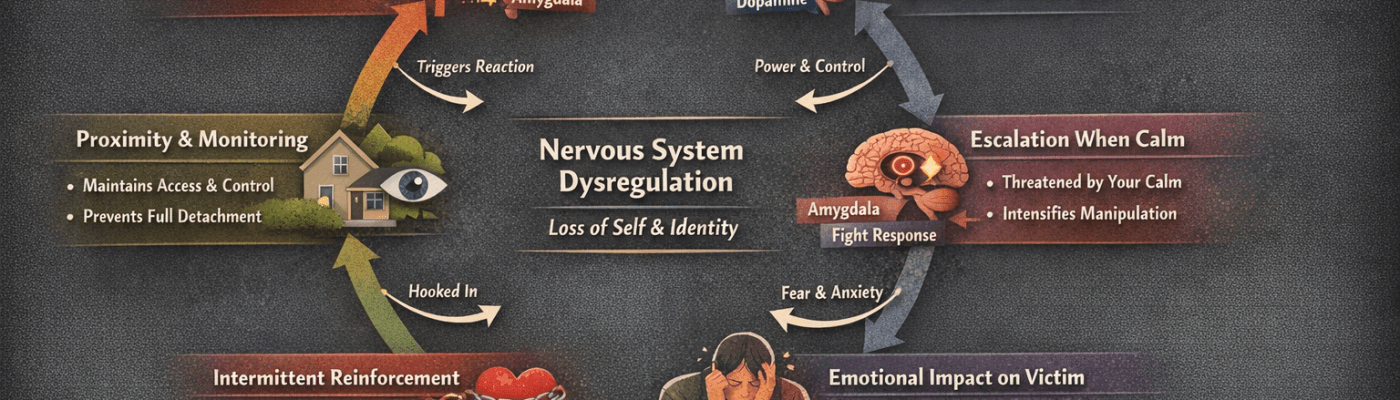
1. Core Pattern (The Loop)
- Trigger / Boundary Assertion
- You assert a need or boundary
- Abuser perceives threat to control
- Escalation Response
- Criticism, manipulation, withdrawal, or threats
- Often sudden, feels “out of nowhere”
- Temporary Compliance / Relief
- They may soften, apologize, or show brief attention
- Your nervous system feels relief (dopamine)
- Return to Baseline Behavior
- They revert to control-focused patterns
- Cycle repeats, often stronger each time
Visual cue: Circular arrows looping, red → orange → yellow → back to red.
2. Nervous System Impact
- Hypervigilance
- Anxiety spikes during escalation
- Intrusive thoughts between interactions
- Physical tension / stress
Visual cue: Brain + body icon with wavy stress lines.
3. Psychological Reality
- They cannot recognize harm → escalation is not a negotiation
- Sense of entitlement drives relentless behavior
- Your attempts to reason trigger more escalation
- No internal “off switch” without external intervention
Visual cue: Thought bubble with “always right / never wrong” label.
4. Protective Strategies
- Distance / Boundaries
- No engagement unless safe
- Self-regulation
- Grounding, routines, support network
- Documentation / Accountability
- Track incidents, notify authorities if threatened
- Avoidance of argument / persuasion attempts
- Protect nervous system, not their ego
Visual cue: Shield icons, green zones, arrows pointing away from escalation cycle.
5. Key Takeaway
“Relentless abusers are wired for control, not empathy. Their escalation is predictable — your protection depends on boundaries, awareness, and self-regulation, not changing them.”
 Linda C J Turner | Trauma Therapist & Emotional Healing Specialist