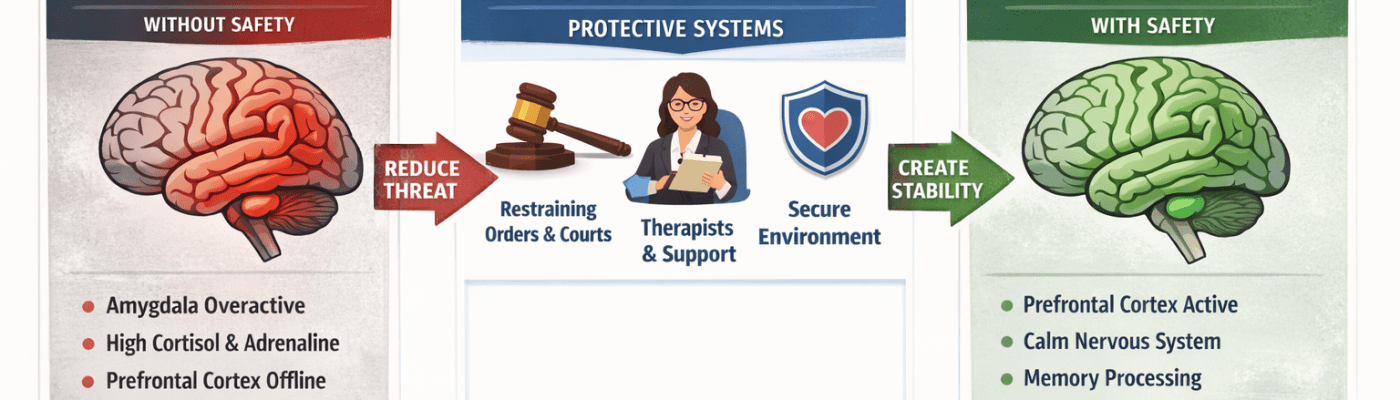
| Aspect | THREAT MODE (Survival Brain) | REFLECTIVE MODE (Thinking Brain) |
|---|---|---|
| Primary Brain Area | Amygdala dominant | Prefrontal cortex dominant |
| Nervous System State | Sympathetic (fight / flight / freeze) | Parasympathetic + balanced regulation |
| Stress Hormones | High cortisol, adrenaline | Low cortisol, stable neurochemistry |
| Perception of Disagreement | Seen as attack or danger | Seen as information or difference |
| Perspective-Taking | Absent or severely impaired | Fully available |
| Emotional Regulation | Poor / reactive / impulsive | Stable / self-regulated |
| Cognitive Style | Black-and-white thinking | Nuance and complexity tolerated |
| Empathy Capacity | Shut down | Active and accessible |
| Accountability | Externalizes blame | Can self-reflect and repair |
| Communication Style | Insults, mockery, emojis, threats | Listening, calm expression |
| Goal in Conflict | Win, dominate, control | Understand, resolve, protect connection |
| Response to Facts | Rejects or distorts | Integrates and evaluates |
| Typical Behaviors | Gaslighting, intimidation, projection | Curiosity, boundaries, collaboration |
| Effect on Others | Triggers fear, confusion, self-doubt | Creates safety and clarity |
| Capacity for Healthy Dialogue | ❌ Not possible | ✅ Fully possible |
🔑 Key Neuroscience Insight
You cannot reason someone out of Threat Mode.
The circuitry required for perspective-taking is offline.
Trying harder doesn’t help — it worsens stress for both nervous systems.
🌱 What This Means for Healing
- Arguing with a threat-brain rewires your own nervous system toward hypervigilance
- Disengaging protects your prefrontal cortex
- Boundaries are not avoidance — they are biological self-protection
Real communication only happens when both brains are in reflective mode.
 Linda C J Turner | Trauma Therapist & Emotional Healing Specialist