The brain doesn’t care whether a pattern is moral — only whether it is repeated and reinforced.
When an abuser:
- controls a partner
- devalues her
- uses intimidation or manipulation
- avoids consequences
- replaces rather than repairs
those behaviours are rewarded (dopamine release).
Over time:
- domination → reward
- empathy → irrelevant
- accountability → threat
The brain rewires accordingly.
2. How “all women are the same” becomes a neural shortcut
This belief is not philosophical — it’s cognitive economy.
Psychologically:
- It reduces cognitive dissonance
- Removes the need for self-reflection
- Justifies repeated harm
Neurologically:
- The prefrontal cortex stops engaging in nuanced social processing
- Stereotypes become default neural schemas
- Individual differences are filtered out
The brain collapses complexity into a rule:
“Women behave X → therefore I behave Y.”
This is schema-driven cognition, reinforced by repetition.
3. Objectification as a learned neural response
Repeated abuse trains the brain to:
- see women as interchangeable
- respond to boundary-setting with hostility
- experience empathy as weakness
Functional imaging in individuals with high antisocial traits shows:
- reduced activation in empathy networks (anterior insula, medial PFC)
- increased reward activation when exerting control
So the brain literally finds control more stimulating than connection.
4. Why the pattern repeats with every woman
Because the pattern is not relational — it is intrapersonal.
The abuser does not respond to who the woman is.
They respond to:
- perceived vulnerability
- availability
- capacity to regulate their emotions
Each new woman activates the same pre-wired loop:
Idealise → control → devalue → blame → replace.
The woman changes.
The neural loop does not.
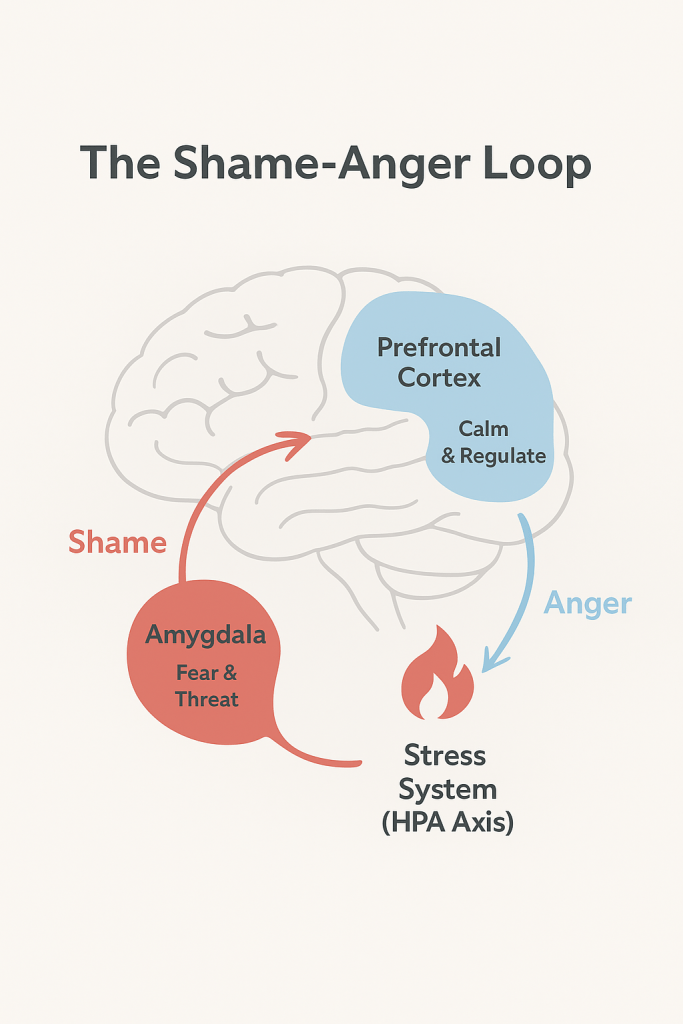
5. “All women are the same” = protection against shame
Shame is neurologically intolerable for many abusers.
To avoid it:
- Responsibility is externalised
- Blame is generalised
- Memory is selectively edited
Neuroscience shows chronic blame externalisation is associated with:
- amygdala hyperreactivity
- poor prefrontal inhibition
- rigid belief systems
So the belief protects the self from collapse.
6. Why abuse escalates over time
Experience-dependent plasticity causes tolerance.
Just like addiction:
- What once gave a sense of control no longer suffices
- Stronger tactics are needed
- Boundaries provoke rage
This is why later partners often experience:
- faster escalation
- less charm
- more overt cruelty
The brain has learned the shortest path to dominance.
7. Why this belief rarely changes
Beliefs tied to reward and identity are the hardest to dislodge.
Change would require:
- sustained accountability
- loss of reward
- confrontation with harm caused
- emotional processing of shame
Most abusers avoid all four.
So the brain keeps choosing the familiar.
The core truth
“All women are the same” is not truth.
It is a neural justification for repetition.
Experience-dependent plasticity explains why:
- abuse is patterned
- partners are interchangeable
- insight is absent
- change is rare without external force
 Linda C J Turner | Trauma Therapist & Emotional Healing Specialist